Cable Lead Time Guide: What Affects Delivery Time in B2B Cable Orders?
Author: Site Editor Publish Time: 17-04-2026 Origin: Site
Cable Lead Time Guide: What Affects Delivery Time?
Cable delivery time is shaped by more than factory speed. For engineers, procurement teams, project owners, and system integrators, the real schedule depends on cable construction, material availability, customization, testing scope, packing rules, line loading, and shipping method. This guide explains what truly drives lead time and how to reduce avoidable delay risk before placing the order.
Lead time is affected by product complexity, materials, customization, testing, and shipping arrangement—not just production speed.
Custom colors, OEM print marking, special documents, and nonstandard packaging often extend delivery more than buyers expect.
The best way to shorten schedule risk is to freeze technical details early and keep noncritical items standardized.
■What Lead Time Really Includes
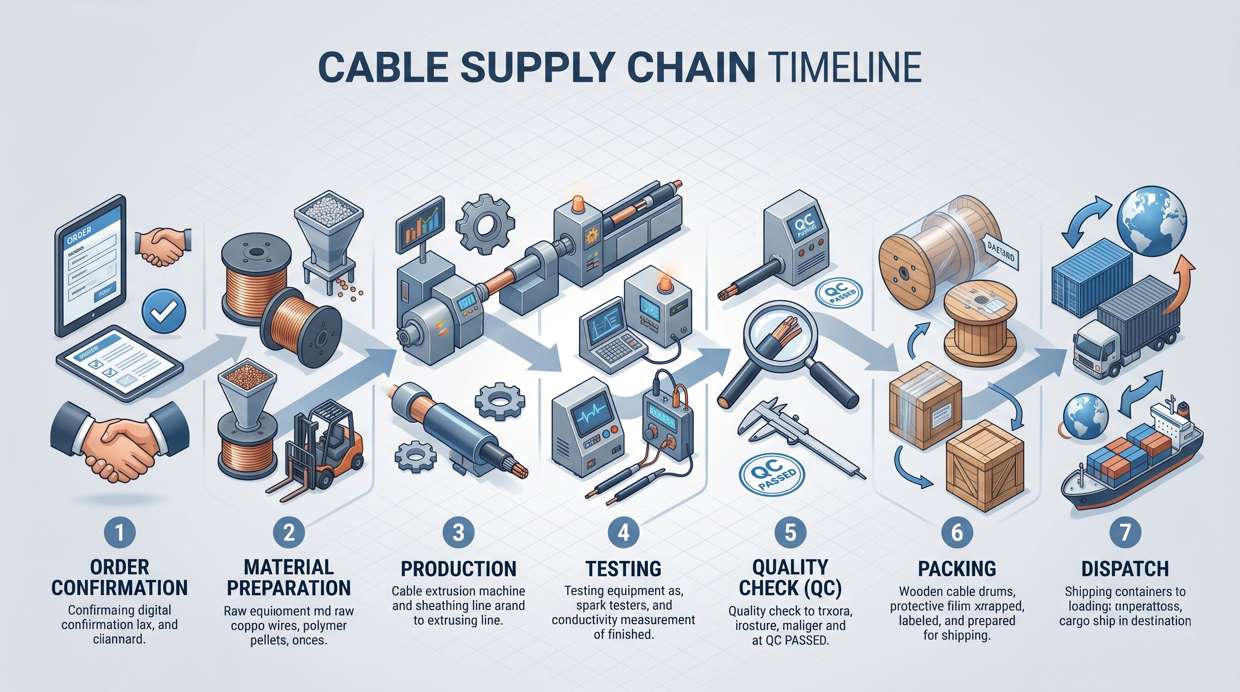
Many buyers ask one simple question: How long will delivery take? In cable projects, that question usually combines several different timelines. Lead time may refer to engineering confirmation, material preparation, production, testing, packing, or dispatch readiness. If the supplier and buyer define these stages differently, the schedule looks clear on paper but becomes unstable in execution.
In most B2B cable supply cases, lead time means the period from order confirmation to goods ready for shipment. It does not automatically include sea transit, customs clearance, local trucking, or site delivery. For project planning, these stages must be separated.
| Stage | What It Covers | Typical Risk |
|---|---|---|
| Technical confirmation | Cable structure, conductor, insulation, jacket, shielding, standard, print marking, packing | Specification gaps or hidden assumptions |
| Commercial confirmation | Price, MOQ, payment term, Incoterm, sample policy | Late PO or order release |
| Material preparation | Copper, fiber, compounds, tapes, shielding materials, reels, labels | Raw material shortage or mismatch |
| Production | Extrusion, cabling, shielding, armoring, jacketing, marking, assembly | Line loading or process bottleneck |
| Testing and QC | Routine tests, dimensional checks, electrical or optical checks, final inspection | Rework or document delay |
| Packing and release | Coils, drums, pallets, export marking, labels, dispatch documents | Late approval or packing mismatch |
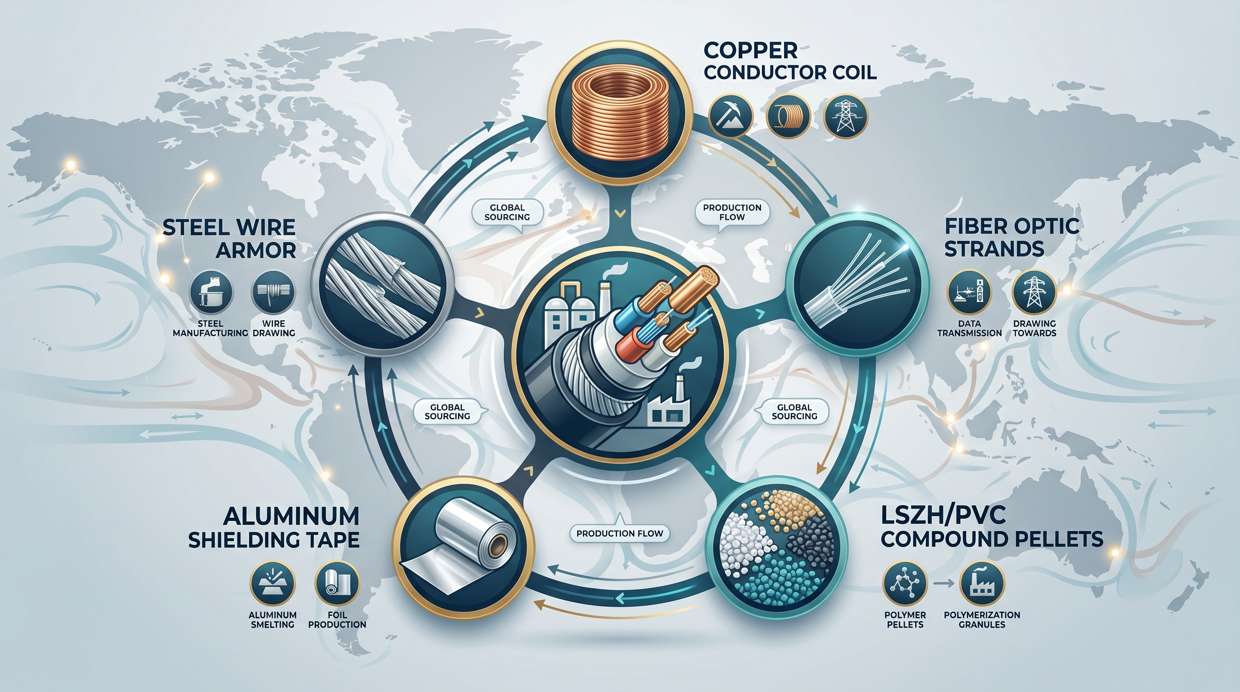
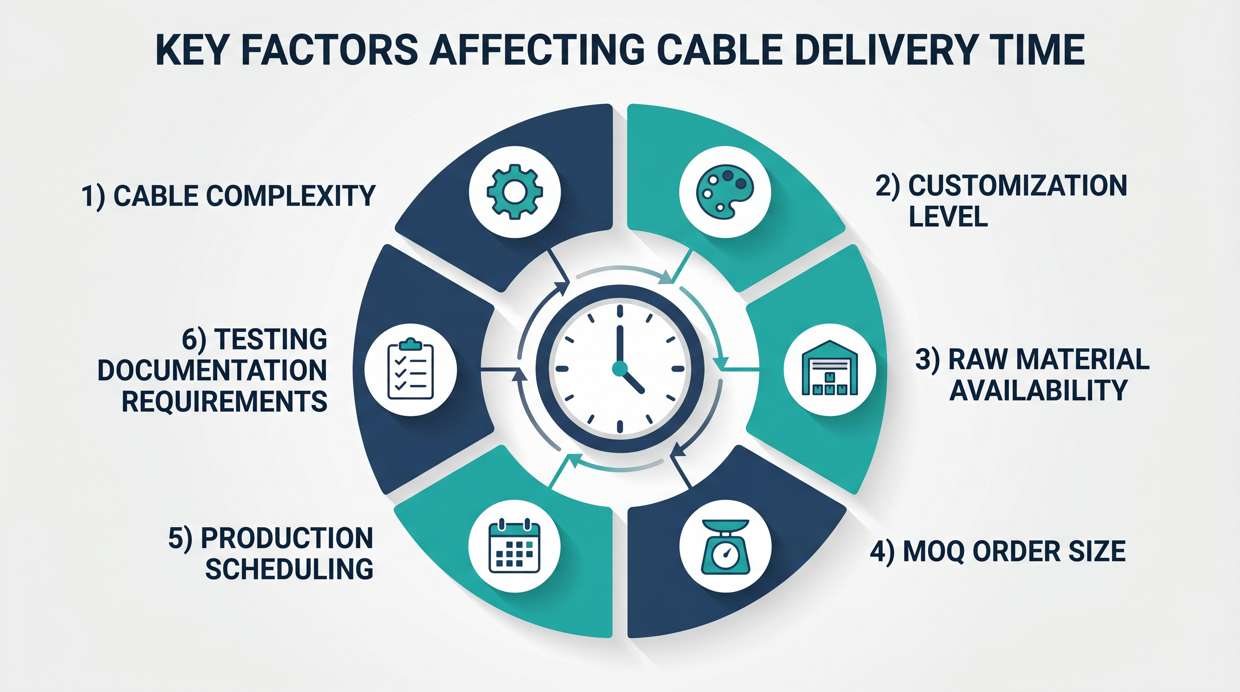
Cable lead time is influenced by both product-side variables and execution-side variables. Product-side variables include cable type, structure complexity, conductor or fiber choice, jacket compound, and shielding or armoring design. Execution-side variables include material availability, production slot loading, testing scope, packaging rules, and shipping method.
A standard indoor cable with stable materials can usually move through production faster than a custom fire-resistant, shielded, armored, hybrid, or project-specific cable. The order length alone does not define the timeline. Two orders with the same quantity can require very different scheduling windows.
| Factor | Why It Matters | Lead Time Impact | Buyer Action |
|---|---|---|---|
| Cable construction complexity | More layers and tighter tolerances require more setup and inspection | Medium to high | Use standard construction where possible |
| Raw material availability | Production cannot start smoothly without the right copper, fiber, compounds, tapes, reels | High | Confirm key materials before release |
| Customization level | Custom colors, print, labels, and packing add approval and preparation steps | High | Separate must-have from nice-to-have items |
| Order size | Very small orders may wait; very large orders may need multiple runs | Medium | Split urgent and nonurgent quantities if practical |
| Testing and documents | Customer-defined reports and inspections can delay release | Medium to high | Provide required document list at inquiry or PO stage |
| Shipping arrangement | Factory-ready date and site-arrival date are different planning points | High on total delivery window | Manage production and logistics separately |
■How Customization Changes the Schedule
Standard products usually have shorter and more predictable lead time because the factory already knows the structure, materials, print layout, and packing routine. Customized orders require more engineering review, more procurement coordination, and more approval checkpoints before mass production starts.
Common schedule-extending custom points include nonstandard conductor design, special jacket compounds, custom outer sheath color, OEM print marking, customer-specific labels, barcode rules, reel lengths, and export pallet format. Each item may look small by itself, but together they reduce schedule stability.
| Order Type | Production Difficulty | Approval Risk | Lead Time Effect |
|---|---|---|---|
| Standard catalog cable | Low | Low | Usually shortest |
| Standard cable with custom print | Low to medium | Medium | Slight extension |
| Standard cable with custom color | Medium | Medium | Moderate extension |
| Fully customized cable | High | High | Usually longest |
| Custom cable with special documents or inspection | Medium to high | High | Often longer than expected |
■Production Time vs Shipping Time
Production lead time and shipping lead time are different planning layers. A factory-ready date tells you when the goods can leave the plant. It does not tell you when the goods will arrive at the jobsite. Buyers who combine these two dates into one delivery promise create avoidable schedule pressure later.
For real project planning, there should always be three dates: factory-ready date, shipment departure date, and site-arrival date.
| Mode | Best Use Case | Main Advantage | Main Risk |
|---|---|---|---|
| Courier | Samples, urgent small accessories | Fastest dispatch | High cost, not suitable for bulk cable |
| Air freight | Urgent medium-weight cargo | Faster than sea | Cost pressure |
| Sea freight | Bulk project orders | Lowest unit transport cost | Longer transit and port delay risk |
| Rail / multimodal | Some regional or mixed-route projects | Balanced cost and speed | Route-dependent reliability |
■Common Delay Risks in Real Cable Orders
Many lead time problems are not caused by production failure. They are caused by incomplete order definition. This is especially common when buyers finalize technical details in stages, approve sheath print late, or add project-specific packing or document rules after the order has already entered the production queue.
The safest approach is to treat the purchase order as a complete execution document rather than a partial commercial confirmation.
| Delay Cause | What Usually Happens | How to Reduce the Risk |
|---|---|---|
| Incomplete specification | Factory must re-confirm structure or material combination | Use a complete technical checklist before PO |
| Late print approval | Outer jacket printing cannot start smoothly | Freeze wording and spacing early |
| Nonstandard color request | Material preparation takes longer than expected | Confirm standard alternatives if timeline is tight |
| Special packaging added late | Packing must be reworked or re-labeled | Define coil, reel, pallet, carton rules in PO |
| Order change after confirmation | Materials and schedule must be adjusted | Freeze core specs before deposit or release |
| Missing document list | Release is delayed at final stage | Request full document package at inquiry or PO stage |
■Decision Rules / Engineer’s Shortcut
Lead time becomes unstable when several variables change at the same time. A new cable structure by itself may be manageable. A new structure plus custom color, OEM print marking, third-party testing, special reel length, and tight delivery deadline is a very different risk profile. Engineers and buyers should judge lead time based on the total change load, not one isolated item.
| Situation | When to Choose This Path | When Not to Choose It | Alternative | Cost / Risk / Maintainability Impact |
|---|---|---|---|---|
| Use standard spec + standard packing | Tight schedule, repeat project, stable requirements | Branding or compliance needs require project-specific definition | Keep only essential custom points | Lowest risk and most predictable delivery |
| Add OEM print only | Brand traceability matters but schedule is still important | Artwork is not approved or wording may change | Use standard print for urgent shipments | Moderate approval risk, manageable if frozen early |
| Add custom color | Site identification or project coding requires it | Timeline is compressed and color is not mission-critical | Use standard color + labels | Higher material and scheduling risk |
| Request custom documents / third-party inspection | Project owner or market access requires it | The requirement is still unclear or may be changed late | Use standard factory report if acceptable | Can extend release stage significantly |
| Split urgent and nonurgent order lines | Some items are installation-critical and others are not | All items must stay in one shipment for customs or project control reasons | Use phased delivery plan | Improves milestone protection but may increase logistics complexity |
■Buyer Checklist Before Releasing the PO
A strong purchasing question is not only What is your lead time? It is What exactly is driving the lead time in this order? That question forces both sides to confirm the real schedule assumptions. It also helps distinguish between ex-works readiness, shipment departure, and final arrival.
| Question | Why It Matters | Recommended Action |
|---|---|---|
| Is the cable standard or custom? | Defines engineering and material risk level | Mark custom points clearly in RFQ and PO |
| Are all materials already qualified and available? | Material readiness often controls actual start date | Confirm critical materials in advance |
| Is sheath print already approved? | Late artwork approval blocks jacketing stage | Freeze text, spacing, sequence before production |
| Are reports or compliance files required? | Release can be delayed after production if files are added late | Provide full document list at PO stage |
| Is the delivery date factory-ready or site-arrival? | Avoids confusion between production and logistics promises | Manage ETA separately from production schedule |
| Can urgent and nonurgent items be separated? | Protects installation-critical milestones | Use split shipment or phased release if practical |
■FAQ
■Conclusion
Cable delivery time is shaped by much more than factory speed. Product complexity, raw material readiness, customization level, line loading, test scope, document requirements, packaging rules, and transport method all affect the real schedule. For engineers and procurement teams, the safest decision is to treat lead time as a full supply-chain question rather than a single number.
For Zion Communication customers, delivery reliability improves most when technical scope, print marking, packaging, and documentation are confirmed early. If the project has a fixed installation date, it is usually smarter to reduce noncritical customization and protect schedule stability than to rely on last-minute acceleration.



 Fiber Optic Tools
Products 6 families
Solutions 6 markets
Resources Tools & docs
Certificate
Certification and compliance references for project review, qualification and purchasing documentation.

 Fiber Optic CableAccess and backbone
 Ethernet CableCat5e to Cat8
 Coaxial CableRF and video signal
 Fire, Security & AlarmSafety systems
 Voice, Audio & VideoSignal cabling
 Power & Control CableEnergy and control
Fiber optic cable systems
Outdoor, indoor, FTTH and distribution cable lines for access networks, backbone routes and campus deployments.
 Telecom & ISP NetworksFTTH, PON, ODN
  Data Center InfrastructureServer room cabling
  Building Low-Voltage SystemsBMS, AV, weak current
  Security & Fire ProtectionAlarm, CCTV, access
  Industrial Automation CablePLC, RS485, fieldbus
  Energy & Power InfrastructureSolar, battery, power
 Telecom & ISP Networks
For FTTH / PON access, outdoor fiber deployment, aerial routes, duct routes, direct burial routes, rural broadband and ODN planning.
Tools
Use calculators and planning tools for conduit capacity, PoE voltage drop and fiber optic link loss budget work.