Conduit Fill Chart & Sizing Rules for Cat6/Cat6A and Coax
Author: Site Editor Publish Time: 09-01-2026 Origin: Site
Conduit Fill Chart & Sizing Rules for Cat6/Cat6A and Coax
A practical engineering guide for choosing conduit size for Ethernet and coaxial cable runs, with 40% fill examples, PoE thermal guidance, mixed-cable calculation rules, and field-ready decision shortcuts for ZION Communication projects.
Stay at ≤40% conduit fill for new pulls, and ≤30–35% when bundling high-power PoE runs.
Always calculate based on actual cable OD; Cat6A and shielded cables normally require larger conduit than Cat5e or Cat6 UTP.
Mixed Ethernet + coax bundles should be calculated by cross-sectional area, not only by cable count.
Use the visual calculator to estimate conduit fill percentage for Cat5e, Cat6, Cat6A, RG6, RG11 and mixed cable bundles, with practical warnings for PoE load, bend difficulty and expansion margin.
Open Conduit Fill Calculator■ 1) Why Conduit Fill Matters in Modern Cabling
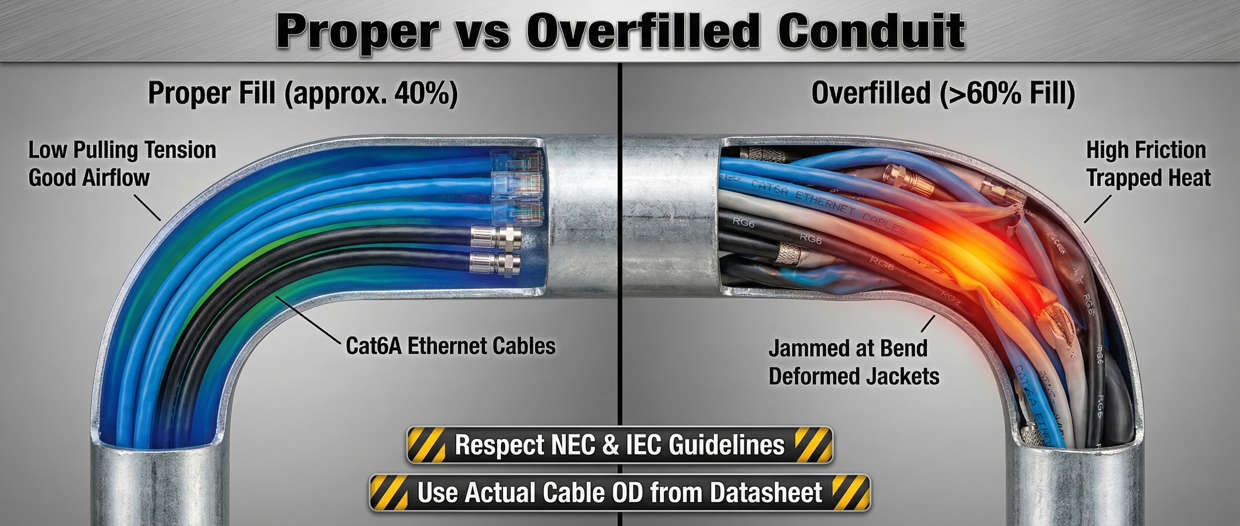
In many low-voltage projects, conduit sizing is decided by habit: reuse what worked before and hope the new cable bundle will fit. With today’s larger Cat6A, shielded Ethernet, PoE++ power levels, and mixed-media bundles such as Ethernet + coax + control cable, that rule-of-thumb approach is increasingly risky.
For ZION Communication customers, conduit fill is not only a mechanical question. It also affects pulling force, cable jacket compression, bend radius, PoE heat rise, signal reliability, and future expansion. A conduit may remain in a building for many years, while cable types and bandwidth requirements continue to change.
■ 2) Definitions, Limits & Design Targets
Conduit fill describes how much of the internal cross-sectional area of a conduit is occupied by cables. For multi-cable bundles, the practical engineering target is usually to keep the total cable area at or below 40% of the conduit’s internal area.
Standard Conduit Fill Limits
| Scenario | Recommended Fill | Typical Use Case | ZION Recommendation |
|---|---|---|---|
| Single cable in conduit | Up to 100% | Single feeder, single coax trunk | Still leave margin for easier pulling and replacement |
| New multi-cable installation | ≤ 40% | Office, commercial, data center | Default design target for Ethernet and coax bundles |
| Future cable additions | ≤ 60% | Retrofit or expansion | Plan spare capacity at the initial design stage |
| High-power PoE bundles | ≤ 30–35% | PoE+/PoE++ to cameras, APs, lighting | Increase conduit size and reduce bundle density |
■ 3) Simple Conduit Fill Formulas
The calculation is straightforward. You only need the outer diameter (OD) of the cable and the inner diameter (ID) of the conduit. For mixed cable bundles, calculate each cable type by area and then add the results together.
Cable Area
Acable = π × (OD / 2)2
Conduit Area
Aconduit = π × (ID / 2)2
40% Fill Rule
Abundle ≤ Aconduit × 0.40
If cable OD increases by roughly 10%, the conduit’s usable cable capacity may drop by about 20%. This is why Cat6A F/UTP or S/FTP often cannot be routed in conduits originally sized for smaller Cat5e UTP.
Typical Cable & Conduit Dimensions
| Cable Type | Typical OD (mm) | Common Application | Conduit Note |
|---|---|---|---|
| Cat5e UTP PVC / LSZH | 5.3 – 5.8 | Legacy office links, basic PoE | Fits easily; often oversized conduit in retrofit |
| Cat6 UTP LSZH | 6.0 – 6.6 | 1G / 2.5G office cabling | Check bends and fill in 20–25 mm conduits |
| Cat6A F/UTP / S/FTP | 7.4 – 8.5 | 10G links, high-power PoE | Usually requires one conduit size up vs Cat5e |
| RG6 Coax | 6.8 – 7.0 | CCTV, CATV, broadband | Often mixed with Ethernet in shared conduit |
■ 4) Worked Example: Cat6A in 1" EMT Conduit
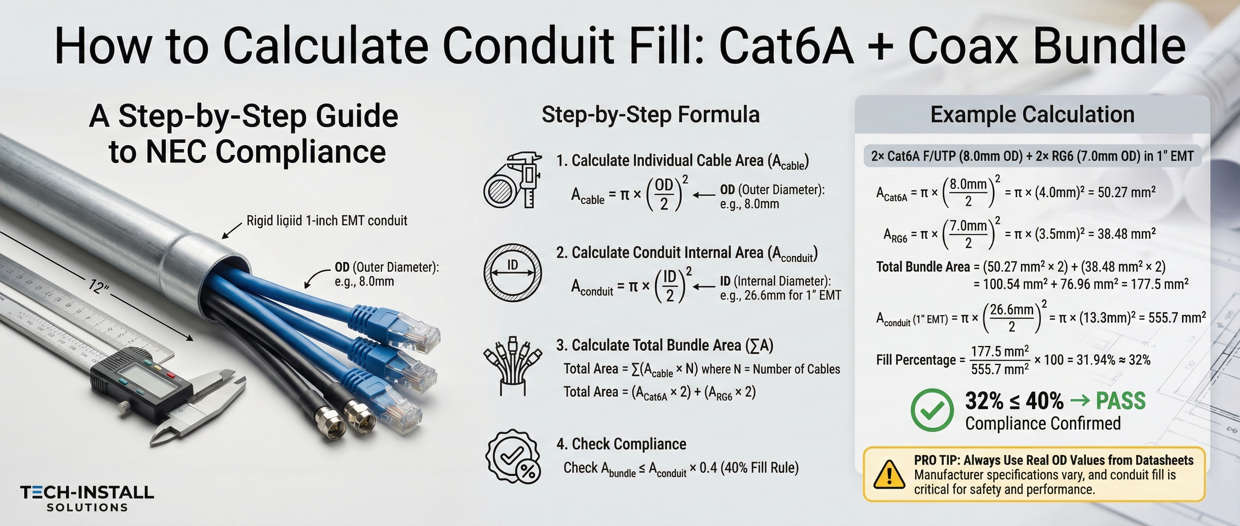
Let’s walk through a real-world example using a typical Cat6A F/UTP cable and a standard 1" EMT conduit.
| Parameter | Value | Comment |
|---|---|---|
| Cable type | Cat6A F/UTP LSZH | For 10G and high-power PoE |
| Cable OD | 8.0 mm | Use actual datasheet value on project |
| Conduit type | 1" EMT | Inner diameter ≈ 26.6 mm |
| Cable area | ≈ 50.3 mm² | π × (8 / 2)² |
| Conduit area | ≈ 556 mm² | π × (26.6 / 2)² |
| Allowed @ 40% fill | ≈ 222 mm² | 556 × 0.40 |
| Max cable count | 4 cables | 222 / 50.3 ≈ 4.4 → 4 runs |
3 × Cat6A in 1" EMT is comfortable for normal short runs.
4 × Cat6A is the practical upper limit and should be checked against bends and pull length.
5+ Cat6A cables should use larger conduit or additional conduit pathways.
■ 5) Sample Conduit Fill Charts: Cat6, Cat6A, RG6 and RG11
The following charts provide approximate maximum cable counts for common EMT conduit sizes based on typical cable ODs and a 40% fill target. Real-world values should be derated for tight bends, long pulls, flexible conduit, shielded cable, PoE++ loading, and future expansion.
Cat6 Conduit Fill Chart (Approx. 6.1 mm / 0.24 in OD)
| EMT Size (Trade) | Typical Use Case | Max Cat6 Cables | Notes |
|---|---|---|---|
| 3/4" EMT | Short home runs, small drops | ≈ 6 | Minimum recommended size for data |
| 1" EMT | Small bundles, office drops | ≈ 8 | Good for a few workstations or APs |
| 1 1/4" EMT | Medium office / IDF bundles | ≈ 15 | Common for small IDF to closet runs |
| 1 1/2" EMT | Larger bundles to IDF/MDF | ≈ 20 | Allows room for growth |
| 2" EMT | Main horizontal pathways | ≈ 35 | Good for multi-tenant risers |
| 2 1/2" EMT | Heavy PoE or large bundles | ≈ 60 | Consider derating for high-watt PoE |
| 3" EMT | Large campus / warehouse runs | ≈ 80 | For big backbones and distribution |
| 4" EMT | Major backbone / riser conduit | ≈ 120 | For large buildings or multi-floor feeds |
Cat6A Conduit Fill Chart (Approx. 8.0 mm / 0.315 in OD)
| EMT Size (Trade) | Typical Use Case | Max Cat6A Cables | Notes |
|---|---|---|---|
| 3/4" EMT | Avoid for Cat6A bundles | ≈ 3 | Not practical for reliable pulls |
| 1" EMT | Home / small office AP runs | ≈ 4 | Safe limit for easier pulls |
| 1 1/4" EMT | Office zone cabling | ≈ 9 | Reliable choice for Cat6A bundles |
| 1 1/2" EMT | IDF room trunk | ≈ 12 | Recommended Cat6A minimum for risers |
| 2" EMT | Horizontal backbone | ≈ 22 | Good for PoE+/PoE++ deployments |
| 2 1/2" EMT | PoE++ heavy floors | ≈ 35 | Safer with fewer tight bends |
| 3" EMT | Large commercial floors | ≈ 50 | Clean headroom for future expansion |
| 4" EMT | Building backbone | ≈ 80 | Critical for riser and core pathways |
Coax Conduit Fill Chart: RG6 / RG11
| EMT Size | Max RG6 | Typical Use Case |
|---|---|---|
| 3/4" | ≈ 3 | Small home / CCTV drops |
| 1" | ≈ 4 | Apartment feeds / small splitters |
| 1 1/4" | ≈ 7 | Small building distribution |
| 1 1/2" | ≈ 10 | IDF / CCTV bundles |
| 2" | ≈ 16 | Riser or multi-drop feeds |
| 3" | ≈ 35 | Large MDF / backbone |
| 4" | ≈ 55 | High density coax riser |
| EMT Size | Max RG11 | Typical Use Case |
|---|---|---|
| 3/4" | Avoid | Too tight for reliable pulls |
| 1" | ≈ 2 | Very short runs only |
| 1 1/4" | ≈ 4 | Trunks in small buildings |
| 1 1/2" | ≈ 6 | Low-loss backhaul segments |
| 2" | ≈ 10 | Multi-service backbone |
| 3" | ≈ 20 | Satellite / CATV riser |
| 4" | ≈ 30 | Campus feed / long trunks |
Note: These values are practical engineering references, not absolute geometric limits. Derate cable counts when conduits include multiple tight bends, flexible conduit sections, high PoE++ loading, or significant future expansion.
■ 6) PoE, Temperature Rise & Risk Control
Power over Ethernet turns data cables into both signal and power infrastructure. In tightly packed conduits, PoE currents cause temperature rise in the cable bundle. The center of the bundle runs hottest and has the poorest ability to dissipate heat.
As cable temperature rises, copper DC resistance increases. This leads to extra voltage drop and can cause borderline PoE links to fall below device power thresholds at the far end, especially on long runs or with 60–90 W PoE++ loads.
| PoE Scenario | Recommended Fill Target | Design Action |
|---|---|---|
| Standard PoE / PoE+ (≤30 W) | ≤ 40% | Standard 40% rule acceptable in most cases |
| High-density PoE+ switches | ≤ 35% | Increase conduit size or split bundles |
| PoE++ Type 3/4 (60–90 W) | ≤ 30–33% | One trade size larger + shorter bundle lengths |
≤30–35% fill for PoE++ bundles, short pull sections, smooth bends, 23AWG Cat6A.
35–40% fill with long runs, several bends, or dense switch loading. Upsize conduit when possible.
Over 40% fill with high-power PoE, tight bundles, or poor ventilation. Expect heat and voltage margin issues.
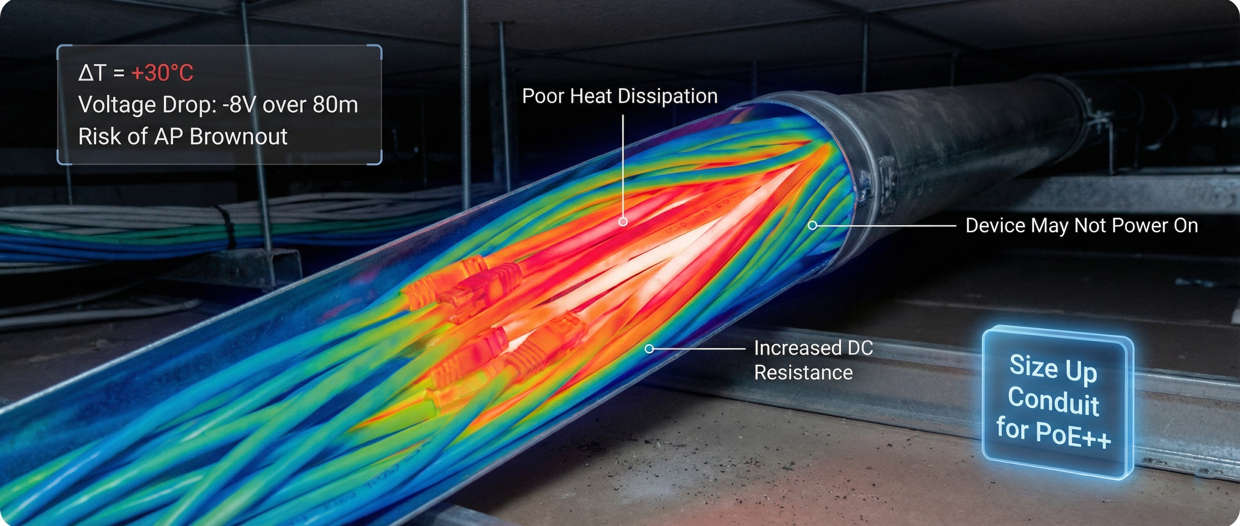
For high-power PoE designs, treat conduit fill as a thermal parameter, not just a mechanical one. A cable pull may pass on installation day but still create voltage drop and device uptime problems after the system is fully loaded.
■ 7) Mixed Ethernet + Coax Bundles in One Conduit
Many projects use shared pathways for multiple low-voltage systems: Ethernet data, CCTV coax, access control, alarm cable, or BMS signals. When mixing different cable types, the area calculation stays the same, but you must sum the area of each type.
Mixed Fill Calculation
Total bundle area:
Abundle = (ACat6A × NCat6A) + (ARG6 × NRG6) + …
Example: 2 × Cat6A (8.0 mm OD) + 2 × RG6 (7.0 mm OD) in 1" EMT:
Cat6A area ≈ 50.3 mm² → 2 × 50.3 = 100.6 mm²
RG6 area ≈ 38.5 mm² → 2 × 38.5 = 77.0 mm²
Total bundle area ≈ 177.6 mm²
1" EMT 40% allowance ≈ 222 mm²
Result: acceptable by fill area, but still check bends, shielding, grounding, and future expansion.
■ 8) Conduit Types, Bends & Installation Factors
Conduit material, geometry, and layout strongly influence how far you can safely push fill percentages. Two designs with the same fill percentage may behave very differently if one has multiple tight bends or uses flexible conduit instead of rigid EMT.
| Factor | Impact | Practical Recommendation |
|---|---|---|
| EMT / IMC / RMC | Lower friction and strong mechanical protection | Preferred for commercial and data center pathways |
| PVC conduit | Common indoors and underground | Check actual internal diameter per trade size |
| Flexible conduit | Higher pulling friction | Reduce target fill or add pull boxes |
| Multiple bends | Higher pulling tension and bend stress | More than two 90° bends usually means size up or break the run |
■ 9) Decision Rules / Engineer’s Shortcut
To speed up submittal reviews and on-site decisions, use the following shortcut rules before running a detailed calculation.
| Project Situation | Recommended Action | Why It Matters | Risk Level |
|---|---|---|---|
| Small Cat6 office drops | Use 3/4" to 1" EMT | Good cost-performance balance | PASS |
| Cat6A with 10G or PoE+ | Use 1" minimum; prefer 1 1/4" for bundles | Larger OD and bend sensitivity | WARNING |
| PoE++ dense camera or AP runs | Target ≤30–35% fill; split conduits | Heat rise and voltage drop control | FAIL RISK |
| RG11 coax trunk | Avoid small conduit; use 1 1/4"+ depending on count | Large OD and lower flexibility | WARNING |
| Future tenant expansion | Leave 20–30% spare pathway capacity | Avoid expensive re-pulling and new pathway work | PASS |
If a bundle includes Cat6A, PoE++, RG11, shielded Ethernet, or more than four cables in a single pathway, move one conduit size up by default and check fill using actual OD values. The small material cost increase is usually far lower than the labor and rework cost of a failed pull.
■ 10) FAQ
Is 40% conduit fill always required?
For new multi-cable pulls, 40% is the safest practical reference. Local code, conduit type, and installation method should still be checked.
Can Cat6A fit in the same conduit as Cat6?
Sometimes, but not at the same cable count. Cat6A has a larger OD, especially shielded versions, so capacity drops quickly.
Should PoE++ use lower conduit fill?
Yes. For 60–90W PoE applications, lower fill helps reduce heat buildup and voltage drop risk.
Can Ethernet and coax share one conduit?
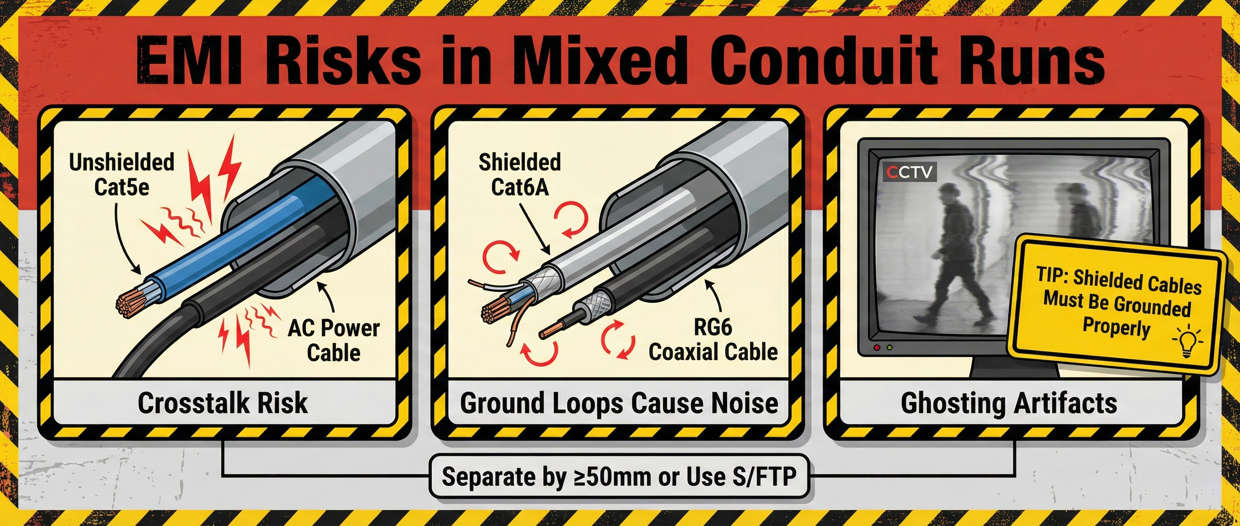
For low-voltage systems it is common, but fill, bend radius, shielding, grounding, and separation rules must be checked before installation.
■ 11) Conclusion & Project Checklist
Conduit sizing for Ethernet and coaxial cable is no longer a minor construction detail. With larger cable diameters, higher PoE power levels, and mixed bundles, conduit fill directly affects installation success, thermal performance, and long-term maintainability.
For engineering teams and procurement buyers, the most cost-effective choice is often not the smallest conduit that passes the calculation, but the conduit size that allows reliable pulling, safe operating temperature, and future expansion with minimal rework.
Actionable Checklist for Your Next Project
Collect actual OD values from datasheets for all planned cable types.
Size conduits to ≤40% fill for new installations and ≤30–35% for high-power PoE bundles.
Account for bends, flexible conduit, and section length when deciding acceptable fill.
For mixed Ethernet + coax paths, sum areas for each cable type and verify thermal / EMI behaviour.
Reserve 20–30% spare capacity in backbone and riser conduits for future migration and expansion.
Send your cable type, cable count, conduit size, bend count, PoE load, and installation environment to ZION Communication. Our team can help you prepare a practical cable and conduit recommendation for RFQ, submittal, or project planning.