G.652.D vs G.657.A2 Fiber: What’s the Real Difference for FTTH and Indoor Routing?
Author: Site Editor Publish Time: 01-04-2026 Origin: Site
G.652.D vs G.657.A2 Fiber: What’s the Real Difference?
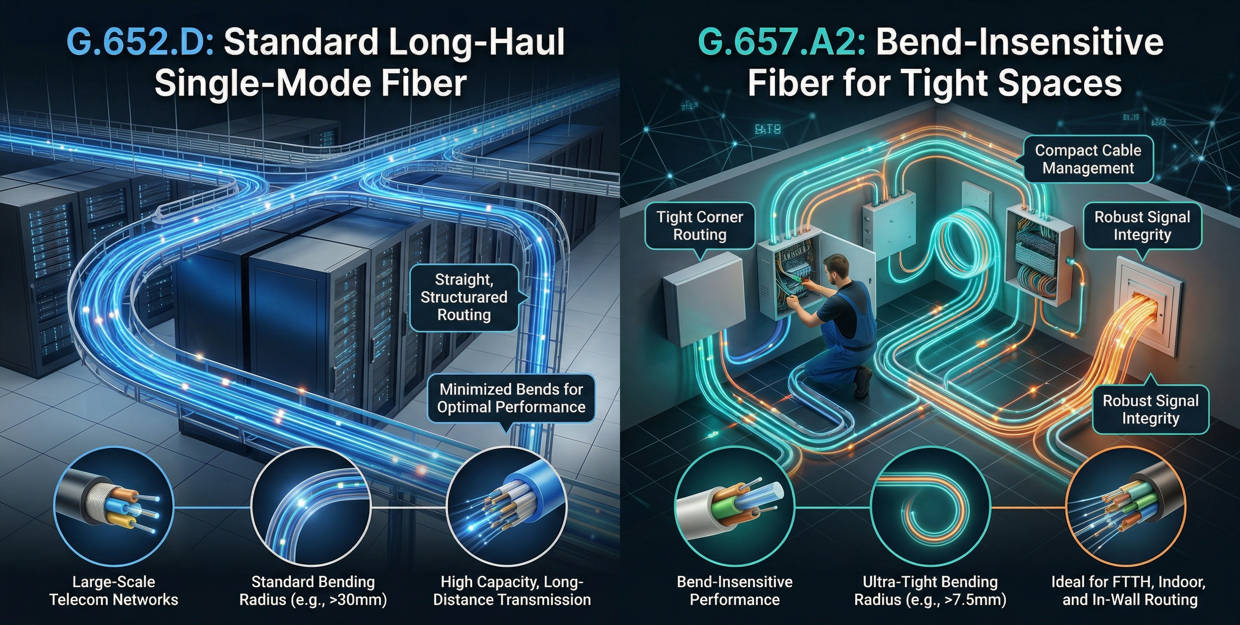
G.652.D and G.657.A2 are both single-mode fiber options, but they are optimized for different routing conditions. G.652.D remains a strong baseline for standard transmission and straighter paths, while G.657.A2 adds better bend performance for FTTH, indoor routing, and space-limited installations. The real decision is not which one replaces the other, but which one better matches your route geometry, handling risk, and installation environment.
Choose G.652.D when the route is mostly straight and bend stress is limited.
Choose G.657.A2 when the installation includes tighter bends, indoor routing, wall boxes, or FTTH drop sections.
This is not a replacement story. Both fit single-mode network logic, but A2 is better for bend-sensitive environments.
■ G.652.D vs G.657.A2 Fiber, Which One Is Better?
Neither one is universally better for every project. G.652.D is still a very sound choice for standard single-mode transmission and routes that remain relatively straight. G.657.A2 becomes the better option when the cable will pass through tighter bends, wall outlets, compact terminal boxes, indoor corners, or FTTH drop paths where bend-related loss is a real deployment risk.
So the right conclusion is simple: choose based on route geometry, not on the idea that one standard has “replaced” the other. In many projects, G.652.D is fully sufficient. In bend-sensitive installations, G.657.A2 usually gives more practical margin and lower field risk.
The real difference is not “old vs new.” It is “standard straight-route fiber vs bend-insensitive fiber for tighter installation conditions.”
■ What G.652.D and G.657.A2 Are Designed For
G.652.D is the standard single-mode baseline most buyers already know. It fits general transmission use, standard outdoor deployment, feeder routes, and other cable paths where the route is relatively open and bend stress is not the dominant concern.
G.657.A2 is also a single-mode fiber, but its value is different. It is selected when the project needs better bend performance in real installation conditions such as FTTH drop cables, indoor building routing, wall outlets, subscriber-side terminations, and compact cable-management areas.
| Fiber Type | Main Design Logic | Typical Route Profile | Typical Buyer Concern |
|---|---|---|---|
| G.652.D | Standard single-mode transmission baseline | Straighter routes, feeder sections, general outdoor runs | Reliable mainstream choice for normal routing |
| G.657.A2 | Bend-insensitive single-mode deployment | FTTH, indoor pathways, wall boxes, tight corners | Lower risk in compact and bend-sensitive installations |
■ What G.657.A2 Adds Beyond G.652.D
G.657.A2 does not create a different optical system. Its value is that it gives buyers and installers more bend tolerance while staying within mainstream single-mode deployment logic. In practical project language, that means the route can tolerate tighter handling conditions with less risk of bend-related loss.
This is why G.657.A2 is often chosen in projects that look ordinary on paper but become harder in the last section of the route. The extra performance is most valuable where fiber is stored, turned, or terminated in smaller spaces.
Better tolerance for tighter routing
More flexibility in indoor cable handling
Lower field risk in FTTH end-point deployment
A more installation-friendly choice in compact spaces
It does not mean G.652.D is obsolete
It does not mean every project should automatically move to A2
It does not remove the need to check route shape and project conditions
It does not mean all bend-insensitive fiber classes are the same
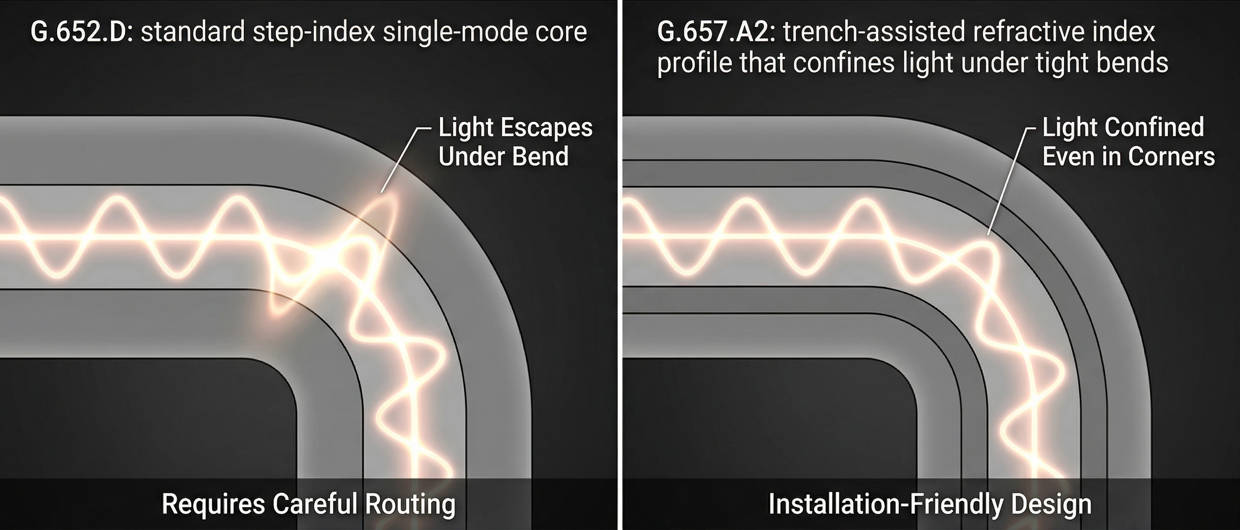
■ Bend Radius Comparison
This is the heart of the comparison. G.652.D works well when the route stays relatively open and physically controlled. G.657.A2 is preferred when the cable must tolerate tighter bends without adding the same level of practical risk. In real installation terms, that difference often matters more than theoretical discussions about standards.
| Item | G.652.D | G.657.A2 |
|---|---|---|
| Bend tolerance logic | Suitable for normal routing and controlled cable paths | Better suited to tighter and more compact routing conditions |
| Typical handling margin | Lower when turns become tight | Higher in boxes, corners, and dense cable management |
| Installation risk in small spaces | Higher | Lower |
| Best use logic | When the route is mostly straight | When the route is bend-sensitive in practice |
The buyer-side question should be: how tight does the cable path become in the real installation, not just in the drawing?
■ Compatibility and Splicing Considerations
In most commercial discussions, the real question is not whether G.657.A2 belongs to some separate deployment world. The practical question is whether the project benefits enough from extra bend tolerance to justify choosing it from the start. That is why this comparison should be framed around application conditions, not “replacement.”
For splicing, mixed deployment, and maintenance planning, buyers should still confirm the actual cable datasheet, project BOM, and installation practice. Good documentation reduces later confusion, especially when the project uses multiple cable structures or involves long-term service handover.
| Checkpoint | Why It Matters | Practical Advice |
|---|---|---|
| Fiber type on datasheet | Confirms the actual project specification | Check before RFQ approval or bulk procurement |
| Splicing practice | Prevents field-level assumptions from becoming rework | Confirm with supplier and installer team early |
| Maintenance records | Helps future troubleshooting and replacement | Keep the selected fiber type clearly listed in project files |
■ Which One Is Better for FTTH?
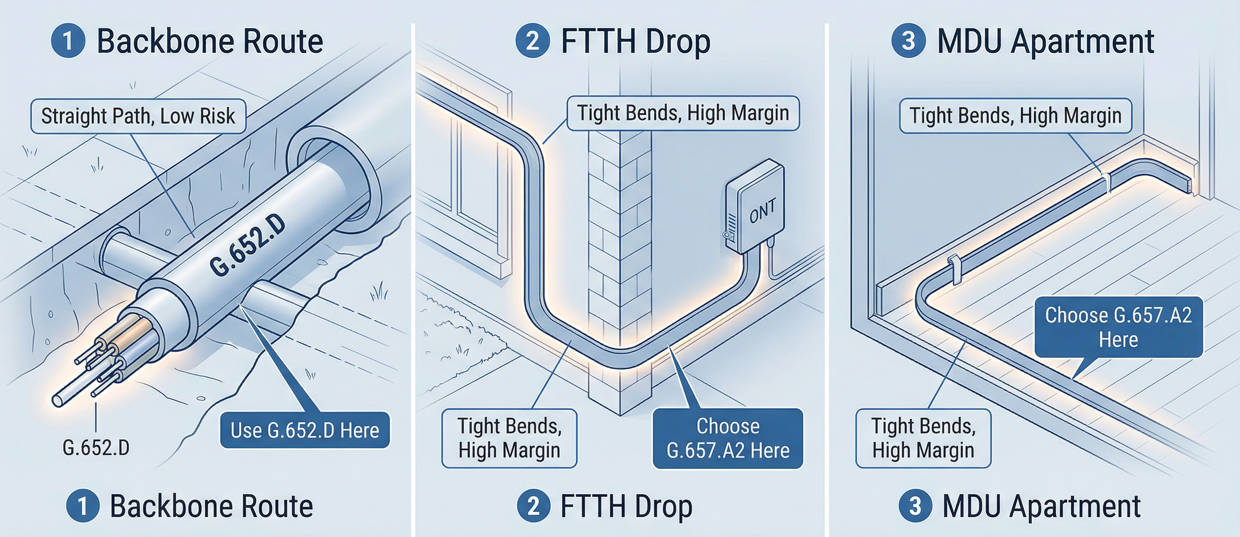
For FTTH, G.657.A2 is usually the safer choice. The reason is practical rather than theoretical: FTTH routes often include wall outlets, indoor turns, compact terminal boxes, customer-end cable storage, and technician handling in tight spaces. These are exactly the conditions where better bend performance creates real value.
G.652.D can still appear in access networks, but when the installation becomes tighter and less predictable, G.657.A2 usually provides better deployment margin and lower risk of bend-related performance issues.
| FTTH Scenario | Better Choice | Why |
|---|---|---|
| Indoor drop route | G.657.A2 | Better tolerance in tighter cable paths |
| Wall outlet or ONT entry | G.657.A2 | Lower practical risk under compact routing |
| Simple straight access section | Depends on route shape | Bend-sensitive endpoints may still justify A2 |
■ Which One Is Better for Backbone or Straight Routing?
For backbone, feeder, or mostly straight routing, G.652.D often remains the more natural fit. It matches standard single-mode deployment logic well and is often sufficient when the cable path is physically open and controlled.
G.657.A2 is not a wrong choice for these routes, but its strongest advantage appears when the installation includes tighter geometry or less predictable endpoint handling. If the project is clearly straight and spacious, G.652.D remains highly reasonable.
■ Decision Rules / Engineer’s Shortcut
Use the table below as a fast project-level filter. This is the simplest way to decide whether G.652.D remains enough or whether G.657.A2 should be prioritized.
| Decision Question | If Yes | If No |
|---|---|---|
| Will the cable pass through tight bends, corners, or compact terminal space? | Choose G.657.A2 first | Continue to next decision point |
| Is this an FTTH, indoor, MDU, or subscriber-side route? | G.657.A2 is usually the safer choice | Continue to next decision point |
| Is the path mostly straight and physically controlled? | G.652.D is often sufficient | Prefer A2 if field handling may become tighter later |
| Is maintenance simplicity under future handling important? | A2 may reduce long-term field risk | G.652.D may remain enough |
■ When to Choose It
When to choose G.652.D
The route is mostly straight and well controlled
The project focuses on general single-mode transmission needs
Bend-sensitive points are limited and manageable
The buyer wants a standard baseline for feeder or backbone deployment
When to choose G.657.A2
The route includes corners, smaller boxes, or compact indoor cable paths
The project is FTTH, indoor drop, MDU, or subscriber-side deployment
Installer handling conditions may vary in the field
The project wants better tolerance against bend-related loss risk
When not to overcomplicate the decision
If the route is clearly straight and bend stress is minor, G.652.D remains a sound answer. If the route is clearly bend-sensitive, G.657.A2 is usually the smarter specification. The mistake is not choosing one or the other. The mistake is ignoring the physical route.
■ Comparison Table
| Item | G.652.D | G.657.A2 |
|---|---|---|
| Positioning | Standard single-mode fiber | Bend-insensitive single-mode fiber |
| Main strength | General transmission and straighter routes | Tighter routing and better installation tolerance |
| Best-fit applications | Backbone, feeder, standard outdoor routing | FTTH, indoor drop, wall outlets, compact access pathways |
| Selection logic | Choose when bend stress is limited | Choose when bend sensitivity is part of the job |
| Project risk profile | Lower material complexity, but less tolerance in tight spaces | Better protection against bend-related field issues |
■ Buying Advice by Project Type
Buyers should not choose based only on catalog familiarity or nominal cost. The better method is to evaluate where the fiber will actually turn, enter, be stored, and be handled after delivery. In bend-sensitive projects, route geometry often matters more than simple standard naming.
| Project Type | Suggested Direction | Why |
|---|---|---|
| FTTH drop and indoor subscriber connection | Prefer G.657.A2 | The route is more likely to include compact and bend-sensitive points |
| Wall box, ONT area, apartment corridor routing | Prefer G.657.A2 | Higher installation margin in tight spaces |
| Backbone and feeder route | Prefer G.652.D if route is straight | The standard baseline often fits the route well |
| Mixed project with straight trunk plus difficult end points | Evaluate G.657.A2 carefully | A2 can reduce endpoint handling risk and simplify deployment margin |
■ FAQs
Is G.657.A2 better than G.652.D?
Not in every case. G.657.A2 is usually better for bend-sensitive routes, while G.652.D remains a strong choice for standard single-mode deployment and straighter paths.
Is G.657.A2 compatible with G.652.D-based projects?
In practical project planning, the comparison is usually framed around application benefit rather than separate network logic. Buyers should still confirm the actual datasheet and project specification before procurement.
Which one is better for FTTH?
G.657.A2 is usually better for FTTH because the installation environment often includes tighter bends, terminal points, and compact indoor cable paths.
Is G.652.D obsolete?
No. G.652.D is still highly relevant for general single-mode deployment, especially in backbone, feeder, and straighter routing environments.
How should buyers think about cost and risk?
Do not compare only material cost. Also evaluate route geometry, installer handling, terminal storage conditions, and the cost of avoidable bend-related field issues.
Can suppliers support custom cable construction around these fiber types?
Yes. Many projects can be customized by cable structure, fiber count, jacket type, and application environment. It is best to submit route type, installation method, and project conditions together with your inquiry.
■ Conclusion
G.652.D vs G.657.A2 is best understood as a routing decision, not a replacement story. If the cable path is mostly straight and well controlled, G.652.D remains a solid and practical choice. If the route includes tighter bends, indoor boxes, FTTH drop sections, or more difficult end-point handling, G.657.A2 is usually the more resilient option.
The best next step is to review the actual route shape, terminal conditions, and installation environment before finalizing the fiber type. That makes the selection more accurate, more defensible, and more useful for both procurement and field deployment.
Send your route type, fiber count, installation environment, indoor or outdoor use, and any bend-sensitive points. ZION can help match the right fiber type and cable construction to your project.