How to Choose Foil Screen Data Cable for Industrial and Commercial Projects
Author: Site Editor Publish Time: 14-04-2026 Origin: Site
How to Choose Foil Screen Data Cable for Industrial and Commercial Projects
Foil screen data cable is often the right choice when a project needs stronger EMI protection than UTP can provide, but does not yet require the larger diameter, higher cost, or extra mechanical robustness of braid-based shielding everywhere. The key is not to choose by shielding name alone. Engineers and buyers should evaluate EMI severity, installation method, data rate, connector system, fire rating, jacket material, and grounding continuity together before approving a cable specification.
Choose foil screen cable for fixed runs with moderate to high EMI, where you need a better balance between protection, cable size, and cost than UTP can offer.
Do not select by shielding alone. Installation method, connector system, fire rating, jacket material, and grounding continuity are equally important.
In strong-noise, high-vibration, drag-chain, or high-abuse environments, foil-only shielding is often not enough; braid-based shielding or fiber may be the safer engineering choice.
■ What foil screen cable means in real projects
Foil screen data cable is not simply “a shielded cable.” In engineering terms, it refers to constructions that use aluminum foil as the primary shielding layer, either around all pairs or around each pair plus the overall cable core. This gives better protection against external electromagnetic interference than UTP, while typically keeping the cable lighter and more compact than braid-based alternatives.
For many commercial and light-to-medium industrial applications, foil screen cable is the practical middle option: better EMI control than unshielded cable, but easier to install and usually more cost-effective than heavier shield structures. The problem starts when projects assume that “foil shielded” automatically means suitable for all industrial environments. It does not.
| Shielding Type | Structure | Typical Strength | Typical Limitation | Recommended Use |
|---|---|---|---|---|
| UTP | No screen or shield | Low cost, easy installation | Weak EMI protection | Clean office and low-noise environments |
| F/UTP | Overall foil screen | Good EMI protection with moderate cost | Less robust for harsh mechanical conditions | Commercial buildings, cabinets, fixed industrial runs |
| F/FTP | Overall foil + pair foil | Better crosstalk and noise control | Higher cost and more careful termination | Higher-performance commercial and industrial links |
| S/FTP or SF/UTP | Braid plus foil shielding | Strong EMC and better mechanical durability | Larger diameter and higher cost | Severe EMI or harsher industrial conditions |
■ Start with the EMI environment, not the category name
The first screening question is simple: how electrically noisy is the route? If the project is in a commercial building, control room, cabinet area, ceiling space, or building automation network with moderate interference, foil screen cable is often sufficient. It improves resistance to external EMI without making installation unnecessarily heavy or expensive.
However, once the route enters areas with variable frequency drives, motors, welding equipment, heavy switching devices, long parallel runs with power cables, or dense industrial control equipment, the decision changes. In those cases, the issue is no longer “shield or no shield.” The issue is whether the shielding level is strong enough and whether the full channel can maintain that protection under real operating conditions.
| Environment | EMI Level | Foil Screen Suitability | Typical Recommendation |
|---|---|---|---|
| Office floors, meeting rooms, retail, standard ceilings | Low | Usually yes | UTP or F/UTP depending on reliability margin needed |
| Control cabinets, BAS, AV, security systems | Low to medium | Strong candidate | F/UTP or F/FTP |
| Factory cells with motors, VFDs, switching equipment | Medium to high | Conditional | F/FTP or stronger, with strict grounding and separation design |
| Welding, heavy machinery, severe industrial EMI zones | High | Often not enough | S/FTP, industrial heavy-duty shielded cable, or fiber |

■ Fixed installation vs dynamic movement: a critical boundary
Foil screen cable is usually best for fixed installation. If the cable will remain in trays, conduits, cabinets, ceiling spaces, risers, or machine frames without repeated movement, it can be an efficient and reliable choice. But as soon as the cable enters drag chains, robotic systems, moving gantries, repeated flexing points, or vibration-heavy equipment, selection must shift from “shield type first” to “mechanical design first.”
In those applications, a suitable cable needs verified bend performance, flex life, jacket resistance, and conductor stability. A standard foil-screen data cable may pass electrical tests on day one but still fail early because the structure is not designed for repeated movement. This is one of the most common hidden risks in industrial projects.
■ Match shielding with data rate, distance, and topology
After the environment and installation method are clear, match the cable to the network requirement. This is where many buyers confuse category rating with shielding strategy. They are not the same. Category rating addresses transmission performance. Shielding addresses resistance to interference. A proper specification must satisfy both.
| Network Need | Typical Cable Level | Typical Shielding Choice | Comment |
|---|---|---|---|
| 100 Mb/s industrial Ethernet | Cat5e equivalent | UTP, F/UTP, or F/FTP | EMI and connector environment decide the shield need |
| 1 Gb/s building or industrial network | Cat5e / Cat6 | F/UTP or F/FTP | Good balance for many fixed installations |
| 10G commercial backbone or high-performance industrial link | Cat6A | F/FTP or stronger | Requires screened connectivity and correct termination |
| Extreme EMI or electrical isolation need | Depends on design | Fiber | Best when shielding risk is too high or isolation is required |
■ Connector system and 360° shield continuity matter as much as the cable
A foil screen only works when the shield is maintained through the entire channel. That means cable, connector, coupler, jack, patch panel, and cabinet entry need to support the same screened strategy. If the project buys shielded cable but uses the wrong connector family or poor termination practice, the real EMI benefit can drop sharply.
For commercial networks and cabinet wiring, shielded RJ45 systems are common. For field-level industrial Ethernet, M12 connectors are often more suitable because of vibration resistance, sealing performance, and industrial compatibility. The correct choice depends on the protocol, data rate, enclosure requirement, and site conditions.
| Project Element | What to Confirm | Why It Matters |
|---|---|---|
| Connector type | RJ45, M12 D-coded, M12 X-coded, or other industrial interface | Must match protocol, speed, and site environment |
| Shield termination | 360° contact and correct foil/drain wire handling | Weak terminations reduce actual EMI protection |
| Grounding strategy | Consistent cabinet and system grounding plan | Avoids performance loss and unintended noise issues |
| Channel compatibility | Cable, module, patch panel, and cord all screened and compatible | The channel performs as a system, not as separate components |

■ Jacket material and fire rating must be selected separately
This is one of the biggest specification mistakes in both commercial and industrial work. Shielding solves EMI and EMC problems. Jacket material and fire rating solve installation, durability, and code compliance problems. A cable can be electrically appropriate and still be the wrong product if the jacket or flame classification does not match the project environment.
That means indoor commercial routes may require CM, CMR, CMP, LSZH, or project-specific fire performance. Industrial routes may also require oil resistance, abrasion resistance, UV resistance, chemical resistance, moisture resistance, or low-temperature flexibility. These are not secondary details. They are core approval criteria.
■ Decision rules: when to choose foil screen cable and when to step up
A good engineering decision is usually not about choosing the “highest” shield type. It is about choosing the most appropriate protection level for the actual route. Overbuilding increases cost and installation complexity. Underbuilding increases risk, downtime, and troubleshooting cost.
| Choose This Option | Best Fit | Why | Watch Out For |
|---|---|---|---|
| F/UTP | Commercial buildings, cabinets, standard fixed industrial links | Good EMI improvement with controlled cost and diameter | Not ideal for severe EMI or heavy mechanical stress |
| F/FTP | Higher-performance screened channels, 10G-focused routes | Better pair isolation and stronger noise control | Termination quality becomes more critical |
| S/FTP / SF/UTP | High-EMI, high-PoE, harsher industrial routes | Stronger EMC and better shield robustness | Larger diameter, cost, and installation burden |
| Fiber | Extreme EMI, isolation, long distance, or risk-sensitive projects | Removes electrical interference from the copper channel equation | Different termination and equipment planning required |
| Selection Factor | Low-Risk Answer | Higher-Risk Answer |
|---|---|---|
| Installation method | Fixed route, stable cable position | Continuous movement, drag chain, repeated flexing |
| Noise exposure | Separated from power and major noise sources | Near VFDs, motors, welders, long parallel power runs |
| Connector handling | Controlled termination and screened connectivity | Frequent retermination, field abuse, poor continuity control |
| Mechanical environment | Clean and stable | Vibration, abrasion, oil, chemicals, outdoor exposure |
■ Common specification mistakes that create hidden project risk
Writing only “shielded cable” in the specification without defining F/UTP, F/FTP, or braid-based structure.
Choosing the cable category correctly but ignoring the site EMI level and routing conditions.
Buying foil screen cable but pairing it with the wrong connector family or incomplete screened connectivity.
Assuming a shielded cable is automatically suitable for drag-chain or repeated-flex applications.
Confusing shielding with fire rating, and overlooking plenum, riser, LSZH, oil resistance, or chemical resistance requirements.
Ignoring grounding continuity and field termination quality, which can erase much of the expected shielding benefit.

■ FAQ
■ Conclusion
Foil screen data cable is a smart engineering choice when the route needs stronger EMI protection than UTP can offer, but does not justify the size, cost, and complexity of heavier braid-based shielding everywhere. In many commercial buildings, equipment cabinets, control systems, and fixed industrial links, F/UTP or F/FTP provides an effective balance between protection, installation efficiency, and budget control.
The safest selection method is to evaluate EMI level, installation pattern, network speed, connector system, jacket material, fire rating, and grounding continuity together. When projects move into stronger interference zones, high-vibration environments, dynamic applications, or high-risk reliability requirements, it is usually better to step up to stronger shield structures or move directly to fiber.
Share your installation environment, data rate, fire requirement, and connector preference. ZION can help match the right shielding structure, jacket system, and project-ready configuration for your industrial or commercial application.



 Fiber Optic Tools
Products 6 families
Solutions 6 markets
Resources Tools & docs
Certificate
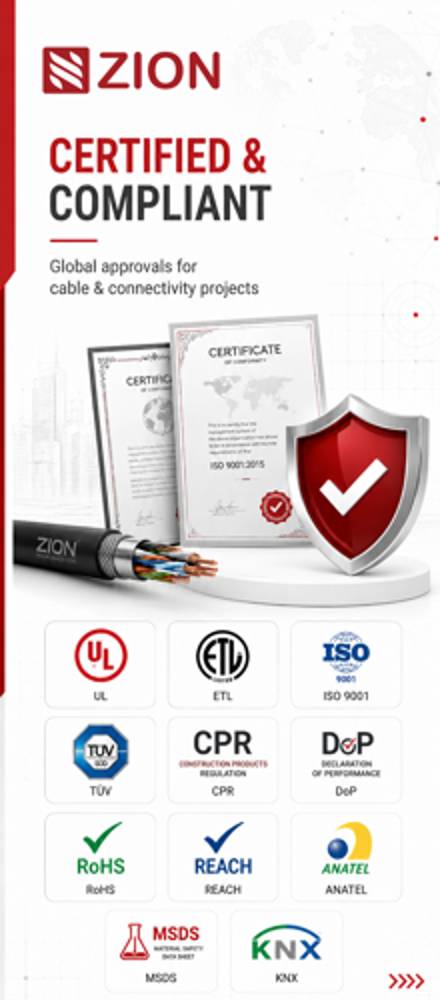
Certification and compliance references for project review, qualification and purchasing documentation.
 Fiber Optic CableAccess and backbone
 Ethernet CableCat5e to Cat8
 Coaxial CableRF and video signal
 Fire, Security & AlarmSafety systems
 Voice, Audio & VideoSignal cabling
 Power & Control CableEnergy and control
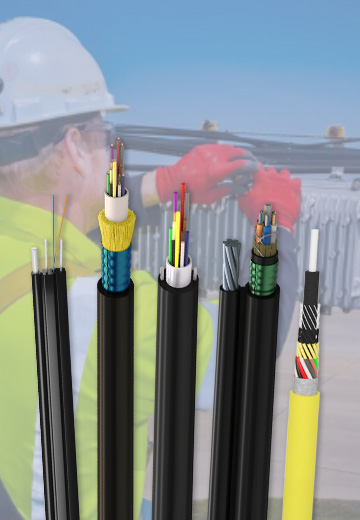
Fiber optic cable systems
Outdoor, indoor, FTTH and distribution cable lines for access networks, backbone routes and campus deployments.
 Telecom & ISP NetworksFTTH, PON, ODN
  Data Center InfrastructureServer room cabling
  Building Low-Voltage SystemsBMS, AV, weak current
  Security & Fire ProtectionAlarm, CCTV, access
  Industrial Automation CablePLC, RS485, fieldbus
  Energy & Power InfrastructureSolar, battery, power
 Telecom & ISP Networks
For FTTH / PON access, outdoor fiber deployment, aerial routes, duct routes, direct burial routes, rural broadband and ODN planning.
Tools
Use calculators and planning tools for conduit capacity, PoE voltage drop and fiber optic link loss budget work.