How to Review a Cable Specification Sheet Before Ordering
Author: Site Editor Publish Time: 13-04-2026 Origin: Site
How to Review a Cable Specification Sheet Before Ordering
A cable datasheet is not just a product summary. For engineers, buyers, project managers, and system integrators, it is the main decision document for judging application fit, compliance, installation risk, lifecycle cost, and fire-survival suitability for critical circuits. This guide shows what to verify first and where ordering mistakes usually start.
Never approve a cable by model name and price alone. Review application fit, materials, mechanical limits, compliance, and installation practicality.
Do not confuse flame-retardant cable with fire resistance cable. They solve different risks.
A complete datasheet review usually costs less than one field replacement, one failed inspection, or one delayed handover.
■ What Should You Check First?
Before approving any cable model, review the specification sheet in this order: application fit, core construction, insulation and jacket system, electrical or optical data, mechanical limits, compliance and approvals, and compatibility with real installation conditions. If one of these seven areas is unclear, the cable should not be approved only on unit price or product name.
| Priority | What to Review | Why It Matters |
|---|---|---|
| 1 | Application fit | Prevents wrong selection for indoor, outdoor, duct, burial, aerial, industrial, or fire-survival use |
| 2 | Conductor or fiber construction | Affects compatibility, signal stability, voltage drop, and installation flexibility |
| 3 | Insulation and jacket system | Determines durability, smoke behavior, flame performance, UV, oil, and chemical resistance |
| 4 | Electrical or optical data | Shows whether the cable is measurable and truly equivalent, not only structurally similar |
| 5 | Mechanical limits | Reduces pulling damage, bending stress, panel congestion, and field failure risk |
| 6-7 | Compliance and compatibility | Prevents approval delays, connector mismatch, installation inefficiency, and documentation gaps |

■ Why the Specification Sheet Matters More Than the Product Name
A product name only tells you the category. The datasheet tells you whether the cable is actually suitable for the project. Two products may both be described as Ethernet cable, RS485 cable, fiber optic cable, control cable, or fire resistance cable, but their real suitability can still differ in conductor material, shielding design, insulation system, jacket compound, bend performance, circuit-integrity behavior, environmental resistance, compliance level, and termination practicality.
This is why a cable specification sheet should be treated as an engineering decision reference rather than a sales attachment. In B2B projects, the cost of a wrong cable choice is rarely the cable price itself. The bigger losses usually come from rework, delayed approvals, field replacements, shutdown risk, and maintenance complexity.
■ Step 1: Start with the Real Installation Scenario
The first question is not “What category is this cable?” The first question is “Where and how will it actually be installed?” Many ordering errors happen because the environment is defined too loosely.
Indoor fixed wiring
Outdoor exposed routing
Underground duct installation
Direct burial
Aerial self-supporting deployment
Industrial cabinet wiring
Tight patching paths in data centers
FTTH drop installation
Fire alarm, emergency lighting, smoke extraction, evacuation, and other life-safety circuits
If the installation method and the required circuit-survival function are not explicitly matched to the cable construction, selection risk is high. A flame-retardant cable may reduce flame spread but still fail to maintain circuit integrity during fire. A low-smoke sheath may improve evacuation conditions but does not automatically make the cable fire resistant.
■ Step 2: Verify the Core Construction
Once the installation environment is clear, the next step is to confirm the conductor or fiber structure. This directly affects compatibility, signal stability, voltage drop, flexibility, and long-term performance.
Conductor material: bare copper, tinned copper, or other
Conductor size: AWG or mm²
Solid or stranded conductor
Number of cores or pairs
Strand class and flexibility level
Pair twisting or pair shielding where relevant
Fiber type: single mode or multimode
Fiber standard: G.652.D, G.657.A1, G.657.A2, OM3, OM4, OM5
Fiber count
Loose tube, tight buffer, breakout, ribbon, or drop construction
Strength member design
Water-blocking structure if needed
■ Step 3: Review Insulation and Jacket Material Carefully
In many real projects, the insulation and sheath influence lifecycle performance just as much as the conductor. For fire resistance cable selection, this review is even more important because the cable may need to do more than resist ignition. It may need to maintain power or signal continuity during a defined period of fire exposure.
| Material / Construction Element | Main Function | Why It Matters |
|---|---|---|
| LSZH sheath | Reduces smoke and corrosive gas release | Improves visibility and reduces secondary equipment damage during fire |
| Flame-retardant sheath | Limits flame spread along the cable route | Helps reduce fire propagation risk |
| Mica tape or fire-resistant barrier | Helps maintain circuit integrity during fire | Critical for emergency circuits that must keep operating |
| XLPE or special insulation system | Provides electrical insulation stability | Supports both normal operation and fire-survival design |
| Shielding layer | Protects signal integrity in normal operation | Still important for alarm, control, and communication circuits |
| Armoring or mechanical protection | Improves physical durability | Useful where critical circuits also face mechanical stress |
■ Fire Resistance Cable vs Flame-Retardant Cable: Do Not Confuse Them
One of the most common review mistakes is treating fire resistance cable and flame-retardant cable as the same product type. They are not the same, and this distinction matters in buildings, transport, industrial safety systems, and mission-critical facilities.
| Type | Main Purpose | What It Means in Practice |
|---|---|---|
| Flame-retardant cable | Reduces or slows flame spread | Helps limit fire propagation along the cable route |
| Fire resistance cable | Maintains circuit integrity during fire exposure for a defined period | Helps emergency systems keep operating during a fire event |
If the requirement is only to reduce flame spread in general building wiring, a flame-retardant design may be enough. If the circuit must continue operating during a fire, such as in alarm, emergency lighting, smoke extraction, evacuation, or other safety systems, the cable must be reviewed as a fire resistance cable selection.

■ Step 4: Check Shielding Structure, Not Just Whether It Is “Shielded”
Not all shielded cable designs are equivalent. Shielding affects EMI resistance, control signal stability, grounding requirements, cable diameter, and cost.
Unshielded
Overall foil shield
Overall braid shield
Pair-by-pair shield
Foil plus braid combination
Individually shielded pairs plus overall shield
Choose a more advanced shielding structure when the route is close to motors, drives, switching power systems, or high-current cables; when the signal is low-voltage or communication-sensitive; when the run length is long; or when intermittent faults would be expensive to diagnose. But remember: shielded cable without correct bonding and grounding practice may not deliver the expected benefit.
■ Step 5: Validate Electrical or Optical Performance Data
A proper specification sheet should include measurable performance values, not only construction descriptions. This is where many “looks similar” alternatives stop being equivalent.
Rated voltage
Test voltage
Conductor resistance
Insulation resistance
Impedance
Capacitance
Attenuation
Frequency rating
Attenuation at relevant wavelengths
Bend performance
Insertion loss
Return loss
Tensile and crush limits
Fiber standard compliance
If a lower-priced cable does not publish complete performance data, it should not be treated as a cheaper equivalent. It should be treated as a higher-uncertainty option with greater project risk.
■ Step 6: Check Mechanical Data Before Installation Problems Happen
Mechanical mismatch is one of the most common hidden causes of cable failure. Review minimum bend radius, tensile strength, crush resistance, outer diameter, cable weight, flexibility class, and torsion or flex-cycle performance when applicable.
If the cable must pass through tight corners, compact panels, moving chains, rooftop transitions, vertical shafts, or shared conduits, mechanical review deserves the same attention as electrical review. A cable can be electrically correct and still be the wrong choice if it is too stiff, too large, or too fragile for the route.
■ Step 7: Confirm Environmental Ratings and Fire Boundaries
A specification sheet should define both where the cable can be used and where it should not be used. Review operating temperature, installation temperature, storage temperature, UV resistance, moisture resistance, water-blocking design, oil resistance, chemical resistance, rodent protection, flame retardancy, low-smoke and halogen-free behavior, and fire-resistance or circuit-integrity claims where applicable.
| Condition | What to Check on the Spec Sheet | Why It Matters |
|---|---|---|
| Outdoor exposed use | UV-resistant sheath, weatherability | Prevents cracking and premature aging |
| Duct or underground use | Water-blocking, moisture barrier | Reduces long-term ingress risk |
| Industrial plant | Oil and abrasion resistance | Improves service life |
| Public building | LSZH and flame behavior | Supports safety expectations |
| Fire-survival circuits | Fire-resistance performance, circuit-integrity claim, smoke behavior | Helps emergency systems remain operational during fire exposure |
| Tight routing | Bend radius and cable OD | Prevents installation stress |

■ Step 8: Review Standards and Compliance Before Approval
For B2B projects, compliance is part of the engineering decision rather than an afterthought. Depending on the application and market, review whether the sheet references IEC standards, UL listing or recognition, CPR class, RoHS, REACH, CE-related declarations, flame test standards, fire-resistance test references, and telecom or fiber standards where relevant.
A technically suitable cable may still be commercially unusable if it lacks the required standard references or approval documentation. This is especially important for public buildings, export projects, industrial infrastructure, and safety-related circuits.
■ Step 9: Check Compatibility with Connectors, Panels, and Delivery Conditions
Even a technically compliant cable can become inefficient or impractical if it does not fit the real system. Confirm outer diameter, connector termination range, gland and clamp size, tray and conduit fill, panel routing space, patch density, reel or drum length, identification method, and packaging format.
Project delays often happen when the cable is too large for the connector system, too stiff for cabinet routing, unsuitable for tray fill constraints, or supplied in impractical reel lengths. This is a classic example of a cable that is technically acceptable but operationally inefficient.
■ A Practical Review Workflow Before Ordering
| Review Stage | Key Question | Accept / Reject Logic |
|---|---|---|
| Application review | Is the cable designed for the actual installation method and duty? | Reject if application fit is vague |
| Core review | Are size, type, count, and structure correct? | Reject if system compatibility is uncertain |
| Material review | Do insulation and jacket match environment, smoke, and fire requirements? | Reject if material boundaries are weak |
| Performance review | Are electrical or optical values clearly published? | Reject if measurable data is incomplete |
| Mechanical review | Can the cable be installed without excessive stress? | Reject if bend, pull, or size limits are impractical |
| Compliance review | Does it meet project and market requirements? | Reject if standards or documentation are missing |
| Delivery review | Does packaging, marking, and termination format support field efficiency? | Reject if operational practicality is poor |
■ Common Mistakes When Reviewing Cable Specification Sheets
Comparing only conductor size or fiber count while ignoring shielding, jacket material, fire behavior, and environmental suitability
Assuming “outdoor” is one condition when duct, direct burial, aerial, and rooftop use have different requirements
Ignoring bend radius and cable diameter until panel or conduit problems appear onsite
Treating all shielded cables as equivalent even though shield design and grounding practice differ
Confusing flame retardancy with fire resistance
Using incomplete datasheets for decision-making
Approving the cheapest option without lifecycle thinking
■ When to Choose a Higher-Spec Cable
A higher-spec cable is usually justified when downtime cost is high, field replacement is difficult, routing conditions are harsh, EMI sensitivity is high, fire-survival function is required for critical circuits, compliance is non-negotiable, or the installation is part of long-life infrastructure.
A practical decision rule is simple: choose the more robust cable when the cost of failure is greater than the added cable price. In B2B infrastructure, that threshold is often reached earlier than many buyers expect.
■ How ZION COMMUNICATION Supports Better Cable Selection
At ZION COMMUNICATION, cable selection should be based on the actual installation environment, performance target, safety requirement, and lifecycle expectation rather than only category name or headline specification.
For projects involving fiber optic cables, FTTH cables and assemblies, Ethernet and communication cables, RS485 / RS232 cables, industrial control and sensor cables, fire resistance cables for emergency and life-safety systems, and customized cable constructions, the right review process is to confirm application fit, conductor or fiber compatibility, insulation and sheath suitability, shielding requirement, fire-performance requirement, mechanical installation limits, compliance scope, and delivery practicality.
Contact ZION COMMUNICATION for technical review, product matching, and custom cable recommendations based on installation environment, compliance requirements, and system compatibility.
■ FAQ
What is the most important thing to check on a cable specification sheet?
The most important check is whether the cable construction matches the real installation environment and required operating function. A cable may look correct by category or size but still fail because of jacket, shielding, bend, fire-performance, or compliance mismatch.
What is the difference between fire resistance cable and flame-retardant cable?
Fire resistance cable is designed to maintain circuit integrity for a defined period during fire exposure. Flame-retardant cable is designed to reduce or slow flame spread. A cable can be flame retardant without being suitable for fire-survival circuits.
Why is jacket material so important?
Because jacket material affects UV resistance, smoke release, flame behavior, flexibility, oil resistance, chemical tolerance, and service life. In many projects, it is one of the main real-world durability factors.
Is shielded cable always the better choice?
No. Shielding is valuable in electrically noisy environments, but it also adds cost, diameter, and grounding requirements. In low-noise environments, an unshielded design may be more practical.
What should a buyer do if the datasheet is incomplete?
Treat the cable as a higher-risk option. Ask for the latest revision, measurable test data, application confirmation, and compliance support before approving the order.
When should procurement teams insist on fire-resistance review?
Whenever the cable is part of fire alarm, emergency lighting, smoke control, evacuation systems, public infrastructure, or any circuit that must remain operational during a fire event.



 Fiber Optic Tools
Products 6 families
Solutions 6 markets
Resources Tools & docs
Certificate
Certification and compliance references for project review, qualification and purchasing documentation.
 Fiber Optic CableAccess and backbone
 Ethernet CableCat5e to Cat8
 Coaxial CableRF and video signal
 Fire, Security & AlarmSafety systems
 Voice, Audio & VideoSignal cabling
 Power & Control CableEnergy and control
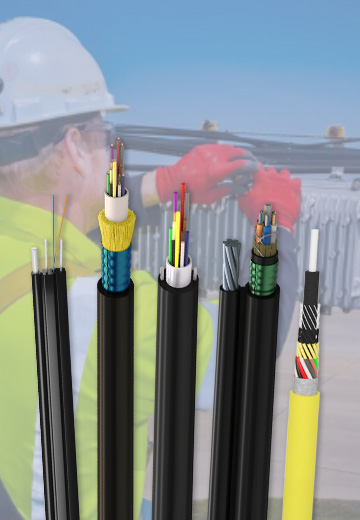
Fiber optic cable systems
Outdoor, indoor, FTTH and distribution cable lines for access networks, backbone routes and campus deployments.
 Telecom & ISP NetworksFTTH, PON, ODN
  Data Center InfrastructureServer room cabling
  Building Low-Voltage SystemsBMS, AV, weak current
  Security & Fire ProtectionAlarm, CCTV, access
  Industrial Automation CablePLC, RS485, fieldbus
  Energy & Power InfrastructureSolar, battery, power
 Telecom & ISP Networks
For FTTH / PON access, outdoor fiber deployment, aerial routes, duct routes, direct burial routes, rural broadband and ODN planning.
Tools
Use calculators and planning tools for conduit capacity, PoE voltage drop and fiber optic link loss budget work.