Indoor Fiber Installation (TIA/EIA-570) | ZION FTTH, FTTR LSZH,G.657.B3 Guide
Author: James Publish Time: 07-01-2026 Origin: Site
Indoor Fiber Installation Guide (TIA/EIA-570) for FTTH & FTTR — ZION LSZH & G.657.B3 Playbook
TIA/EIA-570 is the reference standard for residential and light-commercial cabling. This guide explains how to design and install indoor fiber for FTTH and FTTR projects using LSZH G.657.B3 bend-insensitive OS2 cables, so you meet safety, performance and aesthetic requirements in one shot.
TIA/EIA-570 expects fiber as a first-class medium in homes, MDUs and serviced apartments.
Indoor safety is LSZH-driven: use OS2 G.657.B3 LSZH to combine bend-insensitive FTTR with low smoke, zero halogen performance.
Pre-terminated “invisible fiber” kits from ZION reduce installation risk and future-proof your building for the next 20 years.
■ 1) Why TIA/EIA-570 Matters for Indoor Fiber
Fiber is no longer used only for outside plant and riser links. In 2026, homes, MDUs, hotels and serviced apartments are becoming structured fiber estates with multiple FTTR endpoints in each living unit. TIA/EIA-570 defines how this cabling must be planned and installed so that performance, safety and maintainability stay under control.
For project owners and integrators, “just pulling fiber” is not enough. Indoor routing, bend radius, separation from power, jacket material (LSZH) and test documentation all determine whether your FTTH/FTTR design can truly support Wi-Fi 7, multi-gig WAN and future in-home AI workloads.
The fiber type itself does not cause most call-backs on “fiber-ready” residential projects, but by poor indoor installation: kinks behind furniture, non-LSZH jackets in plenum-like spaces, unprotected connectors near cleaning staff, or random routing with no documentation.
TIA/EIA-570 gives you the rulebook; ZION’s LSZH G.657.B3 fiber and FTTR kits make it practical in the field.
■ 2) TIA/EIA-570 Scope & Indoor Architecture
TIA/EIA-570 covers telecommunications infrastructure inside residential and light-commercial buildings. It defines:
The requirement for a central telecom enclosure
Minimum outlet counts per living area
Permitted cable media: copper, fiber, coax
Recommended routing pathways and separation from power circuits
Testing, labeling and documentation expectations
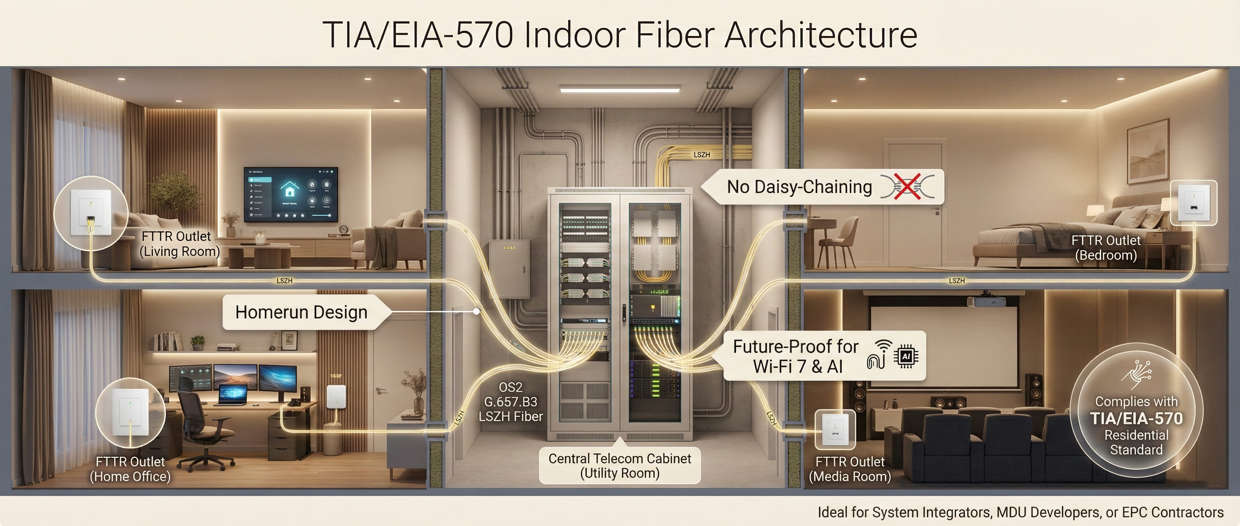
In modern FTTH/FTTR deployments, this translates to a home-run architecture: cables radiate from the telecom cabinet or low-voltage panel to each room or FTTR node. ZION’s product families are designed around this architecture to keep design and installation consistent across projects.
■ 3) Cable Media, LSZH & ZION Product Series
TIA/EIA-570 permits multiple media types, but in 2026 fiber has become the primary vehicle for bandwidth. Inside finished spaces, LSZH (Low Smoke Zero Halogen) jackets are strongly recommended or required by local building codes, especially in Europe and North America.
| Cable Type | Typical Use in TIA/EIA-570 Projects | Fire / Jacket Consideration | ZION Product Series |
|---|---|---|---|
| Cat5e / Cat6 / Cat6A | Legacy data, PoE, control signals | CM/CMR/LSZH depending on region & pathway | ZION Structured Copper |
| Coax (RG6 etc.) | TV, IPTV, satellite feeds | LSZH or low-flame sheath recommended indoors | ZION Coax Cable Series |
| OS2 G.657.A2/B3 Single-Mode | FTTH drop, FTTR backbone, room-to-room fiber | LSZH indoor jacket required/recommended for safety | ZION InviFiber™ G.657.B3 LSZH |
| OM3 / OM4 Multimode | Legacy MDU fiber, short patch links | LSZH indoor tight-buffer recommended | ZION Multimode Indoor Series |
| Hybrid Fiber + Power | Edge devices, ONT locations, cameras | Observe power separation rules and jacket ratings | ZION FTTR Accessory Bundles |
In modern TIA/EIA-570 projects, OS2 G.657.B3 LSZH fiber is the safest default: it delivers bend-insensitive FTTR routing, low smoke and zero halogen emissions in case of fire — critical for enclosed, occupied spaces.
■ 4) Routing Rules: Bend Radius, Separation & Fire Safety
Bend radius & mechanical handling
Even with bend-insensitive designs, fiber is not bend-proof. TIA/EIA-570 expects installers to respect manufacturer guidelines:
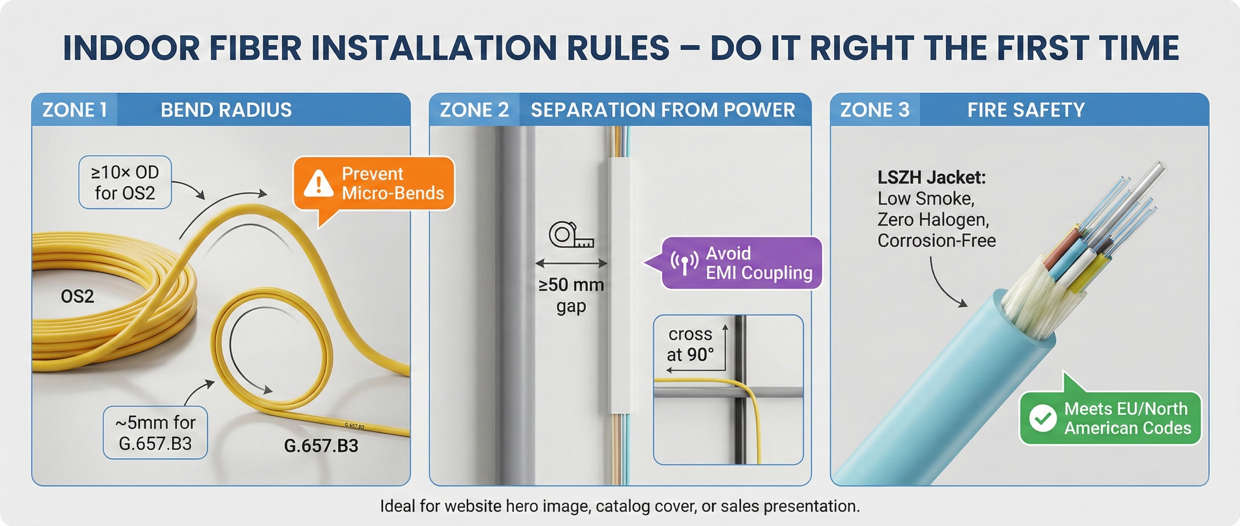
Standard OS2: minimum bend radius ≥ 10 × outer diameter
G.657.A2: typical bend radius down to ~7.5 mm
G.657.B3: bend radius around 5 mm, ideal for FTTR and “invisible” routing
Typical indoor pulling tension: ≤ 50 N (5 kg)
Cables should be guided around corners, not pulled tight. Use smooth curves and dedicated radius control accessories.
Separation from power and other services
To avoid interference and safety issues:
Maintain at least ~50 mm (≈2") separation from AC mains where possible
Cross power cables at 90° when sharing pathways
Avoid sharing tight conduits with high-current conductors
Fire performance: LSZH indoors
In closed spaces, halogenated jackets can release corrosive gases and dense smoke during fire. ZION therefore recommends LSZH jacketed indoor fiber as standard for FTTH/FTTR:
Low smoke density for visibility during evacuation
Zero halogen acids, reducing corrosion damage
Aligned with EU and many North American safety expectations
Whenever fiber enters a living or sleeping area, default to G.657.B3 LSZH. It keeps your designer’s invisible routing and your safety officer’s fire performance on the same page.
■ 5) FTTH & FTTR Under TIA/EIA-570: From Cabinet to Every Room
TIA/EIA-570 calls for a centralized telecom area and structured cabling. FTTH and FTTR deployments simply extend this logic using fiber as the main medium rather than copper.
A typical ZION-based FTTR design looks like this:
Service Entry → ONT / Gateway → FTTR Hub / Splitter
├─ InviFiber™ to Living Room AP
├─ InviFiber™ to Home Office
├─ InviFiber™ to Master Bedroom
└─ InviFiber™ to Media / Gaming Room
The same TIA/EIA-570 principles apply: star/homerun topology, known routing paths, labeled endpoints and properly protected terminations. What changes is that the main “distribution bus” is now OS2 G.657.B3rather than copper.
In 2010, Wi-Fi alone was “good enough”. In 2026, a TIA/EIA-570-compliant home is effectively a small fiber campus, with OS2 G.657.B3 LSZH runs feeding each room and Wi-Fi acting as the last few meters, not the backbone.
■ 6) Outlets, Termination & Pre-Terminated FTTR Kits
Termination best practices
TIA/EIA-570 does not prescribe exact connector types, but industry practice for FTTH/FTTR is:
SC/APC or LC/APC for lower reflection and better PON performance
Shuttered or recessed outlets to protect ferrules from dust and impact
Avoiding loose, unprotected pigtails at user-accessible locations
ZION “Invisible Fiber” outlet concept
ZION’s InviFiber™ solutions focus on both performance and aesthetics:
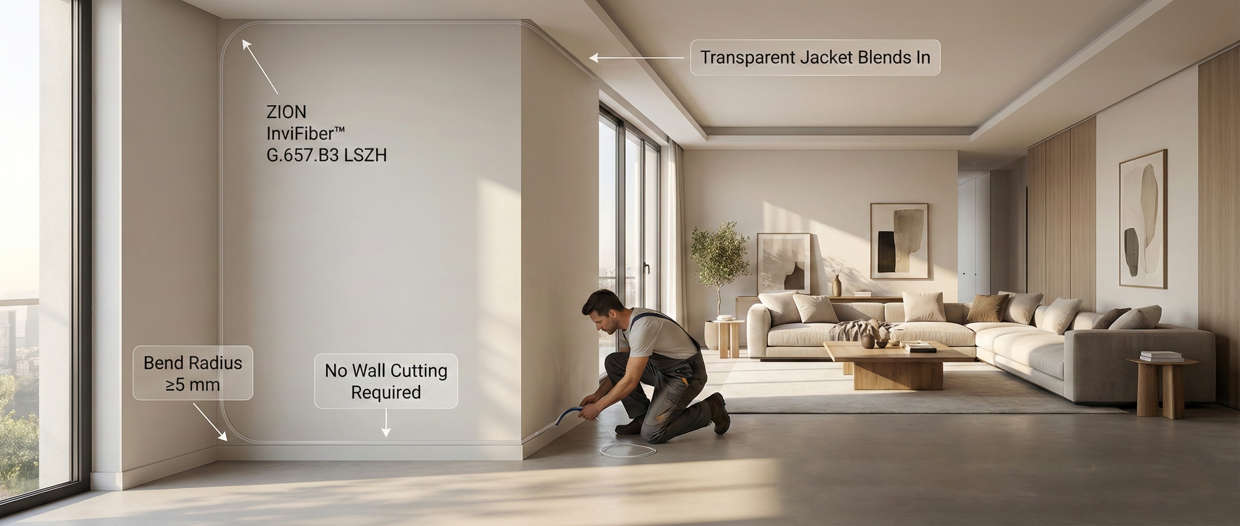
Transparent outer jacket to blend with walls and ceilings
Optional self-adhesive backing for clean routing along edges and frames
Ultra-small G.657.B3 fiber core for tight bending without visible conduits
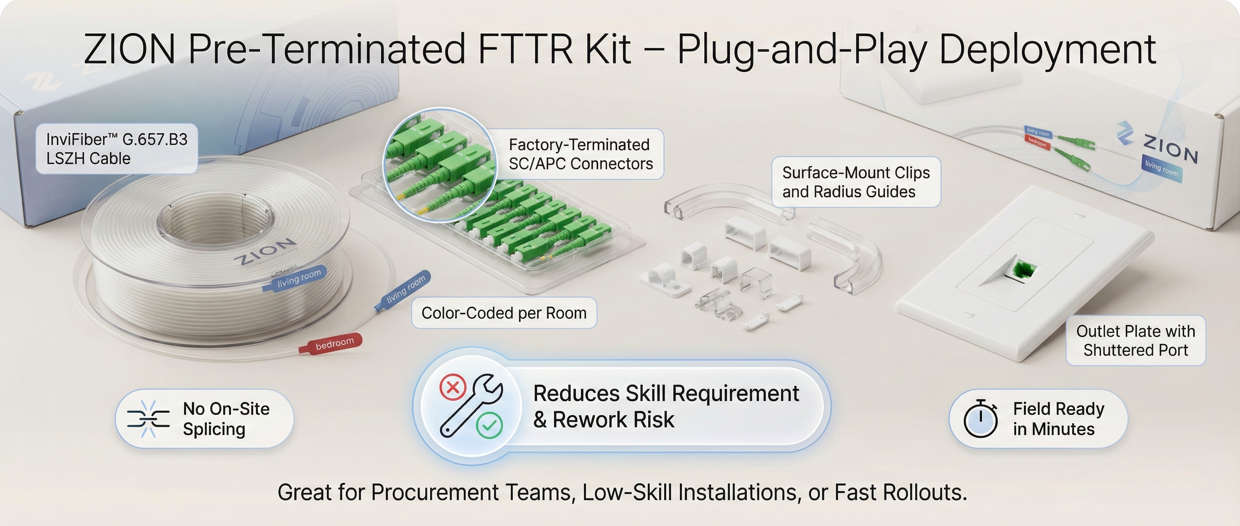
Pre-terminated SC/APC or LC/APC ends for plug-and-play FTTR nodes
For high-end apartments and hospitality suites, this approach allows full-fiber infrastructure with minimal visual impact — a key selling point for architects and premium developers.
■ 7) Testing & Documentation: Delivering a Verifiable System
TIA/EIA-570 expects installed links to be verified, not just assumed to work. For indoor fiber, a simple but consistent test process is essential:
Visual check: no kinks, no crushing, no exposed bare fiber
Continuity test: light source + visual fault locator
Loss test: end-to-end insertion loss within design budget (e.g. ≤0.75 dB for a typical FTTR run)
Optional: OTDR trace for longer or critical links
Documentation should include labeled outlets, cable IDs, routing notes and stored slack locations. This makes future troubleshooting and upgrades predictable — a major advantage for property managers.
| Test / Document Item | What to Check | Why it Matters |
|---|---|---|
| Visual inspection | No sharp bends, no staples, intact LSZH jackets | Prevents invisible damage that causes intermittent faults |
| Continuity / light test | Signal from cabinet to each FTTR node | Confirms routing correctness before closing walls |
| Loss measurement | Total dB from ONT to room outlet | Ensures enough margin for PON and future upgrades |
| Labeling & as-built diagrams | Cable IDs, outlet IDs, path descriptions | Reduces time and risk for maintenance and future changes |
■ 8) Decision Rules / Engineer’s Shortcut
When project timelines are tight and stakeholders want a clear yes/no answer, use the shortcuts below to move from concept to specification quickly.
| Project Situation | Engineer’s Shortcut | Recommended ZION Solution |
|---|---|---|
| Premium apartments / hotel rooms with strict aesthetics | Use “invisible” routing — no surface conduits, no trunking. | InviFiber™ G.657.B3 LSZH with transparent jacket & adhesive backing |
| Standard MDU with FTTR in every living unit | Design once, repeat per floor and stack. | OS2 G.657.B3 LSZH FTTR kits + riser OS2 cables |
| Existing building retrofit with minimal drilling allowed | Follow walls and ceiling edges; avoid going inside walls. | Surface-routed InviFiber™ with clips and radius guides |
| Owner asks: “Can we avoid on-site fiber splicing?” | Switch to pre-terminated factory solutions. | Pre-terminated FTTR room cables + FTTR outlet kits |
| Safety officer requires halogen-free cabling | Specify LSZH for all indoor fiber and twisted pair runs. | ZION LSZH indoor fiber + LSZH structured copper |
■ 9) Conclusion & How ZION Can Help
TIA/EIA-570 turns indoor cabling from “ad-hoc wiring” into a structured, documented system. In 2026, the natural way to implement that system is with fiber — especially OS2 G.657.B3 LSZH for FTTH and FTTR. It provides the bandwidth for Wi-Fi 7, 8K media, smart-home ecosystems and in-home AI servers, while meeting the safety and aesthetic expectations of premium residential projects.
ZION COMMUNICATION supports this with:
OS2 G.657.B3 LSZH indoor/outdoor cables for FTTH entry and FTTR distribution
InviFiber™ invisible fiber solutions with transparent jackets and adhesive options
Pre-terminated FTTR kits, outlets and accessories
Complementary LSZH copper and coax for legacy and PoE needs
Engineering support for TIA/EIA-570-compliant design, testing and documentation
Future-proof your building for the next 20 years by making indoor fiber a strategic, standards-based decision — not an afterthought. Design once, roll out consistently, and keep your tenants, inspectors and IT teams aligned.
Specify OS2 G.657.B3 LSZH fiber, use pre-terminated FTTR kits where possible, and follow TIA/EIA-570 routing and testing practices. This gives you a residential fiber infrastructure that is future-proof for the next 20 years.
Need a customized TIA/EIA-570 indoor fiber blueprint? ZION’s technical team can help you design the full FTTH + FTTR system from cabinet to every room.
Share your building type (single home, MDU, hotel), number of units, expected services (Internet speed, Wi-Fi 7, IPTV, smart home) and any LSZH or fire-rating requirements. ZION can propose a complete indoor fiber solution, including G.657.B3 LSZH cables, InviFiber™ invisible routing, FTTR kits and structured cabling accessories.