Indoor vs Outdoor Cable Jacket Selection Guide
Author: Site Editor Publish Time: 16-04-2026 Origin: Site
Indoor vs Outdoor Cable Jacket Selection Guide
Choosing the right cable jacket is not just about material preference. It directly affects fire performance, UV resistance, moisture durability, compliance risk, service life, and long-term maintenance cost. Indoor jackets are usually optimized for flame behavior and building use, while outdoor jackets are built for weather, sunlight, water, and harsher mechanical exposure.
Choose indoor jackets for building interiors, flame performance, and low-smoke priorities.
Choose outdoor jackets for UV exposure, moisture, weather, ducts, rooftops, and external routing.
For mixed routes, consider dual-rated cable or a managed transition strategy to reduce compliance and failure risk.
■What Is a Cable Jacket?
A cable jacket is the outer protective layer of a cable. It protects conductors, insulation, shielding, fillers, or optical fibers from environmental and mechanical stress during installation and service life. In practical project terms, the jacket is one of the first design elements that determines whether a cable can survive its real operating environment.
The jacket affects more than appearance. It influences UV durability, flame behavior, smoke generation, water resistance, abrasion protection, chemical exposure, flexibility, and long-term maintenance cost. For engineers and buyers, selecting the correct jacket is a reliability decision, not a cosmetic one.
If the route, compliance requirement, or environment is wrong for the jacket, even a well-made cable can become the wrong product for the project.
■Indoor vs Outdoor: Core Difference
The main difference is the environment each cable is designed to survive. Indoor cable jackets are generally optimized for controlled building spaces where flame performance, smoke behavior, and code suitability are critical. Outdoor cable jackets are generally optimized for sunlight, moisture, temperature swings, and harsher physical exposure.
A common mistake is assuming outdoor cable is always “better” because it feels tougher, or assuming indoor cable can work outdoors if the route is short. Both assumptions create risk. A stronger-looking jacket may still be unsuitable for indoor fire-regulated spaces, and an indoor jacket may age quickly when exposed to UV and weather.
| Item | Indoor Cable Jacket | Outdoor Cable Jacket |
|---|---|---|
| Primary environment | Inside buildings | Outside buildings |
| Main design priority | Flame safety, smoke behavior, flexibility | UV, moisture, weather, mechanical durability |
| Typical material direction | LSZH, PVC, flame-retardant compounds | PE, UV-resistant PE, rugged outdoor compounds |
| Sunlight resistance | Usually limited | Usually strong |
| Moisture resistance | Moderate to limited | Usually better |
| Typical risk if misused | Premature outdoor aging | Indoor code or fire-rating mismatch |
■Typical Jacket Materials
The right jacket material depends on the project environment, not on habit or stock availability. Each material solves a different group of engineering problems.
Common for indoor spaces where low smoke and halogen-free performance matter.
Best for: Data centers, public buildings, telecom rooms, indoor structured cabling.
Trade-off: May not be ideal for long-term exposed outdoor service unless specifically designed for it.
Widely used in general indoor applications because of cost efficiency and processing flexibility.
Best for: General commercial indoor use and cost-sensitive projects.
Trade-off: Fire, smoke, and environmental performance depend heavily on formulation and rating.
One of the most common outdoor jacket materials because of good weather and moisture resistance.
Best for: External routing, aerial cable, duct applications, building-to-building links.
Trade-off: Standard PE is usually not intended for many indoor fire-regulated spaces.
Used where UV, chemicals, abrasion, or harsher climate exposure require longer service life.
Best for: Industrial sites, rooftops, perimeter systems, harsher outdoor installations.
Trade-off: Can be stiffer, heavier, and more expensive than indoor alternatives.
■Performance Priorities: What Matters Most?
Selection becomes easier when teams compare the real performance priorities instead of only the cable category. For indoor projects, the biggest concerns are usually flame behavior, smoke level, and compliance. For outdoor projects, the biggest concerns are UV, water, temperature swings, and physical durability.
| Performance Factor | Indoor Priority | Outdoor Priority | Which Side Usually Wins |
|---|---|---|---|
| Flame behavior | High | Secondary unless dual-rated | Indoor |
| Low smoke / low halogen | High | Usually lower unless special design | Indoor |
| UV resistance | Low to moderate | High | Outdoor |
| Water / weather resistance | Limited to moderate | High | Outdoor |
| Flexibility in controlled spaces | High | Moderate | Indoor |
| Abrasion / ruggedness | Moderate | High | Outdoor |

■How to Decide: Start with Environment, Not Habit
The correct selection process is simple: define the route, identify the exposure, check the compliance requirement, and then match the jacket to the real service condition. Many failures happen because teams select based on what is available in stock, what a previous project used, or what seems physically stronger.
A better engineering sequence is:
Define whether the route is fully indoor, fully outdoor, or mixed.
Check building code, fire rating, and project compliance requirements.
Confirm UV, water, heat, cold, abrasion, and chemical exposure.
Match the jacket and cable construction to those conditions.
Compare total project risk and life-cycle cost, not just purchase price.
| Installation Scenario | Recommended Jacket Direction | Why |
|---|---|---|
| Office building cabling | Indoor jacket | Better flame and building-use suitability |
| Data center patching and rows | Indoor LSZH or code-appropriate indoor jacket | Smoke and safety matter in technical spaces |
| Rooftop cable route | Outdoor jacket | UV and temperature exposure |
| Building-to-building run | Outdoor jacket | Weather and moisture resistance |
| External duct installation | Outdoor jacket | Environmental aging and wet-route durability |
| Indoor-outdoor transition | Dual-rated cable or managed transition | Reduces mismatch risk between route sections |
■When to Choose Indoor Cable Jacket
Choose an indoor jacket when the cable will remain inside controlled building spaces and when flame performance, smoke behavior, and code suitability matter more than weather resistance. This is common for structured cabling, indoor fiber backbone sections, control rooms, equipment rooms, and patching environments.
A simple rule works well: if the cable stays inside the building envelope and does not face UV, pooled water, rooftop exposure, or buried routing, an indoor-rated jacket is usually the correct direction.
■When to Choose Outdoor Cable Jacket
Choose an outdoor jacket when the cable will be exposed to sunlight, rain, snow, duct moisture, underground conditions, or wider temperature swings. This applies to campus links, aerial routes, rooftop equipment connections, perimeter systems, and external industrial installations.
If the route includes sunlight, seasonal weather, condensation, wet ducts, or long-term exposure outside the building envelope, an outdoor-rated jacket is usually the safer long-life choice.
■Common Selection Mistakes
Temporary outdoor exposure often becomes permanent. Indoor jackets may harden, crack, or age early under UV and weather.
Mechanical strength does not automatically mean indoor compliance. Fire and building-use suitability still need verification.
A thicker jacket may help durability, but it cannot compensate for the wrong material or the wrong rating.
Mixed indoor-outdoor paths often need dual-rated cable or a defined transition strategy to avoid compliance and reliability problems.
■Decision Rules / Engineer’s Shortcut
This table is designed for fast engineering and procurement review. It clarifies when to choose each direction, when not to choose it, and what alternative is usually safer.
| Option | When to Choose It | When Not to Choose It | Better Alternative | Cost / Risk / Maintainability Impact |
|---|---|---|---|---|
| Indoor LSZH | Indoor occupied spaces, data rooms, public buildings, low-smoke priority | Long-term exposed outdoor service | Outdoor PE or dual-rated cable | Helps reduce indoor fire-related risk; outdoor misuse raises replacement risk |
| Indoor PVC | General indoor commercial use, cost-sensitive systems | Higher fire-performance requirements or outdoor exposure | LSZH indoor or outdoor-rated cable | Lower initial cost, but performance depends heavily on rating and environment |
| Outdoor PE | Sunlight, external runs, ducts, building-to-building routing | Indoor fire-regulated spaces without proper rating | Dual-rated cable | Strong service life outdoors; compliance risk indoors if misapplied |
| Rugged outdoor compound | Industrial, exposed, wet, abrasion-prone environments | Pure indoor use with stronger fire-compliance priority | Indoor-rated flame-compliant cable | Higher initial cost, lower environmental failure risk in harsh sites |
| Dual-rated cable | Mixed indoor-outdoor routes, simplified stock planning, uncertain transitions | Highly specialized projects needing separate optimized designs | Use separate indoor and outdoor sections | Can reduce SKU complexity and installation error, but still needs rating review |
■Cost, Risk, and Maintainability
The wrong jacket often looks cheaper only at the purchase stage. Once rework, inspection problems, early failure, route replacement, and site labor are added, the lowest unit-price option can become the most expensive project choice.
| Factor | Correct Indoor Choice | Correct Outdoor Choice | Wrong Choice Impact |
|---|---|---|---|
| Initial purchase cost | Often moderate | Often moderate to higher | May appear cheaper initially |
| Installation ease | Good in controlled spaces | Good in exposed environments | Rework risk rises |
| Compliance risk | Lower when correctly matched | Lower when correctly matched | Inspection or specification conflict |
| Service life | Good in indoor conditions | Good in outdoor conditions | Can fall sharply |
| Maintenance cost | Predictable | Predictable | Higher due to premature failure or replacement |
■Should You Use Dual-Rated Cable?
In many real projects, dual-rated cable is a practical way to reduce transition mistakes and simplify procurement. It is especially useful for building entry points, campus links, industrial routes, and other installations where the path may move between indoor and outdoor sections.
That said, dual-rated does not mean “universal.” Teams still need to confirm fire rating, environmental suitability, bend behavior, cable construction, and application-specific requirements. Dual-rated cable is a risk-reduction tool, not a replacement for design review.
When indoor and outdoor exposure both matter, the safest project decision is often the one that reduces transition errors first and then checks compliance details second.
■Application Scenarios
Different routes lead to different jacket decisions. These examples help align environment, compliance, and life-cycle thinking.
Indoor LSZH or code-appropriate indoor jackets are usually preferred for racks, rows, patching zones, and technical rooms.
Outdoor jackets are usually required because weather, moisture, and temperature variation are normal conditions.
Outdoor jackets are the safer choice where sunlight and seasonal weather create long-term exposure risk.
Dual-rated or transition-managed solutions often work best because the route may move between cabinets, walls, rooftops, and conduits.
■FAQ
Usually only for very limited short-term situations, and even then it is risky. Most indoor jackets are not designed for long-term UV, moisture, and temperature exposure.
Sometimes, but only if the product’s fire and building-use ratings are suitable for the indoor space. Mechanical ruggedness does not automatically mean indoor compliance.
Not universally. PE is usually better for outdoor weather resistance. LSZH is usually better for indoor occupied spaces where smoke and halogen behavior matter.
In mixed-route projects, often yes. It can reduce transition mistakes, simplify stock planning, and lower replacement or compliance risk.
Match the cable to the real route first, verify the rating second, and compare total project risk third. Do not buy based only on unit price or appearance.
■Conclusion
Indoor and outdoor cable jackets are built for different risks. Indoor jackets are usually selected for flame behavior, smoke control, and building suitability. Outdoor jackets are usually selected for UV resistance, weather durability, moisture protection, and harsher service environments. The correct choice depends less on preference and more on where the cable will actually live.
For engineering and procurement teams, the right question is not “Which jacket is stronger?” but “Which jacket matches this route, this compliance requirement, and this service-life target?” That is the choice that reduces failure risk, avoids unnecessary rework, and improves total project value.



 Fiber Optic Tools
Products 6 families
Solutions 6 markets
Resources Tools & docs
Certificate
Certification and compliance references for project review, qualification and purchasing documentation.
 Fiber Optic CableAccess and backbone
 Ethernet CableCat5e to Cat8
 Coaxial CableRF and video signal
 Fire, Security & AlarmSafety systems
 Voice, Audio & VideoSignal cabling
 Power & Control CableEnergy and control
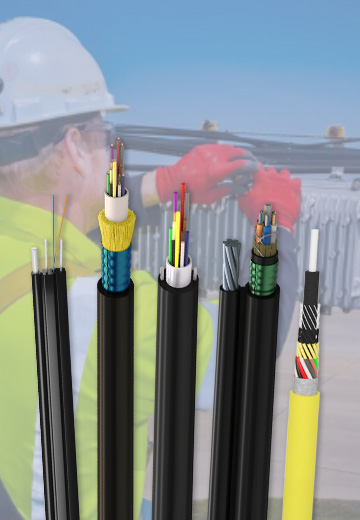
Fiber optic cable systems
Outdoor, indoor, FTTH and distribution cable lines for access networks, backbone routes and campus deployments.
 Telecom & ISP NetworksFTTH, PON, ODN
  Data Center InfrastructureServer room cabling
  Building Low-Voltage SystemsBMS, AV, weak current
  Security & Fire ProtectionAlarm, CCTV, access
  Industrial Automation CablePLC, RS485, fieldbus
  Energy & Power InfrastructureSolar, battery, power
 Telecom & ISP Networks
For FTTH / PON access, outdoor fiber deployment, aerial routes, duct routes, direct burial routes, rural broadband and ODN planning.
Tools
Use calculators and planning tools for conduit capacity, PoE voltage drop and fiber optic link loss budget work.