OEM Cable Printing Guide: What Buyers Should Confirm Before Production
Author: Site Editor Publish Time: 16-04-2026 Origin: Site
OEM Cable Printing Guide: What Buyers Should Confirm Before Production
Cable jacket printing is not just a branding detail. For OEM and private-label orders, the printed line affects product identification, field installation, inspection, traceability, compliance communication, and dispute prevention. Buyers should confirm the exact wording, layout, print durability, meter marking, and approval logic before mass production starts.
Approve the exact print line, not just a general description.
Make sure printed claims match the real cable construction, standards scope, and delivery specification.
Confirm contrast, repeat interval, durability, meter marking, and traceability before production release.
For OEM and private-label cable orders, jacket printing should be treated as a controlled production item rather than a cosmetic add-on. The printed line supports identification, inspection, installation, warehouse handling, traceability, and sometimes customs or compliance review. If the wording is incomplete, inaccurate, too faint, or inconsistent with the delivered cable, the problem often appears after shipment rather than before production. That is why buyers should confirm the content, order, visibility, durability, and approval logic of cable printing before manufacturing begins.
■ Why Cable Printing Matters in Real Projects
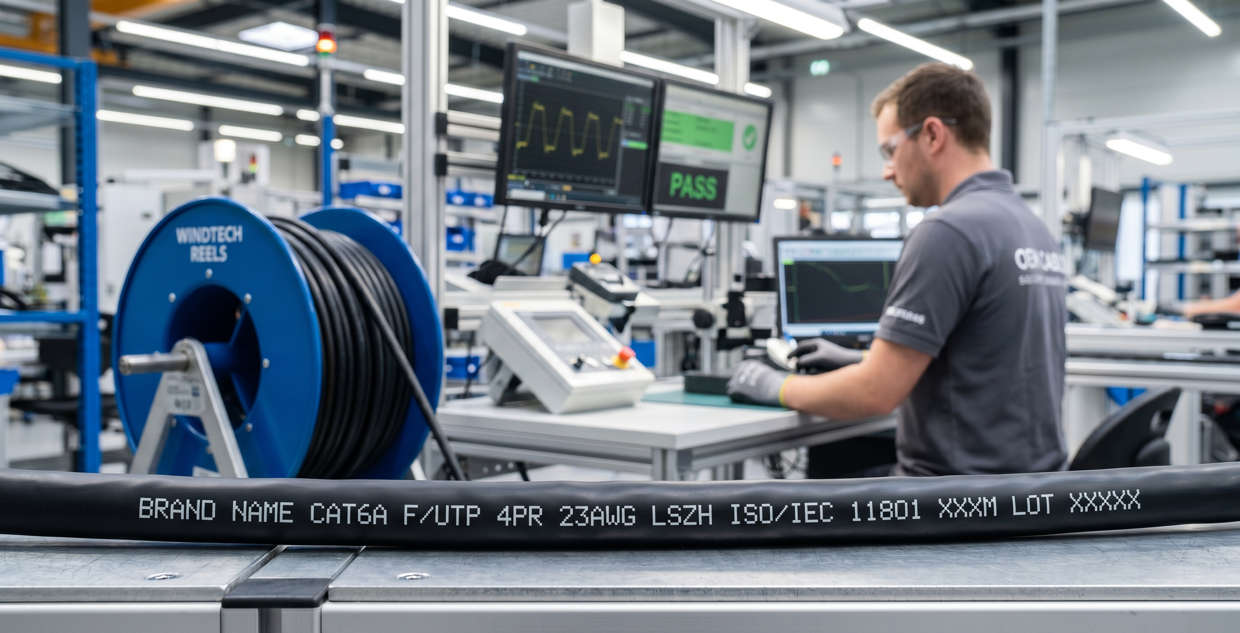
In real supply chains, cable jacket printing does more than display a brand name. It helps warehouse staff separate similar reels, helps installers confirm they are pulling the right cable, helps inspectors check visible identification, and helps buyers trace complaints back to a batch or production period. When printing is vague or missing, teams often rely on outer labels alone, which is risky once the cable is cut, repacked, or installed.
Good cable printing reduces identification mistakes, supports smoother project acceptance, improves after-sales traceability, and lowers the risk of disputes over specification mismatch.
| Printing Function | Why It Matters | Typical Project Value |
|---|---|---|
| Product identification | Confirms cable type in storage and on site | Fewer picking and installation errors |
| Brand presentation | Supports private label visibility | Improved brand consistency in distribution |
| Specification confirmation | Shows model, size, category, or construction | Better field verification and inspection |
| Meter marking | Tracks remaining length and installation usage | Less waste and easier stock control |
| Traceability | Links cable to batch or production record | Faster root-cause review if a complaint occurs |
■ What OEM Cable Printing Usually Includes
The print line depends on cable type, target market, and the buyer’s business model. A project supplier may prioritize technical identification, while a private-label distributor may prioritize visible brand presentation. In both cases, the best practice is to define exactly what should appear on the jacket and in what sequence.
| Printing Item | Purpose | Typical Example | Buyer Note |
|---|---|---|---|
| Brand name | Private-label identity | Customer brand / OEM brand | Confirm exact spelling and capitalization |
| Cable type or model | Technical identification | CAT6 U/UTP, RVV, GJYXCH | Do not copy old model strings without review |
| Conductor / pair / fiber count | Quick size confirmation | 4PR 23AWG, 2C x 1.5mm², 12F | Keep format easy to read in the field |
| Material or jacket type | Confirms sheath selection | PVC, PE, LSZH | Must match delivered compound |
| Standards or ratings | Compliance reference | IEC, EN, UL, CPR class | Only print supported claims |
| Meter marking | Length control | 001M, 002M, 003M | Useful for installation and stock review |
| Batch / lot code | Traceability | Date code or production lot | Important for repeat supply and complaints |
The right print line is usually a balance between brand visibility and operational readability. A print line that looks attractive on a brochure may still be inefficient in a warehouse or on a crowded cable tray if the technical identifier is hard to spot.
■ What Buyers Should Confirm Before Production
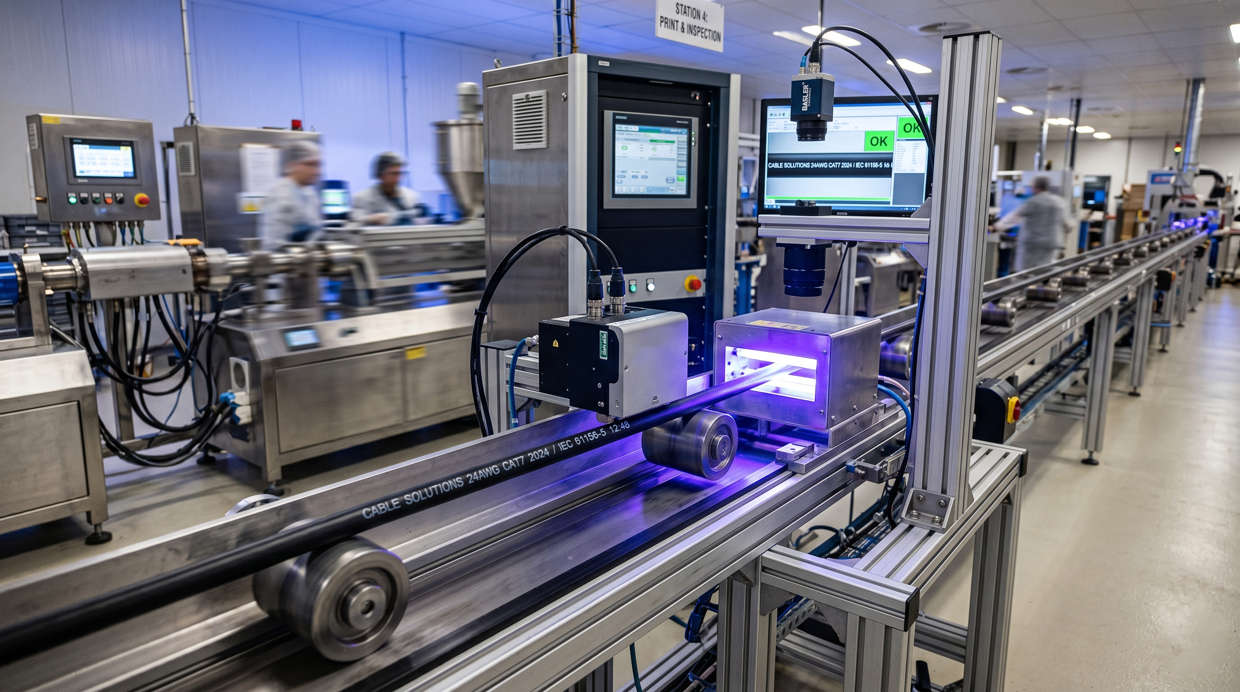
Cable printing should be included in the same approval flow as construction, materials, and packaging. The most important point is not just what text is used, but whether the print line is technically accurate, readable, durable, and aligned with how the cable will be sold or installed.
1) Confirm the Exact Print Content
Approve the final wording as a fixed text string. Do not rely on general email descriptions such as “print our brand and spec on the jacket.” Buyers should approve the exact brand spelling, model format, conductor or fiber count, material wording, ratings, standard references, origin statement, and traceability format.
2) Confirm That Printed Claims Match the Real Cable
The jacket should describe the actual delivered cable, not just the commercial positioning. If the cable is printed as LSZH, shielded, flame retardant, UV resistant, Cat6A, or CPR-classified, the delivered product should support that claim through its real construction and applicable test or approval scope.
| Printed Claim | What Must Be True | Buyer Risk If Not Verified |
|---|---|---|
| LSZH | Jacket compound must really be LSZH | Project rejection or mismatch claims |
| Cat6A | Design and testing must support Cat6A performance | Performance disputes and acceptance failure |
| Shielded | Shield structure must match the print claim | EMI problems and spec mismatch |
| UV Resistant | Jacket should support intended outdoor exposure | Premature jacket degradation |
| Certification / class claim | Claim must be within actual certification or rating scope | Regulatory, inspection, or commercial exposure |
3) Confirm Print Sequence and Layout
The order of the text affects usability. A common sequence might be brand + cable type + conductor count + jacket material + standard + meter mark + batch code. This should be reviewed for field readability, not just visual neatness. Dense trays, dark ceilings, and fast inspection routines all reward clear early identification.
4) Confirm Print Color and Contrast
Contrast is critical. White print on black jackets is usually effective, while light-colored jackets often need black print. Custom jacket colors should be verified with a real sample or photo proof because attractive branding colors do not always translate into clear readability.
| Jacket Color | Preferred Print Color | Buyer Concern |
|---|---|---|
| Black | White | Usually strong visibility |
| White | Black | Generally stable and easy to read |
| Gray | Black or white depending on shade | Low contrast is common if not sample-checked |
| Red / orange / yellow | White or black depending on tone | Custom color review is recommended |
| Blue / green | White often works well | Check legibility in lower-light conditions |
5) Confirm Character Size, Repeat Interval, and Readability
A correct print line still fails if the characters are too small, too faint, or repeated too far apart. Buyers should confirm whether the identification will be read mainly in the warehouse, during installation, or during inspection. The repeat interval should fit the cable’s likely cut lengths and field handling pattern.
6) Confirm Print Durability
Cable printing should survive normal handling, coiling, pulling, and storage. Projects with outdoor exposure, industrial contamination, or repeated repacking may require higher resistance to rubbing, smudging, and environmental wear.
7) Confirm Meter Marking Logic
Meter marks are highly practical for installers, stock managers, and project supervisors. Buyers should confirm whether the meter count resets per reel, what unit format is used, and whether the meter marking appears separately or within the main print line.
8) Confirm Batch Code or Traceability Requirements
For repeat supply, large projects, and complaint-sensitive environments, visible or semi-visible traceability can be valuable. Even if buyers do not need a long printed production code, they should decide whether the cable must be traceable back to the manufacturing lot.
9) Confirm Language and Abbreviation Strategy
Printing should be readable to the people who use it. Engineers often prefer concise technical abbreviations, while distributors or contractors may prefer clearer commercial wording. Multilingual print lines may be helpful in some markets, but they can also become crowded and harder to read.
10) Confirm Compliance and Approval Mark Usage
Certification marks, class references, and standard claims should never be added casually. Unsupported jacket wording creates avoidable legal, commercial, and project acceptance risks. Buyers should only approve printed claims that align with actual product scope and documented support.
If a wording element could affect inspection, acceptance, or customer claims, it should be frozen in the purchase order or approved artwork rather than left to standard factory practice.

■ Common OEM Cable Printing Mistakes
Most printing issues come from incomplete approval rather than complex manufacturing failure. The common pattern is that the buyer confirms the idea of the marking but not the operational details.
Using an old print line from a previous order with the wrong model or rating.
Approving the brand name but not the full technical wording.
Adding certification or standards text without checking actual scope.
Selecting print color without reviewing contrast on the real jacket color.
Forgetting meter marks until after production is already scheduled.
Omitting batch code even though traceability matters later.
Making the print line too long for consistent readability.
Skipping sample proof approval before full production release.
■ Decision Rules / Engineer’s Shortcut
The best cable printing strategy depends on whether the order is aimed at branding, project installation, or quality control. Buyers should decide early what the print line needs to achieve operationally.
| Situation | When to Choose This Printing Approach | When Not to Use It | Alternative | Cost / Risk / Maintainability Impact |
|---|---|---|---|---|
| Simple technical print line | Internal use, project supply, easy field identification | Brand-led retail presentation is the main goal | Brand-first line with controlled spec block | Lower complexity, lower risk, high field usability |
| Brand-first OEM print line | Distributor or private-label market positioning | Installers must quickly identify detailed specs on site | Balanced layout with early technical identifier | Good branding, but readability can drop if overdesigned |
| Expanded print with meter marking | Installation-heavy projects, stock tracking, resale by length | Short custom lengths where meter logic adds little value | Label-based length control | Higher operational value, slight print complexity increase |
| Traceability-focused line | Large projects, repeat supply, complaint-sensitive sectors | Low-volume simple orders with minimal after-sales risk | Outer-label traceability only | Better quality control, more approval discipline needed |
■ Buyer Pre-Production Checklist
Before mass production, buyers should freeze cable printing in the order file the same way they freeze construction, packaging, and labeling requirements.
| Check Item | Why It Should Be Confirmed | Status |
|---|---|---|
| Exact print text approved | Avoid wording mismatch | ______ |
| Claims match real cable construction | Prevent specification and compliance disputes | ______ |
| Layout order approved | Improve field readability | ______ |
| Contrast checked on actual jacket color | Prevent poor visibility | ______ |
| Character size and repeat interval confirmed | Support faster use on site | ______ |
| Meter marking logic defined | Improve stock and installation control | ______ |
| Batch code or lot traceability decided | Support quality follow-up | ______ |
| Compliance marks reviewed | Reduce regulatory and inspection risk | ______ |
| Sample or proof approved | Catch mistakes before mass production | ______ |
| Print specification added to PO / artwork record | Lock requirement for execution | ______ |
■ FAQ
Is cable printing only for branding?
No. Branding is only one function. Cable printing also supports product identification, field confirmation, inspection, traceability, and stock management after the outer label is removed.
Should every OEM cable include meter marking?
Not always. Meter marking is most valuable for installation-heavy projects, warehouse tracking, and cable sold by length. For short custom assemblies, it may add little practical value.
Can buyers request any wording they want on the cable?
Buyers can request custom wording, but printed claims should match the actual construction, test scope, and compliance status of the delivered cable. Unsupported claims create avoidable risk.
What is the most common mistake in OEM cable printing?
The most common mistake is approving the idea of the print without approving the exact final text, sequence, contrast, and sample proof.
Should brand or technical information come first?
That depends on the order purpose. Distribution branding often favors the brand first, while project supply usually benefits from earlier technical identification for easier field use.
Why approve a sample or proof before mass production?
A sample or proof helps confirm wording, contrast, spacing, durability, and overall readability before the full order is printed. It is one of the simplest ways to prevent rework.
■ Conclusion
OEM cable printing should be controlled with the same discipline as cable construction and packaging. When buyers confirm the exact text, claim accuracy, layout sequence, contrast, repeat interval, durability, traceability, and compliance wording before production, they reduce the risk of specification disputes, poor field readability, and avoidable inspection issues. In practical terms, good cable printing helps the right cable stay identifiable from factory dispatch through installation and after-sales service.
ZION can support OEM and private-label cable projects with customized jacket printing, specification confirmation, sampling, and production coordination for engineering, distribution, and export orders.



 Fiber Optic Tools
Products 6 families
Solutions 6 markets
Resources Tools & docs
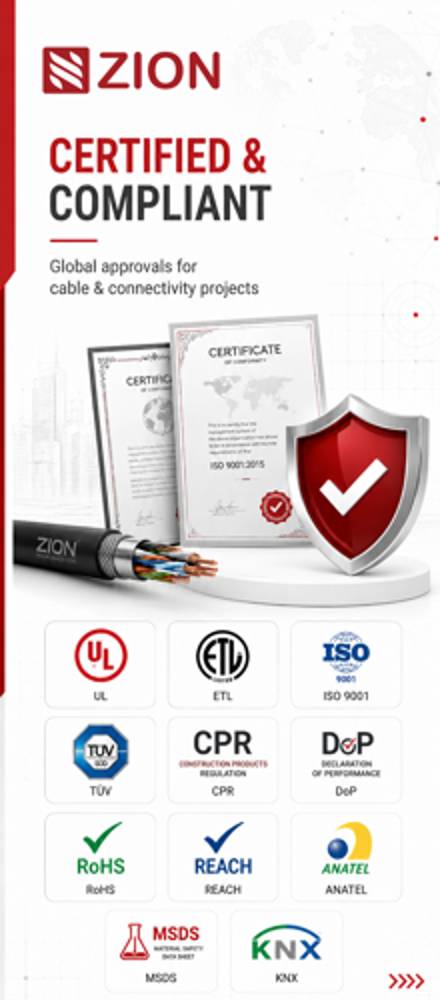
Certificate
Certification and compliance references for project review, qualification and purchasing documentation.
 Fiber Optic CableAccess and backbone
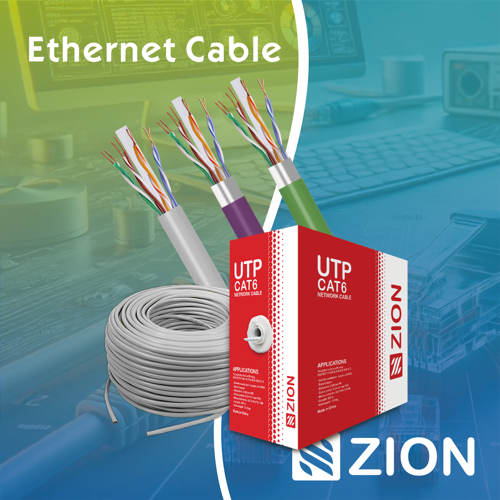 Ethernet CableCat5e to Cat8
 Coaxial CableRF and video signal
 Fire, Security & AlarmSafety systems
 Voice, Audio & VideoSignal cabling
 Power & Control CableEnergy and control
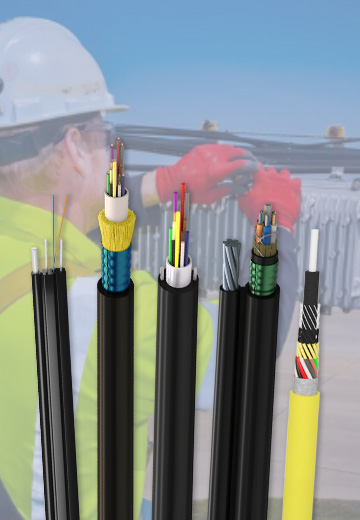
Fiber optic cable systems
Outdoor, indoor, FTTH and distribution cable lines for access networks, backbone routes and campus deployments.
 Telecom & ISP NetworksFTTH, PON, ODN
  Data Center InfrastructureServer room cabling
  Building Low-Voltage SystemsBMS, AV, weak current
  Security & Fire ProtectionAlarm, CCTV, access
  Industrial Automation CablePLC, RS485, fieldbus
  Energy & Power InfrastructureSolar, battery, power
 Telecom & ISP Networks
For FTTH / PON access, outdoor fiber deployment, aerial routes, duct routes, direct burial routes, rural broadband and ODN planning.
Tools
Use calculators and planning tools for conduit capacity, PoE voltage drop and fiber optic link loss budget work.