PE vs PVC vs LSZH: Which Jacket Is Best for Outdoor Foil Screen Cable?
Author: Site Editor Publish Time: 14-04-2026 Origin: Site
Outdoor Foil Screen Cable: PE, PVC, or LSZH Jacket?
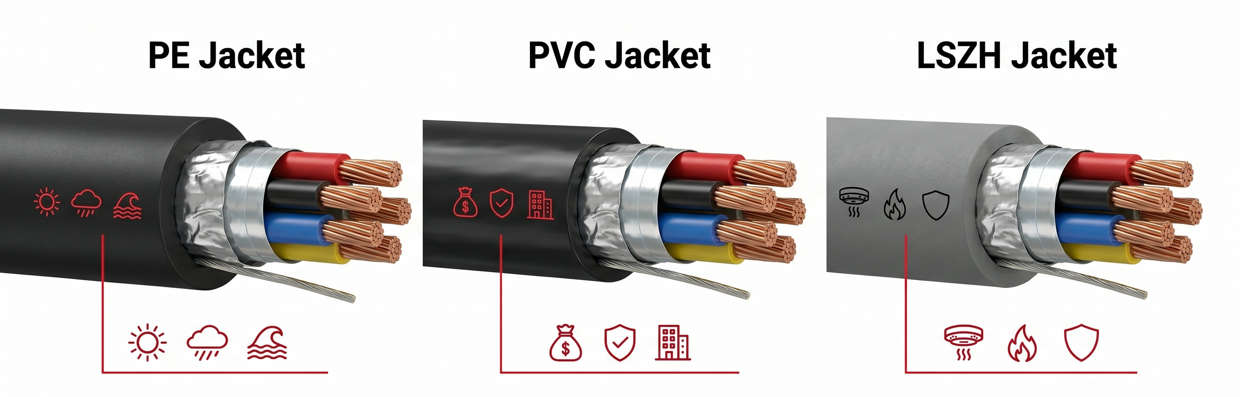
For outdoor foil screen cable, the right jacket is determined by UV exposure, moisture, fire safety, and installation method—not by shielding alone. PE is usually the default for true outdoor duty, PVC can work in lighter outdoor applications with proper sunlight rating, and LSZH is the preferred option when low smoke and low halogen performance matter.
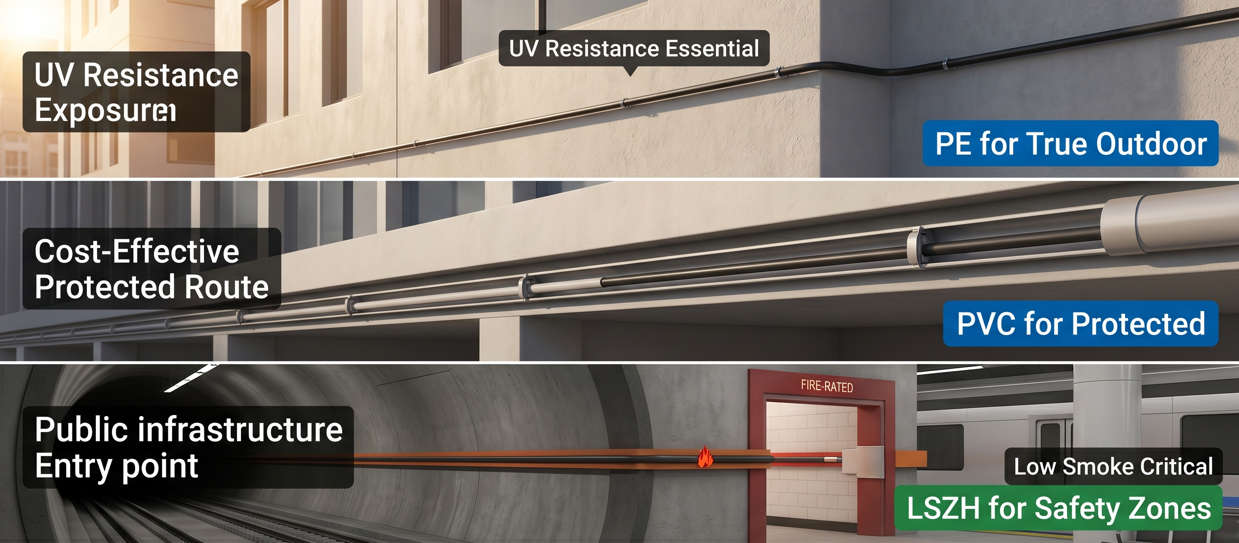
Choose PE for exposed outdoor, wet, duct, or burial-oriented routes.
Choose PVC only when the cable is specified for sunlight/outdoor use and the route is less demanding.
Choose LSZH when fire, smoke, and corrosive gas control matter, but only with confirmed outdoor/UV suitability.
■ 1) What matters most in jacket selection?
For outdoor foil screen cable, the foil shield and the jacket solve different problems. The foil screen helps improve EMI performance, while the jacket determines whether the cable can survive UV exposure, rain, moisture, temperature swings, and installation stress. This is why outdoor selection should start with the route environment first and then move to shielding, conductor, and electrical performance.
In practical procurement, the wrong jacket often creates more field problems than the wrong shielding type. A screened cable may still fail early if the outer sheath is not suitable for direct sun, wet ducts, or mixed indoor-outdoor pathways. For engineering teams, the correct question is not simply “Is the cable screened?” but “Is the screened cable built for this exact outdoor exposure profile?”
■ 2) Quick decision table
| Installation Priority | Recommended Jacket | Why |
|---|---|---|
| Exposed outdoor, rain, wet ducts, direct burial | PE | Best default for outdoor durability, moisture handling, and buried-route logic. |
| Cost-sensitive outdoor route, conduit-protected, lighter duty | PVC | Can work when the cable is specifically rated for sunlight/outdoor use. |
| Public infrastructure, station, tunnel, campus, building perimeter | LSZH | Better when low smoke and low halogen performance matter in fire scenarios. |
| Specification incomplete or unclear | PE | Safer outdoor default unless project fire rules clearly push the design toward outdoor-rated LSZH. |
■ 3) PE vs PVC vs LSZH at a glance
How the three jacket options differ
| Property | PE | PVC | LSZH |
|---|---|---|---|
| Outdoor durability | High | Medium, product-dependent | Medium to high, only if outdoor-rated |
| UV/sunlight suitability | Common choice | Must be confirmed | Must be confirmed |
| Moisture and wet-route logic | Strong default | More limited | Depends on compound and construction |
| Fire / smoke performance | Not the main strength | General-purpose | Best for low smoke / low halogen needs |
| Best-fit use case | True outdoor and burial-oriented routes | Budget-conscious protected outdoor runs | Safety-sensitive indoor/outdoor environments |
■ 4) When PE is the best choice
PE is typically the safest starting point for outdoor foil screen cable because it aligns well with exposed weather, wet locations, duct environments, and direct-burial thinking. For many engineers, PE is the default material when the route is clearly outdoors and long-term durability matters more than indoor fire performance.
This is especially true for pole runs, rooftop paths, facade routing, trenches, utility corridors, and building-to-building connections. In these cases, the cable has to survive the real outdoor environment first. If the cable may face standing moisture, unstable temperatures, or ground contact, PE usually provides the strongest decision logic.
Typical PE-driven application scenarios
Outdoor control or signal cable on exposed structures
Building-to-building outdoor communication links
Wet duct or trench installations
Direct-burial projects with proper construction support
Projects where service life and maintenance reduction are top priorities
■ 5) When PVC is acceptable
PVC can be a reasonable option for outdoor foil screen cable when the installation is lighter duty, more protected, and cost-sensitive. However, PVC should never be selected for outdoor use by assumption alone. The product itself must clearly support sunlight resistance or outdoor installation in its own specification.
In practical purchasing terms, PVC makes more sense for conduit-protected building connections, cabinet-to-cabinet runs, or projects where the route is technically outdoors but not fully exposed to the harshest weather conditions. Even then, it should be treated as a specification-driven choice rather than the default.
■ 6) When LSZH is the better option
LSZH becomes the better engineering choice when fire behavior, smoke reduction, and corrosive gas control are part of the project requirement. This is common in transport infrastructure, public buildings, campuses, utility rooms, tunnels, stations, and mixed indoor-outdoor routes where evacuation visibility and equipment protection matter.
The critical point is that LSZH should not be treated as automatically outdoor-ready. Some LSZH constructions are designed for outdoor use, while others are better suited to protected routes or indoor transition zones. The engineer should therefore confirm both the fire-performance side and the outdoor/UV side before final approval.
Where LSZH usually makes more sense than PE or PVC
Station, airport, tunnel, metro, and public infrastructure routes
Campus perimeter links with building-entry fire concerns
Industrial projects with sensitive equipment nearby
Mixed indoor-outdoor paths where smoke toxicity is a real risk factor
■ 7) Common specification mistakes
| Mistake | Risk | Better Decision |
|---|---|---|
| Selecting by shielding only | EMI may be controlled, but jacket failure shortens service life. | Specify shielding and jacket separately. |
| Assuming all PVC is suitable outdoors | UV aging, misapplication, and shortened durability. | Use PVC only when sunlight/outdoor suitability is confirmed. |
| Assuming all LSZH works outdoors | Premature degradation or route mismatch. | Confirm both fire performance and outdoor/UV suitability. |
| Using a non-burial design underground | Moisture, crush, or long-term reliability problems. | Verify burial capability or add proper protection. |
| Choosing only by lowest initial cost | Higher maintenance and replacement risk. | Evaluate total project cost, not just purchase price. |
■ 8) Engineer’s shortcut
A simple selection sequence can shorten decision time. First, ask whether the route is truly outdoor, wet, or burial-oriented. If yes, start with PE. Second, ask whether the route is relatively protected and cost-sensitive. If yes, a properly rated PVC option may be acceptable. Third, ask whether the route includes public occupancy, indoor transition fire concerns, or critical smoke requirements. If yes, move the review toward LSZH—while still checking outdoor suitability.
■ 9) FAQ
Is PE always the best outdoor jacket?
For most exposed outdoor and burial-oriented installations, PE is usually the strongest default choice. However, if the project also has strict fire-smoke requirements near occupied areas or building entries, an outdoor-rated LSZH design may be more appropriate.
Can PVC foil screen cable be used outdoors?
Yes, but only when the cable is specifically designed and marked for outdoor or sunlight-resistant service. PVC should not be treated as automatically suitable for exposed outdoor routes.
Is LSZH automatically suitable for outdoor installation?
No. LSZH tells you about fire and smoke behavior, not full outdoor readiness by itself. Outdoor use still depends on the exact compound and construction.
What is the safest default if the specification is incomplete?
If the route is clearly outdoors and no strong fire requirement has been defined, PE is usually the safest starting point. Then review whether burial, conduit, public occupancy, or indoor transition requirements change that decision.
■ 10) Conclusion
For outdoor foil screen cable, jacket selection should follow the real installation environment rather than the shielding type alone. PE is usually the best default for exposed outdoor, wet, and burial-oriented routes. PVC can be a workable option when the route is lighter duty and the product is clearly rated for sunlight or outdoor use. LSZH is the stronger choice when low smoke and low halogen performance matter, especially around public or mixed indoor-outdoor spaces, but only when the exact cable is also suitable for outdoor exposure.
For engineers and procurement teams, the most reliable approach is to evaluate four things in order: UV exposure, moisture or burial risk, fire-smoke requirement, and route protection level. That sequence makes jacket selection faster, reduces field failures, and improves long-term project value.
Send ZION your installation conditions, shielding requirement, voltage or signal type, fire-performance target, and route details. We can help you narrow down the right PE, PVC, or LSZH construction for your project.



 Fiber Optic Tools
Products 6 families
Solutions 6 markets
Resources Tools & docs
Certificate
Certification and compliance references for project review, qualification and purchasing documentation.
 Fiber Optic CableAccess and backbone
 Ethernet CableCat5e to Cat8
 Coaxial CableRF and video signal
 Fire, Security & AlarmSafety systems
 Voice, Audio & VideoSignal cabling
 Power & Control CableEnergy and control
Fiber optic cable systems
Outdoor, indoor, FTTH and distribution cable lines for access networks, backbone routes and campus deployments.
 Telecom & ISP NetworksFTTH, PON, ODN
  Data Center InfrastructureServer room cabling
  Building Low-Voltage SystemsBMS, AV, weak current
  Security & Fire ProtectionAlarm, CCTV, access
  Industrial Automation CablePLC, RS485, fieldbus
  Energy & Power InfrastructureSolar, battery, power
 Telecom & ISP Networks
For FTTH / PON access, outdoor fiber deployment, aerial routes, duct routes, direct burial routes, rural broadband and ODN planning.
Tools
Use calculators and planning tools for conduit capacity, PoE voltage drop and fiber optic link loss budget work.