What Is an RJ45 Connector? Selection Guide for Cat6 & Cat6A
Author: Will Publish Time: 31-12-2025 Origin: Site
What Is an RJ45 Connector?
Procurement managers, network engineers, building contractors, and system integrators who need correct purchasing and engineering decisions—not just terminology.
Need help matching cable & connector?
Share your cable type (Cat, shielding, AWG, OD) and application (PoE / outdoor / industrial). ZION engineers will recommend the right RJ45 option.
■ Introduction: Built for Professional Buyers
In global cabling projects, one of the most common causes of commissioning failures is not cable quality, but incorrect RJ45 connector selection. This guide explains what an RJ45 connector really is, how it fits into an Ethernet cabling system, and how to choose the correct RJ45 for Cat6/Cat6A, shielded cabling, PoE/PoE++, and outdoor Ethernet.
■ What Is an RJ45 Connector?
RJ45 is the commonly used name for an 8P8C modular connector (8 positions, 8 contacts) used in Ethernet networks. Strictly speaking, “RJ45” originated as a registered jack definition, while modern Ethernet connectors are technically 8P8C. However, “RJ45” is now the industry-accepted term worldwide.
Terminating Cat5e / Cat6 / Cat6A Ethernet cables
UTP, FTP, STP, and S/FTP cable structures
Solid and stranded copper conductor cables
PoE / PoE+ / PoE++ powered network devices (IP cameras, APs, building automation)
■ Important Clarification: An RJ45 Connector Has No “Category”
A common procurement misconception is assuming an RJ45 connector itself is “Cat6” or “Cat6A.” In reality, category ratings (Cat5e / Cat6 / Cat6A) describe system performance after proper termination and testing. An RJ45 connector is a mechanical and electrical termination component. Performance depends on correct matching between cable and connector.
■ Why RJ45 Connector Selection Matters in Projects
Signal integrity: insertion loss, return loss, NEXT/alien crosstalk risk
PoE reliability: contact stability under load, heat, voltage drop
EMC performance: shielding continuity and grounding path
Lifecycle cost: fewer fails in certification tests, less rework and downtime
■ Key Factors for Selecting the Right RJ45 Connector
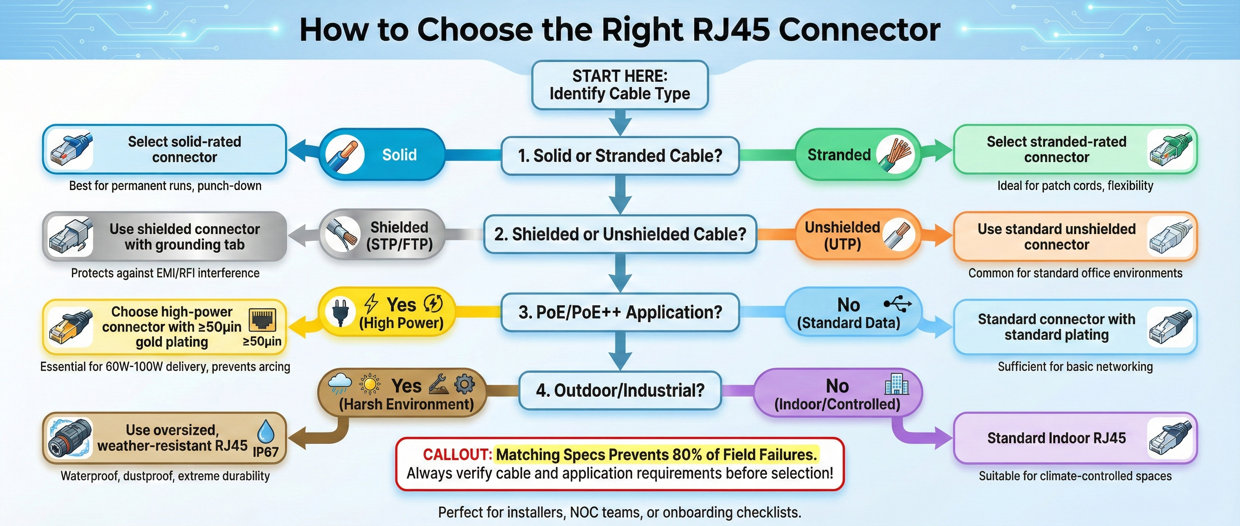
1) Conductor Type: Solid vs Stranded
| Cable Type | Correct RJ45 Connector | Project Risk If Mismatched |
|---|---|---|
| Solid copper (horizontal cabling) | Solid-rated RJ45 | Poor IDC contact, intermittent link, PoE instability |
| Stranded copper (patch cords) | Stranded-rated RJ45 | Higher resistance contact, long-term dropouts |
2) AWG & Insulation Diameter Compatibility
Category labels do not guarantee physical compatibility. Professional selection requires checking conductor AWG, insulation outer diameter, and overall cable OD. This is especially critical for Cat6A, outdoor Ethernet, and CMX/PE jacket cables, which often require oversized RJ45 connectors.
3) Shielded vs Unshielded (UTP / FTP / STP / S/FTP)
UTP cable → Unshielded RJ45
FTP/STP/S/FTP cable → Shielded RJ45 with grounding path
4) PoE / PoE++ Considerations
PoE applications require stable contact performance under load. For PoE+ and PoE++ deployments, choose connectors designed for sustained current, reliable termination, and long-term contact stability. Low-quality connectors can cause localized heating, voltage drop, and accelerated wear.
5) Outdoor & Industrial Installations
Outdoor Ethernet cables (PE jacket, CMX-rated, gel-filled) often have larger OD and stiffer jackets. Standard indoor plugs may not provide proper fit or strain relief. Select outdoor/oversized-compatible RJ45 connectors or consider factory-terminated assemblies for critical links.
■ RJ45 Termination Types: Pass-Through vs Traditional
Pass-through RJ45 connectors are popular among installers due to speed and easier wire verification. Traditional RJ45 connectors often provide better long-term durability, especially in PoE-heavy and outdoor/industrial environments.
| Item | Pass-Through RJ45 | Traditional RJ45 |
|---|---|---|
| Termination method | Conductors pass through nose | Conductors stop inside connector |
| Speed & visual verification | Very fast; easy to verify | Slower; less visual feedback |
| Risk of exposed copper | Possible if trimming is poor | None |
| Moisture / corrosion risk | Higher (depends on trimming & environment) | Lower |
| PoE / PoE++ stability | Medium–Good (quality dependent) | Excellent |
| Best use cases | Fast indoor installs, temporary links | Permanent cabling, industrial/outdoor, PoE-heavy |

ZION recommendation: Choose pass-through for speed in controlled indoor environments. Choose traditional RJ45 for durability, PoE-heavy networks, and outdoor/industrial installations.
■ Compliance, Certification & Fire Performance Considerations
Cabling standards
In structured cabling projects, RJ45 connectors should support system compliance requirements. System performance is validated after termination and testing under relevant standards (e.g., TIA/EIA and ISO/IEC cabling standards).
UL and safety compliance
For many projects (especially North America), UL compliance is a key quality and inspection indicator. Using compliant components helps reduce approval risk and improves procurement confidence in material safety and mechanical integrity.
Fire rating & installation environment (CM / CMP)
While CM/CMP ratings apply to the cable system, connectors should be compatible with the project’s fire performance requirements and installation environment. For plenum spaces and public infrastructure, flame-retardant materials and compliant components are strongly recommended.
■ Common RJ45 Selection Mistakes in Projects
Using Cat6 connectors on Cat6A cables (insulation OD too large)
Ignoring AWG and insulation diameter compatibility
Mixing shielded cable with unshielded RJ45 connectors (broken grounding path)
Field termination for permanent high-speed or mission-critical links
Using indoor connectors in outdoor/high-humidity environments
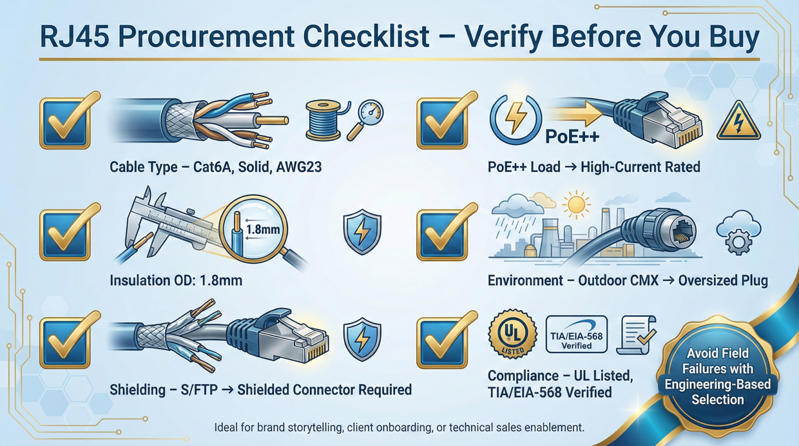
■ RJ45 Connector Procurement Checklist
☐ Insulation OD verified ☐ Overall cable OD verified
☐ Connector suitable for sustained current load
☐ Oversized connector needed ☐ Enhanced strain relief required
☐ UL compliance required ☐ Fire-rated cable system (CM / CMP) considerations
ZION COMMUNICATION: RJ45 Solutions for Professional Projects
ZION COMMUNICATION provides RJ45 connector solutions engineered for professional Ethernet cabling systems, including:
RJ45 connectors for Cat5e / Cat6 UTP cables
Shielded RJ45 connectors for Cat6A STP & S/FTP cabling
Oversized RJ45 connectors for outdoor Ethernet cables
PoE and PoE++ compatible RJ45 connectors
Tool-less RJ45 options for fast field installation
When Field-Terminated RJ45 Connectors Are Not Recommended
Field termination is not always the best solution. For data centers, mission-critical networks, or long-term SLA-based infrastructure, factory-terminated and tested assemblies provide more consistent performance and lower commissioning risk.
Conclusion
An RJ45 connector is more than a plug—it is a critical interface in the Ethernet cabling system. For professional buyers and engineers, correct selection depends on cable construction, mechanical compatibility, shielding continuity, PoE requirements, installation environment, and compliance needs. By applying engineering-based selection principles, projects achieve higher reliability, smoother commissioning, and lower lifecycle cost.
Contact us for more information

Will is the Copper Cabling Product Manager at Zion Communication,
specializing in the development and marketing of Ethernet cabling solutions.
With extensive industry experience, he is dedicated to delivering high-performance
and reliable cabling products to OEM/ODM clients worldwide.
will@zion-communication.com
+86 -18268007201