What Technical Documents Should a Cable Supplier Provide? Buyer Checklist for Cable Approval
Author: Site Editor Publish Time: 17-04-2026 Origin: Site
What Technical Documents Should a Cable Supplier Provide?
For engineers, procurement teams, project managers, and system integrators, cable documentation is part of product quality control. A serious supplier should provide more than a brochure. The right document pack helps verify specifications, confirm compliance, reduce approval delays, prevent shipment mismatch, and improve traceability during installation and after-sales handling.
A datasheet alone is rarely enough for bulk, project, OEM, or compliance-sensitive cable orders.
The most important controls are approved specification, test evidence, compliance proof, marking confirmation, and traceability.
Weak documentation usually leads to higher total project cost through rework, delays, and dispute handling.
■ Why cable documents matter in real B2B projects
When buyers evaluate a cable supplier, price and lead time are only part of the decision. The document package behind the product often determines whether the order can be approved, produced, shipped, installed, and accepted without friction. For engineers, the documents prove whether the design is correct. For procurement teams, they reduce ambiguity between quotation and delivery. For project managers, they reduce approval delays and site disputes. For system integrators, they help confirm compatibility, installation limits, and traceability.
In practice, incomplete or inconsistent documents usually lead to one of four problems: the wrong cable is approved, the correct cable is approved but poorly defined, shipment labels do not match project requirements, or traceability breaks down after delivery. That is why documentation should be treated as part of engineering control, not as an administrative afterthought.
A supplier that can only send a brochure is rarely ready for serious project supply. In most cable projects, buyers should expect product definition, test evidence, compliance proof, packing control, and batch traceability before final shipment approval.

■ Core documents every cable supplier should provide
A qualified cable supplier should normally be able to provide a structured document pack rather than a single generic file. The exact depth depends on cable type, application risk, regulatory requirement, and customization level, but the following documents form the practical baseline for most B2B orders.
| Document | What it should confirm | Why it matters |
|---|---|---|
| Technical Datasheet | Product model, construction basics, material, performance range, operating conditions | Used for technical screening and initial approval |
| Approved Specification Sheet | Exact ordered version, including conductor or fiber count, jacket, shielding, color, print legend, packing | Becomes the production control baseline for bulk or customized orders |
| Construction Drawing / Structure Diagram | Layer sequence, shielding or armor, drain wire, strength member, dimensions | Reduces misunderstanding between similar cable types |
| Test Report | Electrical, optical, mechanical, fire, or environmental performance evidence | Shows the cable was tested, not just described |
| Certificate of Conformity (CoC) | Delivered goods meet the agreed specification or stated standard | Supports incoming inspection and shipment release control |
| Compliance Documents | RoHS, REACH, CPR, flame class, ISO, or market-specific declarations | Important for regulatory review and project acceptance |
| Packing / Label Confirmation | Reel length, carton or drum label format, cable print legend, shipment identification | Prevents OEM mistakes, site confusion, and length disputes |
| Traceability Information | Batch number, production date, reel ID, meter marking, QC release reference | Improves complaint handling and post-delivery accountability |
This is the starting point, but not the finish line. A useful datasheet should clearly state model, materials, rated or measured performance, environmental range, outer diameter, and application boundary.
For OEM, project, or custom orders, this is often the most important document because it confirms what will actually be manufactured, printed, packed, and shipped.
This proves whether the cable has been checked against the relevant performance and regulatory requirements rather than only described in commercial terms.
| Report Type | Main Use | Best Stage |
|---|---|---|
| Type Test Report | Validates a product design or family against stated standards | Supplier qualification or technical approval stage |
| Routine Test Report | Shows batch-level production checks | Before shipment release |
| Third-Party Report | External verification for regulated or high-risk applications | Tender, compliance review, or critical project stage |
| Internal QC Record | Factory release evidence linked to production control | Shipment control and complaint trace-back |
■ What to ask for at each procurement stage
Buyers do not need every file at the first email exchange, but the required documentation should deepen as the order moves from screening to quotation, then to production approval and shipment release. This staged approach helps control both efficiency and risk.
| Procurement Stage | Recommended Documents | Main Goal |
|---|---|---|
| Supplier Screening | Company profile, ISO certificate, sample datasheet, sample test evidence | Check whether the supplier is technically credible |
| Quotation Stage | Datasheet, structure drawing, preliminary specification confirmation | Compare suppliers on an aligned technical basis |
| Pre-Production Approval | Approved specification sheet, print legend, packing confirmation, sample approval if needed | Prevent mismatch before mass production starts |
| Before Shipment | CoC, routine test report, packing list, label details, batch reference | Control delivery release and incoming inspection readiness |
| Project Handover / Audit | Compliance file, traceability records, third-party reports if required, supporting declarations | Support acceptance, filing, and after-sales trace-back |
■ What buyers should verify inside the documents
Receiving files is not enough. The document set must also be internally consistent. A common supplier-side control problem is that the quotation says one thing, the datasheet says another, and the actual cable marking reflects something else.
| Check Item | What to Verify | Risk if Wrong |
|---|---|---|
| Product Model | Matches quotation, PO, approved spec, and shipment label | Wrong item delivered or approved |
| Conductor / Fiber Details | Size, count, material, category, or fiber type are aligned | Performance or compatibility failure |
| Jacket / Insulation Material | PVC, LSZH, PE, TPU, or other material is correct for the environment | Compliance mismatch or poor field durability |
| Shield / Armor Structure | Matches the specified EMC or mechanical protection need | EMC, strength, or installation problems |
| Fire / Flame Rating | Exact class or standard reference is stated clearly | Project approval rejection |
| Print Legend | Branding, wording, meter mark, and custom requirements are confirmed | OEM rework or site confusion |
| Batch Traceability | Batch number, reel ID, and production date can be linked to the shipment | Complaint handling becomes slow and unclear |
If the order is customized, branded, compliance-sensitive, or difficult to replace after installation, treat document consistency as a release gate, not as optional support material.
■ When to require a full document package
Not all cable purchases require the same documentation depth. A small stock order for a low-risk application can be handled with a lighter package. A tender, OEM project, fire-related system, or export order usually needs a more complete approval file.
| Situation | Recommended Package | Reason |
|---|---|---|
| Standard stock purchase | Datasheet + CoC + packing details | Basic verification may be enough if the application is low risk |
| Bulk project order | Datasheet + drawing + approved specification + test evidence + CoC | Reduces mismatch, approval delay, and delivery dispute |
| Fire or safety-related application | Compliance file + fire test evidence + installation guidance | Risk and acceptance threshold are higher |
| OEM / private-label cable | Approved print legend + packing confirmation + traceability + approved spec | Branding and shipment errors are expensive to fix |
| Export to regulated market | Relevant declarations + supporting reports + market-specific compliance documents | Customs or customer approval may depend on them |
| Custom technical cable | Signed specification + sample approval + QC release record | Prevents build deviation during production |
Low-risk standard product
Small order quantity
No OEM print or custom labeling
No special regulatory requirement
Project or tender supply
Customized construction or branded printing
Safety-related or fire-sensitive installation
High replacement cost after installation
■ Common red flags buyers should watch for
Documentation quality is often an early signal of production control quality. Buyers should be cautious if the supplier shows any of the following patterns.
Only a brochure is available, but no usable technical datasheet.
The supplier avoids sharing construction details for a project-critical cable.
Certificates are generic and do not clearly relate to the ordered product.
Compliance claims are vague and do not name the actual standard or class.
There is no clear CoC or shipment-linked release process.
The print legend, label format, or packing method cannot be confirmed before production.
The supplier cannot link reel or batch information back to the delivery.
The higher the compliance burden, customization level, or replacement cost, the more dangerous it is to rely on a datasheet-only supplier.
■ FAQ
Usually not. For bulk, project, OEM, or compliance-sensitive orders, buyers normally also need an approved specification, test evidence, CoC, packing confirmation, and traceability details.
The approved specification sheet or approved drawing is usually the most important because it defines what will actually be manufactured, printed, packed, and shipped.
No. Many standard orders can be supported by internal routine test records and a CoC. Third-party reports become more important when the application is regulated, tender-based, fire-sensitive, or difficult to replace after installation.
Traceability links the delivered goods to reel ID, production date, batch number, and release records. It helps buyers investigate complaints faster and reduces uncertainty in after-sales handling.
Buyers should focus on exact standard references, fire or flame test evidence, compliance declarations, and installation limits. General wording without specific standards is not enough for serious approval work.
That is risky for project and OEM orders. Core technical confirmation and configuration documents should be reviewed before production or before final shipment release, not after the goods arrive on site.
■ Conclusion
A reliable cable supplier should provide more than a generic product sheet. In real B2B projects, buyers usually need a controlled document package covering product definition, approved configuration, construction details, test evidence, compliance support, packing control, and batch traceability. The exact package depends on the application, market, and customization level, but the logic stays the same: better documents reduce ambiguity, approval risk, rework cost, and delivery disputes.
For engineers, procurement teams, project managers, and system integrators, documentation is not only paperwork. It is part of the decision framework that helps ensure the cable delivered is the cable actually required.
If you are reviewing a cable for a project, OEM program, or regulated application, ZION can help you organize the right document package before approval and shipment.



 Fiber Optic Tools
Products 6 families
Solutions 6 markets
Resources Tools & docs
Certificate
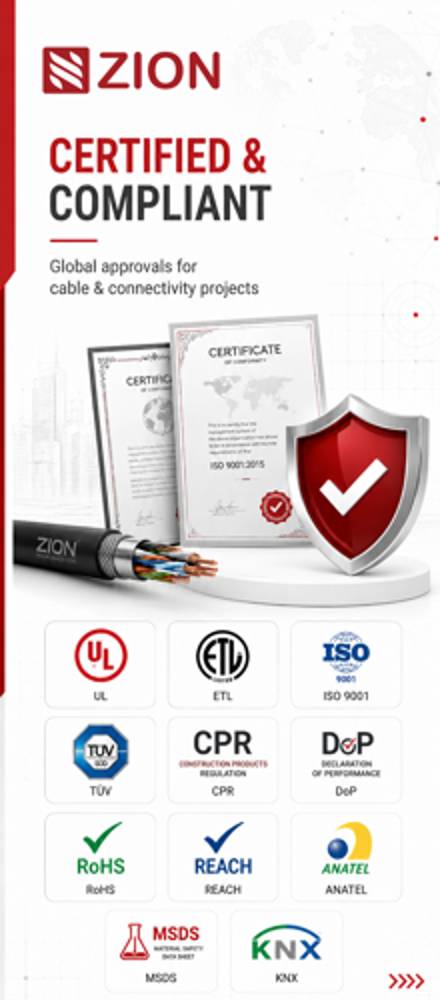
Certification and compliance references for project review, qualification and purchasing documentation.
 Fiber Optic CableAccess and backbone
 Ethernet CableCat5e to Cat8
 Coaxial CableRF and video signal
 Fire, Security & AlarmSafety systems
 Voice, Audio & VideoSignal cabling
 Power & Control CableEnergy and control
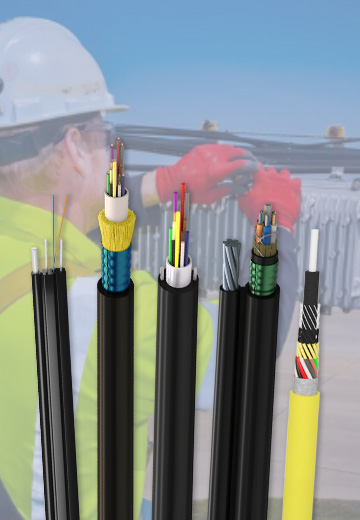
Fiber optic cable systems
Outdoor, indoor, FTTH and distribution cable lines for access networks, backbone routes and campus deployments.
 Telecom & ISP NetworksFTTH, PON, ODN
  Data Center InfrastructureServer room cabling
  Building Low-Voltage SystemsBMS, AV, weak current
  Security & Fire ProtectionAlarm, CCTV, access
  Industrial Automation CablePLC, RS485, fieldbus
  Energy & Power InfrastructureSolar, battery, power
 Telecom & ISP Networks
For FTTH / PON access, outdoor fiber deployment, aerial routes, duct routes, direct burial routes, rural broadband and ODN planning.
Tools
Use calculators and planning tools for conduit capacity, PoE voltage drop and fiber optic link loss budget work.