How International Cable Orders Typically Move from Quotation to Delivery
Author: Site Editor Publish Time: 20-04-2026 Origin: Site
How International Cable Orders Typically Move from Quotation to Delivery
International cable orders usually pass through a controlled sequence of quotation, technical alignment, order confirmation, production planning, manufacturing, pre-shipment checks, dispatch, and delivery. The real project risk is not whether these stages exist, but whether the same requirement stays aligned through all of them.
A cable order is not controlled by quotation alone; it is controlled by how well each stage is handed off to the next.
Most delivery problems begin with unclear specifications, weak change control, or incomplete pre-shipment checks.
The safest workflow keeps quoted product, approved product, manufactured product, and delivered product fully aligned.
■ Overview
International cable orders typically move through a structured chain of quotation review, technical clarification, order confirmation, production scheduling, manufacturing, inspection, shipment preparation, dispatch, and final delivery. For engineers and procurement teams, the key issue is not whether these steps exist, but whether the requirement remains consistent across all of them. In real projects, cable supply risk usually comes from drift between documents, assumptions, materials, marking, packaging, and delivery timing rather than from a single dramatic failure. A good order process therefore works like an engineering control loop: each stage confirms the last one before the next one starts.
This page is written as a process education guide for project teams, buyers, and system integrators. It does not disclose customer-specific terms, actual payment methods, or real transaction amounts. Instead, it explains the typical workflow and the control points that help reduce mismatch risk, schedule slippage, and avoidable rework.
■ Why This Process Matters in Real Projects
In international cable procurement, the quotation is only the starting point. What matters later is whether the quoted product, the approved product, the manufactured product, the shipped product, and the delivered product are still the same thing from a technical and operational perspective. If they are not, problems appear downstream as approval delays, site confusion, documentation gaps, or installation inefficiency.
This is especially important for project-based cable orders involving telecom, data center, building systems, industrial control, or outdoor infrastructure. The more customized the order becomes, the more each document and handoff matters. A cable order should therefore be managed as a controlled workflow, not as a simple price transaction.
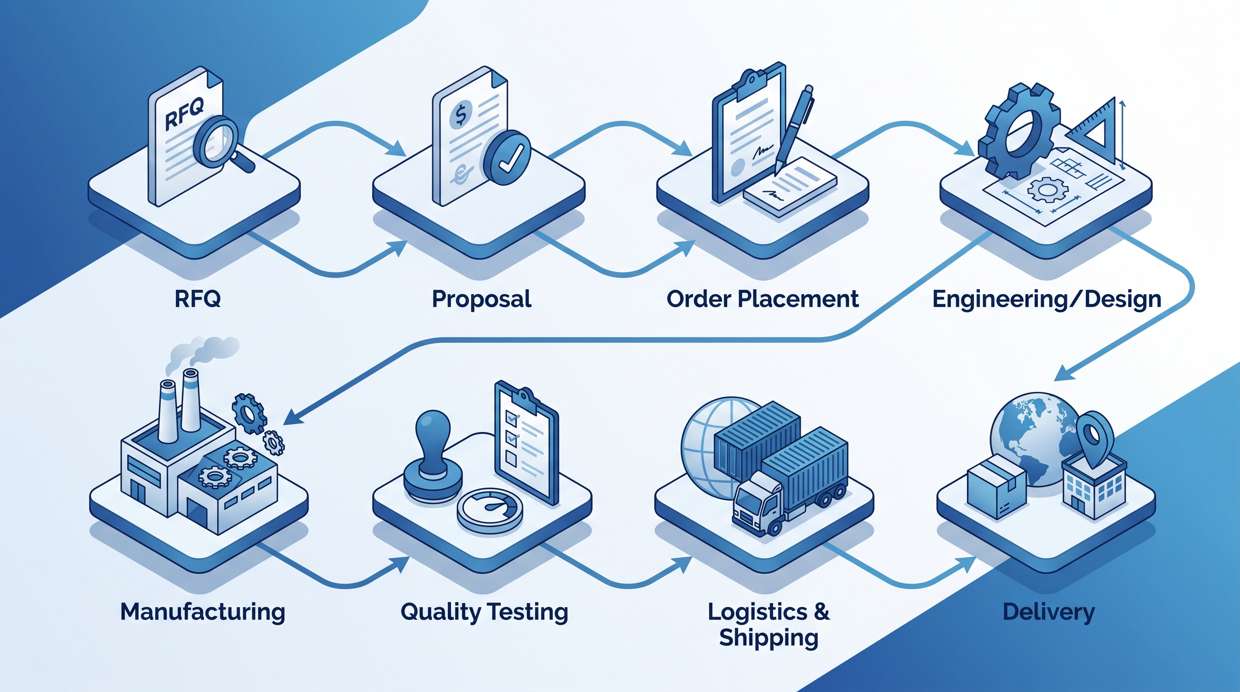
■ Typical Workflow from Quotation to Delivery
The table below shows the standard educational model for how international cable orders typically move. In practice, some projects add approval loops, sample validation, or country-specific document steps, but the core logic remains similar.
| Stage | What Happens | Main Buyer Focus | Main Risk if Missed |
|---|---|---|---|
| 1. RFQ / Inquiry | Buyer shares product request, project context, quantity, standards, and delivery expectations. | Make requirements complete and measurable. | Quote based on the wrong assumptions. |
| 2. Quotation | Supplier defines scope, product basis, assumptions, lead time, and support documents. | Check technical fit, not just price. | Hidden mismatch in product or scope. |
| 3. Technical Alignment | Datasheets, construction, marking, labeling, packing, and compliance details are reviewed. | Freeze critical details before execution. | Late changes that affect delivery and quality control. |
| 4. Order Confirmation | Formal order is checked against quote and executable scope. | Ensure order release matches approved requirements. | Execution gap between sales and production. |
| 5. Production Planning | Materials, slotting, testing, printing, and packaging are scheduled. | Check whether lead time is realistic. | Delay or material/setup mismatch. |
| 6. Manufacturing & QC | Cable is produced, inspected, tested, and traceability records are generated. | Confirm key acceptance points and identity control. | Nonconforming product or weak traceability. |
| 7. Pre-Shipment Preparation | Labels, reels, cartons, packing list, and dispatch readiness are checked. | Make goods easy to identify and receive correctly. | Shipment/document mismatch or handling errors. |
| 8. Dispatch & Delivery | Goods enter the logistics chain and move toward final destination and receipt. | Track transit, documents, and site readiness. | Goods arrive late, unclear, or not project-ready. |
■ Stage-by-Stage Control Points
1) RFQ / Inquiry: Define the Real Requirement
An RFQ should describe more than a cable family name. Terms such as “outdoor cable,” “armored fiber,” or “shielded data cable” are often not enough to support a reliable quotation. Engineers and buyers should define the application environment, structure needs, standard references, marking requirements, expected quantity, and destination conditions as early as possible.
If a requirement affects material, construction, test method, identification, or lead time, it belongs in the RFQ. Otherwise, the quotation may look acceptable but still be built on incomplete assumptions.
2) Quotation: Read It as a Control Document
A quotation should be reviewed as both a commercial and technical document. Teams should check whether the product description, assumptions, standards, customization scope, and lead-time basis are explicit. Price is important, but a lower quote that leaves critical items undefined often increases total project risk later.
| Review Item | What to Check | Why It Matters |
|---|---|---|
| Product description | Model, conductor/fiber count, shield, armor, jacket, OD range | Prevents quotation against the wrong product family |
| Standards / compliance | IEC, CPR, flame level, RoHS, project-specific rules | Avoids approval or acceptance rejection |
| Marking and labeling | Brand, meter mark, custom print, language, project ID | Supports site identification and receiving control |
| Packing method | Reel size, length tolerance, palletizing, protection method | Affects transport, storage, and installation efficiency |
| Lead-time basis | Standard item vs custom production, mixed-line dependencies | Prevents overly optimistic planning |
3) Technical Alignment: Freeze What Must Not Drift
Technical alignment is where many avoidable problems are prevented. This stage usually covers final datasheet review, construction details, conductor or fiber type, insulation and jacket material, color coding, print marking, test expectation, label format, and packaging method. For custom or project-specific cables, it may also include drawing confirmation, sample review, or pre-production approval.
4) Order Confirmation: Close the Gap Between Quote and Execution
Once the order is released, the formal order record should match the approved quotation and technical scope. Quantities, model references, marking instructions, shipment grouping, and destination requirements should all be visible in the executable record. Any item critical to installation, compliance, or traceability should appear in formal order documents rather than existing only in side communication.
5) Production Planning: Check Whether Lead Time Is Real
Lead time in cable supply is not only factory running time. It may also depend on raw material availability, custom compound preparation, print setup, testing, packing, and shipment scheduling. That is why production planning deserves its own review. Standard items and standard packaging usually move more predictably; custom color, custom marking, or multi-SKU project packaging usually need tighter scheduling discipline.
| Condition | Likely Effect on Delivery | Control Advice |
|---|---|---|
| Standard product + standard packing | Usually more predictable | Confirm whether supply is stock-based or production-based |
| Custom print marking | Adds setup dependency | Approve marking content early |
| Non-standard jacket color | May extend material planning cycle | Freeze color before order release |
| Project-specific compliance documents | May delay release or shipment preparation | Define document scope at quotation stage |
| Mixed SKUs in one delivery | One line item can delay the whole shipment | Review dependency by line and packing group |
6) Manufacturing and QC: Protect Identity and Traceability
During manufacturing, the goal is not just to produce cable, but to produce the approved cable and document that result clearly enough for inspection, receiving, and future reference. Depending on product type, control points may include incoming material checks, in-process inspection, dimensional verification, electrical or optical tests, print review, and final release inspection.
For project teams, the most important outputs are usually identity control, key performance records, and traceability by reel, batch, or lot. These reduce future disputes and improve maintainability after delivery.
7) Pre-Shipment Preparation: Make the Goods Easy to Receive Correctly
Pre-shipment preparation includes reel checks, label confirmation, quantity reconciliation, packing list preparation, dispatch marking, and shipment readiness review. This stage matters because warehouses and installation teams often interact first with the label and outer packaging, not with the quotation. If product identity is weak at this point, receiving becomes slower and mismatch claims become harder to resolve.
8) Dispatch and Delivery: Arrival Must Be Project-Ready
A shipment can leave on time and still create project problems if transit assumptions were optimistic, documents were incomplete, reels were not practical for site handling, or product identity was not clear enough for fast receiving. Experienced buyers therefore do not judge success only by dispatch status. They ask whether the goods arrive in a usable, identifiable, and installation-ready condition.
■ Decision Rules / Engineer’s Shortcut
The quickest way to reduce risk is to judge the health of the workflow at each handoff. The table below summarizes what a healthy process looks like and where warning signs usually appear.
| Situation | Healthy Process | Risky Process | Better Action |
|---|---|---|---|
| Quotation review | Scope and assumptions are explicit | Price is checked but scope stays vague | Review quote as both commercial and technical basis |
| Spec control | Critical items are frozen before production | Late changes continue after release | Apply formal change control to material details |
| Lead-time planning | Schedule reflects customization level | Timeline assumes every item is standard | Separate stock logic from make-to-order logic |
| QC and release | Identity, tests, and traceability are visible | Only final shipment status is tracked | Define acceptance points early |
| Pre-shipment control | Labels, counts, and packing are aligned | Shipping is treated as admin only | Check what the receiving team will actually see first |
■ Where Delays and Errors Usually Begin
In most project cable orders, problems do not start because nobody cared. They start because one assumption stayed unconfirmed for too long. A product family may have been named too broadly, a sheath marking may have been treated as a small detail, a packaging instruction may have remained informal, or a lead-time estimate may have been interpreted as fixed when it was still conditional.
Typical causes of delay and error include incomplete RFQs, unclear customization scope, late spec changes, underestimated document requirements, weak coordination between procurement and engineering, and shipment preparation that focuses on dispatch but not receiving readiness.
The more international, project-driven, or compliance-sensitive the order becomes, the more valuable a disciplined workflow becomes. Process clarity is not bureaucracy. It is part of cost control, compatibility control, and delivery reliability.
■ FAQ
Does a quotation mean the cable specification is already finalized?
Not always. A quotation may reflect the current understanding of the project, but marking, labeling, packaging, compliance scope, and some construction details may still need formal confirmation before production starts.
What is the biggest risk between quotation and delivery?
The biggest risk is loss of alignment. The quoted product, approved scope, production record, shipment identity, and delivered goods should all stay consistent. Once they drift apart, delay and dispute risk rises quickly.
Why should buyers care about packaging so early?
Because packaging affects transport protection, warehouse handling, receiving speed, and installation convenience. In long-distance supply, packaging is part of project execution, not just a shipping detail.
Why is lead time often misunderstood?
Because people sometimes treat lead time as machine running time only. In reality, it may include material readiness, customization, testing, packing, and shipment coordination as well.
Is this workflow only relevant for large bulk orders?
No. The same logic applies to smaller orders too. Larger orders simply make the cost of weak process control more visible and more expensive.
What should procurement and engineering each review most carefully?
Engineering should focus on structure, materials, standards, application fit, and compatibility. Procurement should focus on scope clarity, assumptions, lead-time basis, documents, labeling, packaging, and consistency across quotation, order, and shipment records.
■ Conclusion
International cable orders typically move through a predictable sequence from quotation to delivery, but predictable does not mean automatic. The strongest order workflows are built on early requirement clarity, disciplined technical confirmation, realistic production planning, visible traceability, and shipment preparation that supports receiving and installation rather than dispatch alone.
For engineers, procurement teams, and project managers, the objective is not simply to place an order. It is to preserve the original project requirement through every handoff until delivery is complete. That is what reduces mismatch risk, protects schedules, and improves execution quality in real-world cable projects.
ZION Communication supports engineers, buyers, and project teams with cable selection, documentation alignment, and order execution support across optical fiber, copper, and project-driven cable solutions.



 Fiber Optic Tools
Products 6 families
Solutions 6 markets
Resources Tools & docs
Certificate
Certification and compliance references for project review, qualification and purchasing documentation.
 Fiber Optic CableAccess and backbone
 Ethernet CableCat5e to Cat8
 Coaxial CableRF and video signal
 Fire, Security & AlarmSafety systems
 Voice, Audio & VideoSignal cabling
 Power & Control CableEnergy and control
Fiber optic cable systems
Outdoor, indoor, FTTH and distribution cable lines for access networks, backbone routes and campus deployments.
 Telecom & ISP NetworksFTTH, PON, ODN
  Data Center InfrastructureServer room cabling
  Building Low-Voltage SystemsBMS, AV, weak current
  Security & Fire ProtectionAlarm, CCTV, access
  Industrial Automation CablePLC, RS485, fieldbus
  Energy & Power InfrastructureSolar, battery, power
 Telecom & ISP Networks
For FTTH / PON access, outdoor fiber deployment, aerial routes, duct routes, direct burial routes, rural broadband and ODN planning.
Tools
Use calculators and planning tools for conduit capacity, PoE voltage drop and fiber optic link loss budget work.