How to Avoid Quantity Discrepancies in Bulk Cable Shipments
Author: Site Editor Publish Time: 20-04-2026 Origin: Site
How to Avoid Quantity Discrepancies in Bulk Cable Shipments
Quantity discrepancies in bulk cable shipments usually come from weak process control rather than obvious loss. In real projects, the biggest risks are unit confusion, mixed reel lengths, partial reel handling, packing-list drift, and poor final loading checks. For engineers, buyers, and project teams, the practical solution is to keep order quantity, production quantity, packed quantity, and shipped quantity aligned in the same unit across the same control points. When that logic is defined early and verified before container sealing, most shortage claims and receiving disputes can be prevented.
Most quantity disputes are caused by unit mismatch, reel-length confusion, or document inconsistency, not just missing goods.
The safest method is to control quantity at four stages: order definition, production release, packing confirmation, and loading verification.
For mixed SKUs, custom lengths, or container shipments, reel-level traceability and final loading checks should be treated as mandatory.
■ Why quantity discrepancies happen in bulk cable shipments
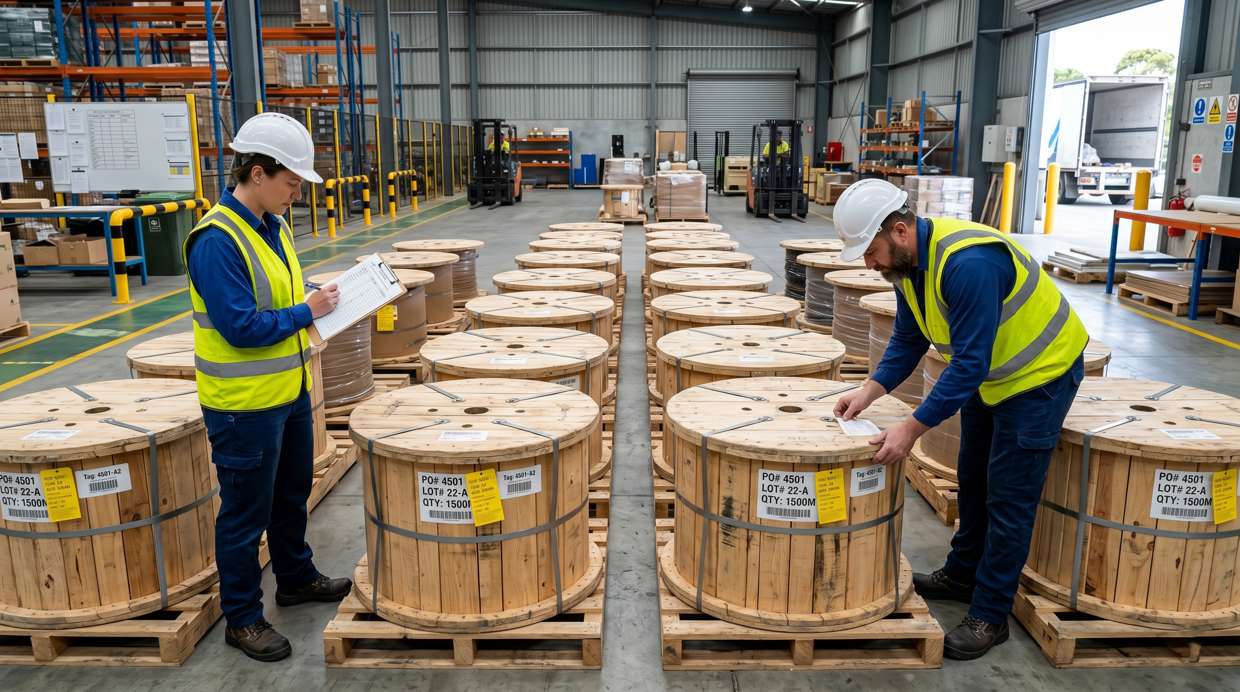
In bulk cable business, “quantity” may refer to meters, feet, reels, cartons, coils, or project cut lengths. That becomes risky when the purchase order, production worksheet, packing list, and shipping marks do not use the same logic. In practice, quantity discrepancies usually come from unit conversion, mixed reel lengths, late manual edits, or poor final loading checks. The real issue is not just counting more carefully; it is building a process where commercial quantity and physical shipment quantity stay aligned from quotation to container sealing.
■ What a quantity discrepancy really means
A quantity discrepancy does not always mean a supplier shipped less cable than ordered. It can also mean the documents use the wrong unit, the packed reel lengths do not match the agreed plan, or the total shipment is correct but the item split is wrong. For receiving teams, this difference matters because the counting method determines whether the problem is a shortage claim, a documentation mismatch, or a deployment risk.
| Discrepancy Type | What It Looks Like | Typical Root Cause | Operational Risk |
|---|---|---|---|
| Unit mismatch | PO shows meters, shipping papers show reels | Unit not frozen early | Receiving team cannot verify quickly |
| Reel-length mismatch | Correct reel count but wrong total length | Mixed standard and custom lengths | Site deployment disruption |
| Partial quantity omission | Small balance not packed or not listed | Weak final consolidation control | Short shipment claim |
| Document mismatch | Packing list, invoice, and labels do not match | Late manual file edits | Customs and reconciliation delays |
| SKU mix-up | Total quantity looks correct but item split is wrong | Similar reels or poor staging segregation | Wrong cable reaches the field |
■ Common causes in bulk cable projects
Sales talks in meters, warehouse counts reels, and shipping papers show cartons. If those units are not linked, discrepancy risk rises immediately.
Project shipments often combine fixed reel sizes and special cuts. Without separate line control, the shipment may be numerically correct but operationally wrong.
Indoor and outdoor cables, fiber and copper items, or same-color jackets can be mixed if staging and label discipline are weak.
Once warehouse activity starts, hand-edited packing documents often drift away from what is physically loaded.
■ Four-stage quantity control framework
The most reliable way to prevent quantity discrepancies is to control the same order at four linked checkpoints: order definition, production release, packing confirmation, and loading verification. Each stage should use the same quantity basis and the same SKU logic.
| Stage | Main Objective | What Must Be Confirmed | If Missed |
|---|---|---|---|
| 1. Order definition | Freeze commercial quantity logic | Unit, line quantity basis, standard reel rule, tolerance, partial reel policy | PO and shipment papers will not reconcile |
| 2. Production release | Tie finished goods to the order | Reel number, batch, actual length, product model, destination order | Weak traceability and higher mix-up risk |
| 3. Packing confirmation | Build documents from actual packed goods | Reel/carton counts, line quantity, package identity, special cuts | Packing list drift |
| 4. Loading verification | Confirm what physically enters the shipment | Loaded count, SKU separation, visible marks, photos, final seal record | Last-minute omissions become shipment claims |

| Control Item | What to Confirm Before Production | Why It Matters |
|---|---|---|
| Unit of measure | Meter, foot, reel, carton, or piece | Avoids cross-team counting mismatch |
| Line quantity basis | Total length, reel count, or cut-length schedule | Keeps PO and shipment logic aligned |
| Tolerance rule | Allowed or not allowed, per reel or per order | Prevents avoidable shortage disputes |
| Partial reel policy | Allowed, separately marked, or prohibited | Protects receiving-side verification |
| Label content | SKU, reel number, actual length, batch, shipment reference | Supports fast traceability after dispatch |
■ Decision rules: when basic control is enough and when strict control is necessary
Not every cable shipment needs the same control depth. The right level depends on order size, packaging complexity, similarity between SKUs, and the cost of field disruption if something is wrong.
| Shipment Scenario | Recommended Control Level | Why | Main Risk if Under-Controlled |
|---|---|---|---|
| Single SKU, fixed standard reels, small volume | Basic control | Low complexity and easy receiving | Minor document ambiguity |
| Multiple SKUs with similar packaging | Medium control | Higher chance of allocation mistakes | Wrong item split |
| Custom cut lengths for projects | Strict control | Site installation depends on length accuracy | Deployment delay and rework |
| Mixed fiber and copper shipment in one container | Strict control | High visual similarity and multiple unit types | Receiving confusion and claim difficulty |
| Multi-site or multi-country delivery split | Strict control | Errors become harder to trace after dispatch | Long dispute cycle and extra logistics cost |
The order contains custom cut lengths or special reel schedules.
Multiple similar cable models are shipped together.
The shipment is containerized and difficult to recount on arrival.
One missing line item could delay a site milestone or installation team.
The receiving side has limited technical inspection capability.
■ Pre-shipment quantity verification checklist
The last checkpoint before container sealing is the best place to prevent a future shortage claim. At this stage, the question is simple: does the physical loading match the approved packing record in the same SKU and the same unit?
| Checkpoint | What to Verify | Minimum Good Practice | Better Practice |
|---|---|---|---|
| Reel count | Number of reels loaded vs packing list | Manual count | Manual count plus reel-number log |
| Carton or pallet count | Package count vs approved document | Physical count | Count plus photo evidence |
| SKU separation | Correct item split and staging logic | Visual separation | Staging map plus scan/check record |
| Label visibility | SKU, length, reel number, batch reference | Visible tags on major packages | Tagged and photographed before loading |
| Final evidence | Proof of actual loading status | Container photos | Photos, loading log, and seal record archived together |
Final packing list, reel or carton breakdown, visible labels, note of any partial reels, and loading photos for higher-risk orders.
One quantity logic from sales to packing, reel-level identification, packing records based on actual packing activity, and a final loading checklist.
■ FAQ
No. Reel count is only reliable when every reel follows the same confirmed standard length and the order was placed on that same basis. In mixed or custom projects, total length and reel identity both matter.
Not always. For small standard orders, line-level packing detail may be enough. For container shipments, custom cut lengths, or mixed SKUs, reel-level or package-level detail is strongly recommended.
It can support verification, but it should not be the only method. Drum type, packaging, and cable construction can all change shipment weight without proving exact usable quantity.
In many projects, the biggest source is not actual shortage but inconsistent logic between the PO, production record, packing list, and physical package labels.
No. Partial reels are manageable when they are approved in advance, shown separately in the packing documents, and clearly identified on the physical labels.
Use a unified quantity unit, assign reel or package IDs, generate packing data from actual packing activity, and keep loading photos and final records together for the shipment file.
■ Conclusion
To avoid quantity discrepancies in bulk cable shipments, the key is not a single final recount. The real solution is a control process that keeps order quantity, production quantity, packed quantity, and shipped quantity aligned from the start. For engineers, buyers, and project teams, the most practical rule is simple: define the unit early, keep reel or package traceability visible, build documents from actual packing data, and verify loading before shipment release. When these controls are in place, most quantity disputes can be prevented before they turn into receiving delays, shortage claims, or project disruption.
ZION Communication supports OEM and project-based cable orders with practical shipment coordination for quantity visibility, packaging traceability, and export documentation control.



 Fiber Optic Tools
Products 6 families
Solutions 6 markets
Resources Tools & docs
Certificate
Certification and compliance references for project review, qualification and purchasing documentation.

 Fiber Optic CableAccess and backbone
 Ethernet CableCat5e to Cat8
 Coaxial CableRF and video signal
 Fire, Security & AlarmSafety systems
 Voice, Audio & VideoSignal cabling
 Power & Control CableEnergy and control
Fiber optic cable systems
Outdoor, indoor, FTTH and distribution cable lines for access networks, backbone routes and campus deployments.
 Telecom & ISP NetworksFTTH, PON, ODN
  Data Center InfrastructureServer room cabling
  Building Low-Voltage SystemsBMS, AV, weak current
  Security & Fire ProtectionAlarm, CCTV, access
  Industrial Automation CablePLC, RS485, fieldbus
  Energy & Power InfrastructureSolar, battery, power
 Telecom & ISP Networks
For FTTH / PON access, outdoor fiber deployment, aerial routes, duct routes, direct burial routes, rural broadband and ODN planning.
Tools
Use calculators and planning tools for conduit capacity, PoE voltage drop and fiber optic link loss budget work.