How to Choose Shielded Ethernet Cable for Noisy Environments | EMI Guide for Industrial & Commercial Networks
Author: Site Editor Publish Time: 15-04-2026 Origin: Site
How to Choose Shielded Ethernet Cable for Noisy Environments
Shielding makes the most sense where motors, VFDs, power cables, contactors, or dense 10G pathways increase EMI risk.
Shielded cable only delivers full value when the entire channel stays shielded and properly bonded.
For many new noisy-environment projects, shielded Cat6A is the safest long-term default.
■ 1) What Counts as a Noisy Environment?
A noisy environment is any installation area where Ethernet cabling is exposed to meaningful electromagnetic interference from nearby electrical equipment, mixed power routing, or dense cable pathways. Typical examples include factories, production lines, control cabinets, transport systems, machine rooms, utility areas, and industrial buildings where motors, drives, contactors, power supplies, lighting systems, or long parallel runs near power conductors can affect link stability.
For engineers and buyers, the key issue is not whether interference exists in theory, but whether it is strong enough to reduce network margin, increase retries, create intermittent faults, or limit future bandwidth upgrades. That is why shielding should be treated as a project-level decision rather than a checkbox on a cable datasheet.
| Environment | Typical Noise Sources | Shielding Priority | Why It Matters |
|---|---|---|---|
| Standard office | Low EMI, controlled pathways | Low | UTP is often sufficient if pathway discipline is good |
| Commercial equipment room | Power distribution, dense bundles | Medium | Shielding may improve margin, especially for higher-speed copper links |
| Control cabinet / machine zone | VFDs, motors, relays, contactors | High | Classic high-EMI condition where shielding usually adds practical value |
| Mixed industrial pathway | Parallel power routing, machinery, long runs | High | Noise risk increases when power and data separation is limited |

■ 2) When Is Shielded Ethernet Worth It?
Shielded Ethernet cable is worth the added cost and installation discipline when the site has real EMI exposure, uptime sensitivity, future speed requirements, or limited pathway separation from electrical systems. In those cases, the extra shielding layer helps maintain signal integrity and reduce the risk of unstable links, unexpected packet loss, or troubleshooting-heavy maintenance.
By contrast, shielded cable is often over-specified in low-noise office spaces where grounding discipline is poor and the actual interference risk is low. In that situation, buyers may pay more for cable, connectors, and labor without gaining meaningful long-term benefit.
| Project Condition | Recommended Direction | Risk if Misjudged |
|---|---|---|
| Light commercial / office | Use quality UTP unless shielding is clearly required | Overspending with little practical return |
| Industrial area with electrical equipment nearby | Specify shielded cable and shielded connectivity | Intermittent faults and weak noise margin |
| 10G-ready structured cabling | Favor Cat6A, often shielded | Lower headroom for future upgrades |
| Poor grounding / weak installation control | Correct bonding discipline before standardizing shielded channels | Shielded system underperforms and becomes harder to maintain |
■ 3) Understanding Shield Types
Buyers often use STP as a catch-all label, but shielded Ethernet cables are not all built the same. The real question is how much shielding the project needs and how much installation complexity the team can manage. For moderate EMI, an overall foil shield may be enough. For harsher conditions, stronger pair isolation or combined shielding structures may be more appropriate.
How to read the main shield constructions
| Type | Construction | Best Use Case | Practical Comment |
|---|---|---|---|
| U/UTP | No shield | Clean office and light commercial areas | Lowest complexity, but limited EMI protection |
| F/UTP | Overall foil around all four pairs | Moderate EMI, structured building cabling | Good balance between protection and cost |
| U/FTP | Each pair individually foil-shielded | Higher pair isolation and stronger noise control | Useful when interference is more demanding |
| S/FTP | Overall braid plus shielded pairs | Heavy EMI and higher-risk industrial conditions | High protection, but highest installation complexity |

■ 4) Choosing Cat5e, Cat6, or Cat6A
In noisy environments, the category decision should consider both current speed and future headroom. Lower categories may still work for legacy 1G links or short industrial runs, but many new projects now need better margin for 10G migration, high-density pathways, and long-term infrastructure value. That is why shielded Cat6A is often the safest default for modern noisy-environment deployments.
For procurement teams, this is also a lifecycle decision. Saving cost with a lower-category cable may look attractive in the short term, but it can increase upgrade risk, re-cabling costs, or long-term compatibility constraints.
| Cable Category | Typical Fit | Strength | Limit |
|---|---|---|---|
| Cat5e | Legacy 1G links, lower-speed devices | Lower material cost | Limited future bandwidth margin |
| Cat6 | General industrial or commercial upgrades | Better performance headroom than Cat5e | May not be the safest long-term answer for new high-performance builds |
| Cat6A | 10G-ready, future-focused, noisy environments | Best long-term margin for many new projects | Higher cable size, cost, and termination discipline |
■ 5) Grounding and Full-Channel Design
This is where many projects go wrong. A shielded cable does not deliver full value if the rest of the channel is unshielded, poorly terminated, or inconsistently bonded. In practice, the shielding path should remain continuous through the cable, connector, jack, patch panel, patch cord, and cabinet grounding arrangement wherever shield continuity is required by the design.
In other words, shielded cabling is a system decision. Buying only shielded bulk cable while mixing it with unshielded accessories often creates extra cost without delivering the expected immunity benefit.
| Channel Element | Recommended Requirement | Why It Matters |
|---|---|---|
| Bulk cable | Shield construction matched to EMI level | Sets the base protection level |
| Jacks / plugs | Shielded hardware where required | Maintains continuity at termination points |
| Patch panel | Shielded panel with clear bonding path | Avoids broken shielding path in the rack |
| Patch cords | Shielded patch cords if the design requires full continuity | Prevents weak points in the channel |
| Grounding / bonding | Verified cabinet and system grounding discipline | Without this, the shielded system may not perform as intended |
■ 6) Installation and Environment Checks
Even a good cable choice can underperform if installation quality is weak. In noisy environments, pathway separation, bend control, termination quality, conductor type, and environmental protection all affect real-world results. That is especially important for industrial or building projects where the cable may also face temperature variation, oil exposure, UV, vibration, or repeated routing constraints inside cabinets and trays.
What to confirm before placing the order
| Checkpoint | What to Review | Procurement Impact |
|---|---|---|
| Run environment | Indoor, outdoor, tray, conduit, cabinet, mixed power pathway | Affects jacket, protection level, and compliance needs |
| Bandwidth target | 1G, multi-gig, or 10G | Drives category selection and lifecycle cost |
| EMI severity | Distance to motors, VFDs, contactors, power cables | Determines whether shielding is optional or necessary |
| Grounding readiness | Cabinet bonding, rack grounding, installer discipline | Affects whether a shielded system will work properly |
| Mechanical / environmental load | Oil, UV, flame, abrasion, flexing, LSZH needs | Prevents specifying a cable that is electrically correct but physically wrong |
■ 7) Engineer’s Shortcut
For fast project decisions, use the table below to decide when shielded Ethernet is the right answer, when it is not, and what the likely trade-offs will be.
| Choose This | When to Choose It | When Not to Choose It | Alternative | Cost / Risk / Maintainability Impact |
|---|---|---|---|---|
| UTP | Clean office environment with controlled pathways | EMI sources are close or future 10G margin matters | F/UTP or Cat6A shielded | Lowest cost, easiest maintenance, lowest EMI protection |
| F/UTP Cat6A | Moderate EMI, structured cabling, future-ready networks | Extreme industrial noise or harsh machinery zones | U/FTP or S/FTP | Good balance of lifecycle value and practical installability |
| U/FTP | Higher pair isolation and better noise control are needed | Budget or termination simplicity is the top priority | F/UTP | Higher material and labor discipline, stronger performance margin |
| S/FTP | Severe EMI and high-risk industrial conditions | Grounding and installation control are weak | Fix infrastructure discipline first | Highest protection, but highest complexity and commissioning demand |
| Shielded industrial-rated cable | Machine networks, control cabinets, harsh physical environments | The site is clean and standard building cable is enough | Standard structured LAN cable | Better long-term reliability if the environment truly requires it |
■ 8) FAQ
Is shielded Ethernet always better than UTP?
No. Shielded Ethernet is better when the site has meaningful EMI exposure, stronger performance requirements, or future bandwidth pressure. In low-noise office spaces, UTP may be the more practical and cost-effective option.
What is the biggest mistake when buying shielded cable?
The most common mistake is treating shielding as a cable-only feature. A shielded system should be designed as a full channel, including compatible connectors, shield continuity, and a proper bonding path.
Should I choose Cat6A for noisy environments?
In many new projects, yes. Cat6A is usually the safest long-term default when the site may need 10G readiness, higher margin, or longer infrastructure life in EMI-sensitive conditions.
Can I use shielded bulk cable with unshielded connectors?
You can physically do it, but it weakens the system concept and may reduce the practical benefit of choosing shielded cable in the first place. For high-EMI projects, full channel consistency is usually the better choice.
What information should I send to a cable supplier before requesting a quote?
Send the application environment, required bandwidth, installation method, run length, proximity to power or machinery, grounding conditions, jacket requirements, flame rating needs, and whether the full channel must remain shielded.
■ 9) Conclusion
Choosing shielded Ethernet cable for noisy environments is not a matter of buying the most expensive cable on the list. The correct decision depends on EMI severity, bandwidth target, pathway conditions, grounding readiness, and long-term maintenance expectations. For many modern projects, shielded Cat6A is the most defensible default because it offers stronger future margin and better fit for higher-performance networks. But even the best shielded cable will not perform as expected if the channel is incomplete or the bonding discipline is weak.
The most practical approach is to evaluate the site first, define the real noise level, confirm the grounding strategy, and then match shield construction, category, and jacket type to the application. That reduces deployment risk, avoids false economy, and makes the final specification easier to defend for both engineering and procurement teams.
Application environment: office, control cabinet, factory, outdoor, mixed pathway
Required speed: 1G, multi-gig, or 10G
Run length and installation method
Distance from power cables, motors, VFDs, or other EMI sources
Grounding and bonding conditions
Jacket, flame rating, LSZH, oil resistance, or UV requirements



 Fiber Optic Tools
Products 6 families
Solutions 6 markets
Resources Tools & docs
Certificate
Certification and compliance references for project review, qualification and purchasing documentation.

 Fiber Optic CableAccess and backbone
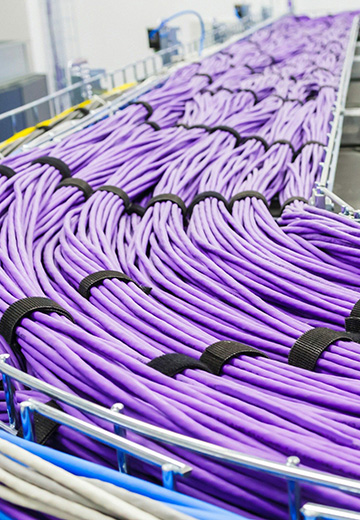
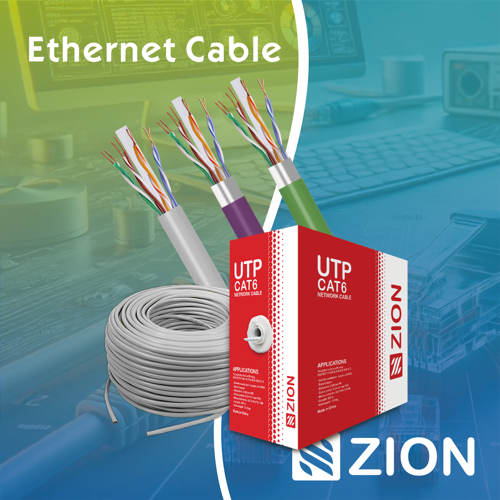 Ethernet CableCat5e to Cat8
 Coaxial CableRF and video signal
 Fire, Security & AlarmSafety systems
 Voice, Audio & VideoSignal cabling
 Power & Control CableEnergy and control
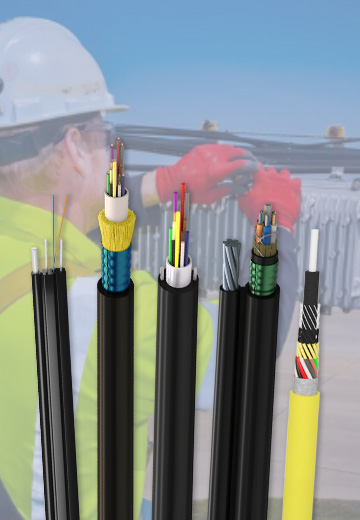
Fiber optic cable systems
Outdoor, indoor, FTTH and distribution cable lines for access networks, backbone routes and campus deployments.
 Telecom & ISP NetworksFTTH, PON, ODN
  Data Center InfrastructureServer room cabling
  Building Low-Voltage SystemsBMS, AV, weak current
  Security & Fire ProtectionAlarm, CCTV, access
  Industrial Automation CablePLC, RS485, fieldbus
  Energy & Power InfrastructureSolar, battery, power
 Telecom & ISP Networks
For FTTH / PON access, outdoor fiber deployment, aerial routes, duct routes, direct burial routes, rural broadband and ODN planning.
Tools
Use calculators and planning tools for conduit capacity, PoE voltage drop and fiber optic link loss budget work.