MPO-8 vs MPO-12 vs MPO-24: Which Fiber Count Should You Choose
Author: James Publish Time: 19-03-2026 Origin: Site
MPO-8 vs MPO-12 vs MPO-24: Which Fiber Count Should You Choose?
A practical decision guide for engineers, buyers, and project teams comparing MPO-8, MPO-12, and MPO-24 by bandwidth mapping, density, migration logic, cost structure, and deployment risk.
Choose MPO-8 when the channel is built around 8-fiber parallel optics and utilization efficiency matters most.
Choose MPO-12 when you need the most universal, modular, and procurement-friendly structured cabling option.
Choose MPO-24 when backbone density, future expansion, and trunk reduction outweigh simplicity.
■ 1) What MPO-8, MPO-12, and MPO-24 Mean
MPO fiber count refers to the number of fiber positions inside the connector ferrule. In practical terms, MPO-8 has 8 fiber positions, MPO-12 has 12, and MPO-24 has 24. The number does not automatically mean “better” or “higher performance.” It mainly defines how the connector aligns with specific optical architectures and how efficiently the cabling plant supports present and future links.
For structured cabling teams, the decision is rarely only about one transceiver generation. It also affects trunk design, cassette compatibility, pathway usage, migration cost, and operational clarity in the field.
| Fiber Count | Basic Definition | Typical Strength | Typical Limitation |
|---|---|---|---|
| MPO-8 | 8 fiber positions in one connector | High efficiency for 8-fiber parallel optics | Less universal in legacy modular cabling systems |
| MPO-12 | 12 fiber positions in one connector | Most common, flexible, and easy to source | May leave fibers unused in 8-fiber channels |
| MPO-24 | 24 fiber positions in one connector | Higher density and stronger trunk aggregation | Higher planning and management complexity |

■ 2) Bandwidth Mapping for 40G / 100G / 400G
The most important selection logic is how fiber count maps to actual transceiver architecture. In many deployments, 40G and 100G parallel optics use an 8-fiber transmission pattern. That is why MPO-8 often looks attractive. However, structured cabling plants are not built only for one active optic generation, so MPO-12 and MPO-24 remain common where modularity and migration matter.
| Speed / Scenario | Typical Channel Logic | Best-Fit Fiber Count | Engineering Note |
|---|---|---|---|
| 40G SR4 | Commonly built around 8-fiber parallel optics | MPO-8 | Efficient channel utilization with minimal unused fibers |
| 100G SR4 | Also commonly aligned with 8-fiber parallel architecture | MPO-8 or MPO-12 | MPO-12 remains common in modular plants despite possible unused positions |
| 400G migration planning | More architecture variation and higher density requirements | MPO-12 or MPO-24 | Selection depends on trunk density and future scale, not just one optic type |
| Large-scale backbone | Aggregation, breakout, and trunk reduction priorities | MPO-24 | Useful where pathway space and connector count must be reduced |

Why mapping errors happen
A frequent mistake is assuming that the same fiber count that fits today’s optics is automatically the best infrastructure choice. In reality, a short-term efficient channel can become a long-term migration constraint if cassettes, trunks, and future expansion plans were not considered at the start.
■ 3) Density, Architecture, and Cable Logic
Density should be evaluated at two levels. The first is channel density, meaning whether the active application uses all available fibers efficiently. The second is system density, meaning how many trunks, patching points, and rack units are required across the whole project.
MPO-8 is efficient in 8-fiber applications, but MPO-12 frequently offers a stronger ecosystem of cassettes, harnesses, and modular patching options. MPO-24 can reduce the number of trunks required in large deployments, but higher density also increases sensitivity to labeling, cleaning discipline, polarity management, and installation quality.
| Fiber Count | Channel Efficiency | System Modularity | Backbone Density | Operational Complexity |
|---|---|---|---|---|
| MPO-8 | High in SR4-style channels | Moderate | Moderate | Low to moderate |
| MPO-12 | Moderate in 8-fiber channels | High | High | Moderate |
| MPO-24 | Depends on architecture | High in designed systems | Very high | Moderate to high |
■ 4) Cost Structure and Deployment Risks
The cheapest connector on paper is not always the lowest-cost system in operation. Component pricing, trunk count, cassette count, installation labor, spare strategy, migration rework, and stranded fiber all influence total project cost.
Component cost vs system cost
MPO-8 may look efficient at channel level, especially when every fiber is used. MPO-12 often benefits from broader market availability and smoother sourcing. MPO-24 may carry more planning burden or assembly complexity, but it can reduce the number of trunks and patching points in high-density designs.
| Selection Factor | MPO-8 | MPO-12 | MPO-24 |
|---|---|---|---|
| Initial component simplicity | Good for direct SR4-oriented links | Very good due to common market support | Moderate |
| Risk of unused fibers | Low in 8-fiber systems | Moderate in some SR4 deployments | Architecture dependent |
| Migration flexibility | Moderate | High | High in planned dense systems |
| Installation discipline required | Moderate | Moderate | High |
| Best cost logic | When utilization efficiency is the main goal | When sourcing flexibility and reusability matter | When reducing trunk count and scaling infrastructure matter |
■ 5) Decision Rules / Engineer’s Shortcut
For fast technical review, use the table below as a shortcut. It is not a replacement for a full channel design, but it works well during early project filtering, RFQ review, and backbone architecture planning.
| Project Condition | Recommended Choice | Why It Fits | Watch-Out Point |
|---|---|---|---|
| 40G / 100G SR4-focused deployment | MPO-8 | Good fiber utilization and clean mapping | Check future modular migration strategy |
| Mixed-speed structured cabling plant | MPO-12 | Common ecosystem, better procurement flexibility | Some channels may not use all fibers |
| Large-scale backbone with limited pathway space | MPO-24 | Higher aggregation density and fewer trunks | Requires stronger planning and labeling control |
| Procurement-led project needing universal availability | MPO-12 | Easier sourcing across trunks, cassettes, and harnesses | Validate channel utilization vs cost expectations |
| Growth-oriented data center backbone | MPO-24 or MPO-12 | Depends on whether density or modular flexibility is the top goal | Do not decide without migration roadmap |
■ 6) Application Scenarios
Different project types usually point toward different default decisions. The following table is useful for sales engineers, bid teams, and system designers aligning technical logic with real application context.
| Application Scenario | Preferred Fiber Count | Reason | Procurement / Design Note |
|---|---|---|---|
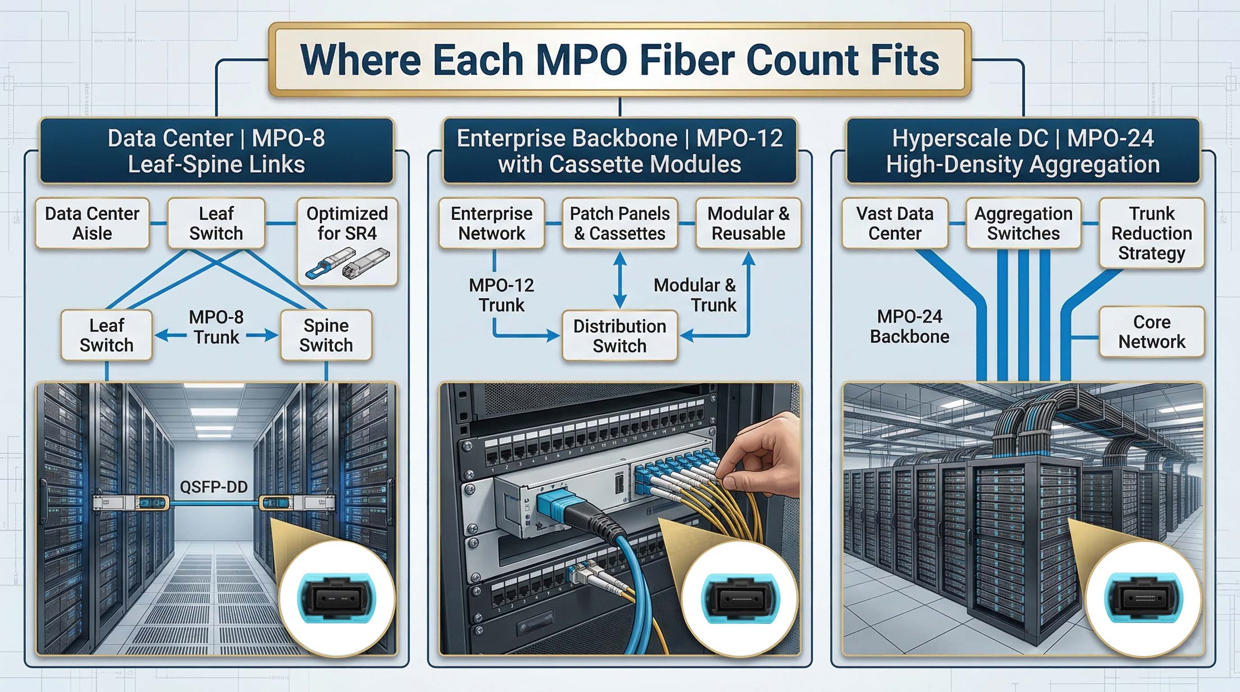
| Data center leaf-spine links using SR4 optics | MPO-8 | Fits 8-fiber parallel optics efficiently | Confirm future breakout and patching plan |
| Enterprise backbone with mixed legacy and modern links | MPO-12 | Most balanced for modular structured cabling | Often easiest to standardize across sites |
| High-density colocation or hyperscale backbone | MPO-24 | Reduces trunk count and improves pathway efficiency | Needs stronger operations discipline |
| RFQ-driven projects with uncertain final optics mix | MPO-12 | Safer for broad compatibility and market sourcing | Useful where project scope may evolve during execution |
■ 7) Common Mistakes to Avoid
Choosing only for today’s transceiver
A design that looks perfect for one active application may create friction when the site adds new speed layers, different breakout structures, or denser backbone zones.
Ignoring stranded fiber economics
Unused positions are not always a problem, but they must be intentional. In some cases they are a worthwhile tradeoff for modularity. In other cases they quietly inflate cost.
Underestimating operational complexity
As density increases, the burden on labeling, cleaning, polarity control, and test discipline also increases. MPO-24 is valuable, but only when the site can manage it properly.
■ 8) FAQ
■ 9) Conclusion
There is no universal best choice between MPO-8, MPO-12, and MPO-24. The correct answer depends on whether your priority is channel efficiency, structured cabling flexibility, or backbone density and migration scale.
Use MPO-8 when your design is centered on 8-fiber parallel optics. Use MPO-12 when you need the safest and most versatile mainstream option for structured cabling. Use MPO-24 when density, trunk reduction, and long-horizon expansion matter more than simplicity.
For engineering teams, the most reliable method is to choose the fiber count only after confirming optics mapping, trunk strategy, cassette architecture, and future migration thresholds. That is the difference between a connector decision and a system decision.
Send your target application speed, fiber type, connector format, trunk length, polarity method, and deployment scenario. ZION can help align the right MPO solution with your bandwidth, density, and migration requirements.