What PI, PO, BOP, and ETD Mean in International Cable Orders
Author: Site Editor Publish Time: 20-04-2026 Origin: Site
PI, PO, BOP, ETD: Common Terms in International Cable Orders
A practical reference for engineers, buyers, project managers, and system integrators who need to understand how key order and shipment terms affect specification control, document alignment, delivery timing, and project risk in international cable procurement.
PI, PO, BOP, and ETD are not just trade abbreviations; they are control points that affect document accuracy, production release, and shipment timing.
In cable orders, the safest approach is to cross-check PI, PO, approved specifications, packing requirements, and shipping milestones as one linked workflow.
BOP should always be defined in plain language, and ETD should never be treated as the same thing as arrival date, customs clearance, or site-ready delivery.
In international cable orders, terms such as PI, PO, BOP, and ETD often appear in quotation review, order confirmation, production release, and shipment planning. For engineers, buyers, and project teams, these abbreviations are not minor trading jargon. They affect whether the right cable is approved, whether the supplier and buyer are aligned on quantity and packaging, whether shipment can be released on time, and whether the project schedule is based on realistic logistics assumptions. This page explains what each term usually means, where it fits in the cable order process, and how to reduce risk before goods move.
■ What PI, PO, BOP, and ETD Mean
In most international cable transactions, these terms work as practical checkpoints between technical alignment, commercial confirmation, production control, and shipment execution. The exact wording may vary by supplier or buyer system, but the core logic is usually similar.
| Term | Full Meaning | What It Usually Refers To | Why It Matters |
|---|---|---|---|
| PI | Proforma Invoice | A preliminary commercial confirmation document issued before final shipment documentation | Helps confirm order scope, quantity, remarks, trade basis, and pre-production alignment |
| PO | Purchase Order | The buyer’s formal order instruction | Locks the ordered model, quantity, project reference, and purchasing scope |
| BOP | Usually Balance of Payment / Balance Payment | The remaining payment milestone under the agreed order process | Can affect shipment release, dispatch readiness, and commercial clearance |
| ETD | Estimated Time of Departure | The planned departure date of the shipment from origin | Critical for project scheduling, receiving plans, transit calculation, and downstream installation timing |
■ Why These Terms Matter in Cable Orders
Cable orders often involve more specification and execution detail than buyers first expect. The order may include conductor size, insulation and jacket material, shielding structure, fire performance, print marking, reel length, packing format, test documents, and destination-specific labels. That means one document mismatch or one misunderstood shipment term can create a much larger production or logistics problem later.
■ What Is a PI?
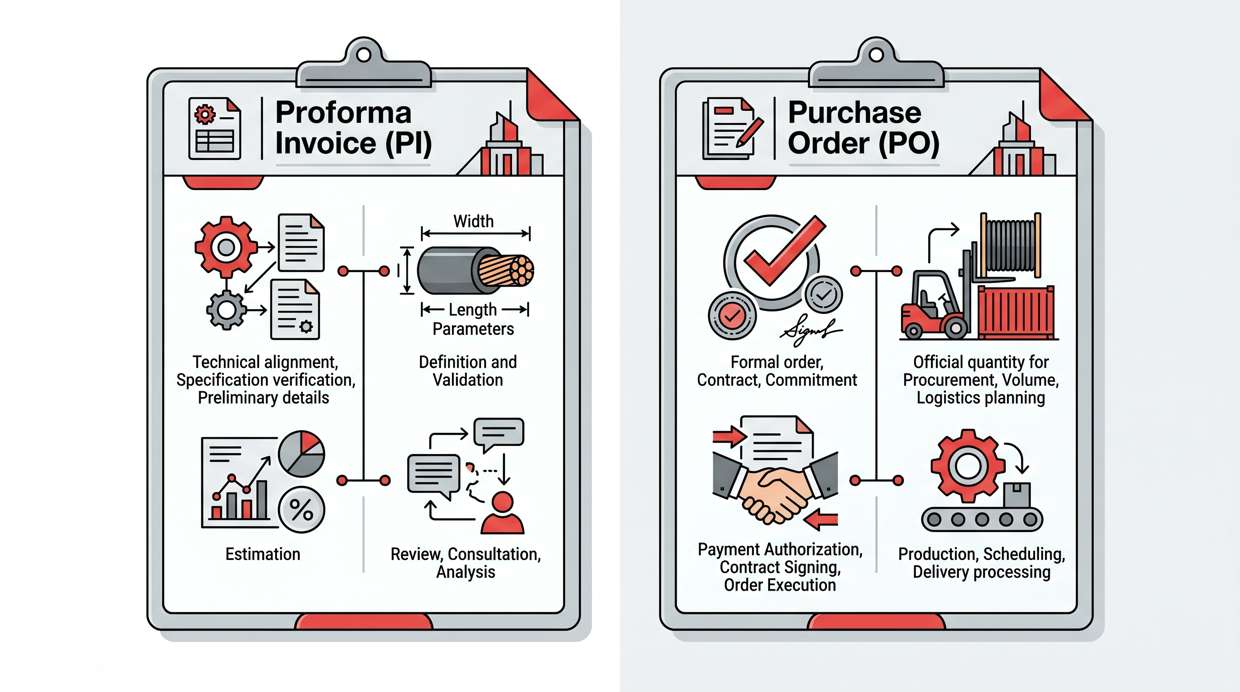
A PI, or Proforma Invoice, is usually the supplier’s preliminary commercial confirmation document. In international cable orders, it is often used for internal buyer approval, order review, and pre-production alignment. It should not be treated as a simple pricing sheet only. In many real workflows, it functions as a bridge between technical scope and commercial execution.
| PI Check Point | Why It Matters | Typical Risk if Overlooked |
|---|---|---|
| Product description | Confirms model and construction basis | Wrong cable type or incomplete scope enters production |
| Quantity and unit | Avoids mismatch in meters, reels, drums, or pieces | Packing and fulfillment errors |
| Technical reference | Links the order to approved data or drawing | Buyer and supplier assume different structures |
| Packing note | Supports shipment and site handling alignment | Reel size, loading, or handling problems |
| Remarks and validity | Clarifies order boundaries and process assumptions | Later disputes over what was actually approved |
■ What Is a PO?
A PO, or Purchase Order, is the buyer’s formal order document. In cable procurement, it should do more than state a product name and quantity. It should clearly define what is being ordered and point back to the right technical approval basis. That is especially important when the cable is customized, project-specific, or tied to a formal document workflow.
| PO Element | What It Should Clarify | Why It Matters |
|---|---|---|
| Exact product name or code | The cable family and ordered design basis | Prevents substitution ambiguity |
| Quantity format | Meters, kilometers, reels, drums, or sets | Avoids fulfillment confusion |
| Revision reference | Links to the latest approved drawing or spec | Reduces outdated revision risk |
| Delivery expectation | Requested shipment timing or delivery window | Helps logistics and project planning |
| Special notes | Print marking, color, testing, packing, or document requests | Reduces change requests and approval gaps later |
A common problem is that the quotation and technical files are detailed, but the PO uses a simplified line such as “optical cable” or “fire resistant cable.” In project work, that is usually too broad. The PO should either contain the exact approved specification or clearly reference the right document set.
■ What Does BOP Usually Mean?
In many export cable workflows, BOP usually refers to the balance payment or the remaining payment stage under the agreed order process. It is not a technical term, but it can affect shipment release, dispatch coordination, and internal order completion. Because companies may use it differently, buyers should confirm the exact operational meaning rather than rely on abbreviation alone.
■ What Is ETD?
ETD, or Estimated Time of Departure, is the planned date when cargo leaves the origin port, terminal, or dispatch point. It is one logistics milestone, not the entire delivery timeline. In cable projects, ETD should be read together with transit time, ETA, customs handling, inland transfer, and site receiving plans.
| Milestone | What It Means | What It Does Not Mean |
|---|---|---|
| ETD | Planned departure from origin | Arrival, customs release, or site delivery |
| ETA | Estimated arrival at destination | Factory completion or unloading clearance |
| Production completion | Goods finished in factory | Same as booked vessel departure |
| Document readiness | Shipping documents prepared | Cargo has already departed |

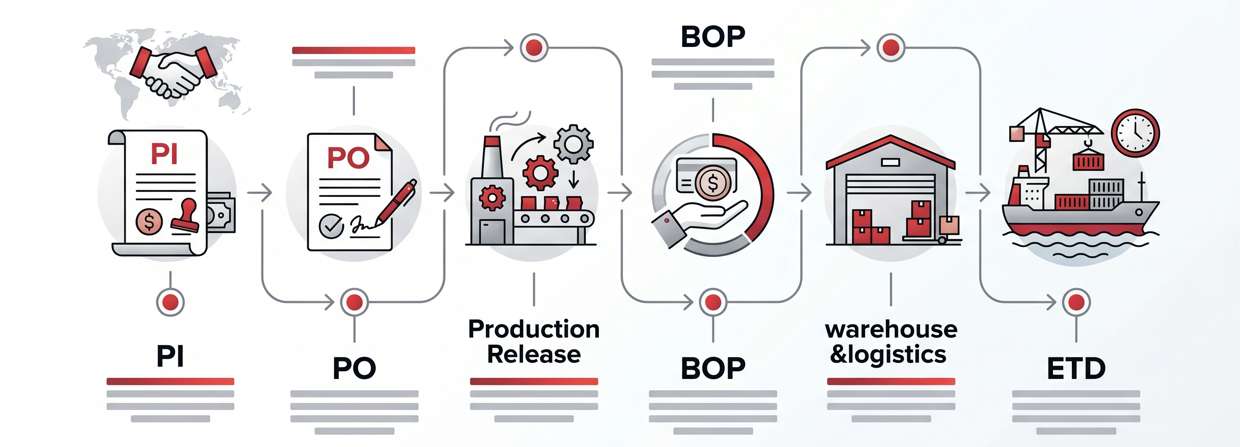
■ Typical Cable Order Workflow
The exact sequence varies by company, but the order logic below is a practical education model for international cable orders. It helps teams understand where PI, PO, BOP, and ETD normally sit in the broader process.
| Stage | Main Document / Term | Main Owner | What Buyers Should Confirm |
|---|---|---|---|
| 1. Scope alignment | Specification / drawing / quotation basis | Engineering + sales + procurement | The cable type, structure, standard, and special requirements are fully aligned |
| 2. Commercial pre-confirmation | PI | Supplier | Description, quantity, remarks, and process assumptions are correct |
| 3. Formal ordering | PO | Buyer | PO matches the approved product and order basis |
| 4. Production release | Internal order package | Supplier | No mismatch exists between PI, PO, and approved technical files |
| 5. Completion and packing | Inspection / packing readiness | Supplier | Goods are actually ready, packed, and documented |
| 6. Final commercial release | BOP or equivalent milestone | Buyer + supplier | No remaining commercial hold blocks dispatch |
| 7. Shipment execution | ETD | Logistics + supplier + buyer | Departure timing is usable for actual project planning |
■ Common Mistakes to Avoid
Treating PI as only a pricing sheet: in cable business, it often defines the pre-production order basis.
Issuing a PO that is more generic than the approved specification: this creates room for interpretation and mismatch.
Using BOP without defining it: finance, procurement, logistics, and project teams may interpret it differently.
Planning installation around ETD only: departure date is not arrival date, customs clearance, or site-ready delivery date.
Assuming document alignment happens automatically: quotation, PI, PO, drawing, packing notes, and print requirements still need cross-checking.
■ Decision Rules / Engineer’s Shortcut
For procurement and engineering teams, the fastest way to reduce international cable order risk is to treat these abbreviations as linked checkpoints rather than isolated document labels.
| Situation | What It Usually Means | What You Should Do |
|---|---|---|
| PI description is too broad | Scope may not be fully locked | Ask for the exact model, construction, or approved spec reference |
| PO and PI wording differ | Document mismatch risk exists | Reconcile both before production release |
| BOP is mentioned without explanation | Commercial release logic may be unclear | Ask what exact operational milestone it refers to |
| ETD is provided very early | Schedule may still be tentative | Check whether booking, packing, and dispatch readiness are confirmed |
| Technical drawing exists but is not cited in the PO | Traceability is weak | Add the drawing or spec reference to the PO |
■ Buyer Verification Checklist Before Production or Shipment
| Verification Item | Why It Should Be Confirmed |
|---|---|
| Product model and construction | Prevents wrong manufacturing basis |
| Quantity and unit of measure | Avoids reel, packing, and fulfillment mismatch |
| Packing method | Supports loading efficiency and site handling |
| Print marking and labeling | Important for identification, approval, and installation traceability |
| Document references | Keeps PI, PO, and technical files aligned |
| Commercial milestone understanding | Prevents shipment hold caused by misunderstanding |
| ETD assumption | Avoids unrealistic delivery or installation planning |
■ FAQ
■ Conclusion
PI, PO, BOP, and ETD are common terms in international cable orders, but they should never be treated as routine shorthand without process context. For cable buyers, these terms affect more than paperwork. They influence specification control, production release, shipment readiness, and project timing. The safest approach is to treat each term as a checkpoint: PI confirms the pre-order commercial basis, PO formalizes the buyer’s requested scope, BOP should be defined as a clear operational milestone, and ETD should be used as one departure date inside a much larger delivery plan. When those checkpoints are aligned early, international cable orders become more predictable, traceable, and easier to execute.
ZION Communication can support buyers with specification review, document alignment, packing confirmation, and export order coordination for international cable projects.



 Fiber Optic Tools
Products 6 families
Solutions 6 markets
Resources Tools & docs
Certificate
Certification and compliance references for project review, qualification and purchasing documentation.

 Fiber Optic CableAccess and backbone
 Ethernet CableCat5e to Cat8
 Coaxial CableRF and video signal
 Fire, Security & AlarmSafety systems
 Voice, Audio & VideoSignal cabling
 Power & Control CableEnergy and control
Fiber optic cable systems
Outdoor, indoor, FTTH and distribution cable lines for access networks, backbone routes and campus deployments.
 Telecom & ISP NetworksFTTH, PON, ODN
  Data Center InfrastructureServer room cabling
  Building Low-Voltage SystemsBMS, AV, weak current
  Security & Fire ProtectionAlarm, CCTV, access
  Industrial Automation CablePLC, RS485, fieldbus
  Energy & Power InfrastructureSolar, battery, power
 Telecom & ISP Networks
For FTTH / PON access, outdoor fiber deployment, aerial routes, duct routes, direct burial routes, rural broadband and ODN planning.
Tools
Use calculators and planning tools for conduit capacity, PoE voltage drop and fiber optic link loss budget work.