What to Confirm Before Approving a Cable Production Sample
Author: Site Editor Publish Time: 21-04-2026 Origin: Site
What to Confirm Before Approving a Cable Production Sample
A practical approval guide for engineers, buyers, project managers, and system integrators before mass production starts.
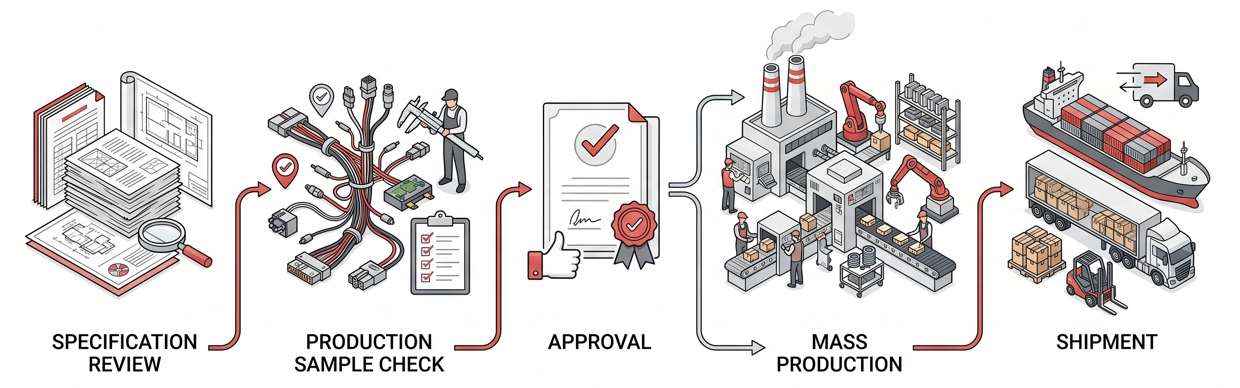
A production sample should confirm more than appearance. It should verify structure, performance relevance, printing, installation fit, and production repeatability.
The approval stage is one of the lowest-cost points to stop a batch-level mistake before mass production, labeling, packing, and shipment preparation begin.
For custom, branded, or application-sensitive cables, sample approval should be treated as a formal release gate rather than a routine sign-off step.
■Direct Answer
Before approving a cable production sample, the buyer should confirm five things: the cable construction matches the approved specification, the sample supports the required performance level, the printing and labels are correct, the cable fits the real installation environment, and the sample represents repeatable mass production rather than a one-off mock-up. This stage is not only a visual check. It is the last practical control point before materials, printing, packing, and production time are committed at scale. Teams that approve loosely often discover problems later in the form of wrong jacket materials, wrong conductor or fiber structure, unreadable printing, poor routing behavior, or avoidable rework in the field.
| Approval Area | What to Confirm | Main Risk If Ignored |
|---|---|---|
| Construction | Conductor or fiber count, shielding, insulation, jacket, outer diameter, structural details | Wrong product released into mass production |
| Performance relevance | Key parameters consistent with project expectations | Field failure or underperformance |
| Printing and labels | Model, size, meter marks, order references, reel and carton identity | Acceptance delay, sorting error, relabeling cost |
| Installation fit | Flexibility, bend behavior, routing size, connector or gland compatibility | On-site rework and poor install efficiency |
| Repeatable production | Whether the sample reflects real materials and standard production conditions | The approved sample does not match the actual batch |

■Why Production Sample Approval Matters
In cable purchasing, the quotation defines the commercial direction and the datasheet defines the target parameters, but the production sample shows what the supplier is actually preparing to manufacture. That is why this stage matters. It turns drawings and descriptions into a physical reference that can be checked before larger material consumption, printing setup, packing work, and delivery planning begin.
A well-reviewed sample reduces three common risks at the same time: technical mismatch, avoidable cost correction, and schedule disruption. For engineers, it confirms whether the structure is truly aligned with the application. For procurement teams, it reduces the chance of approving the wrong item or releasing a batch that later needs rework. For project managers, it lowers the risk that field installation or site acceptance will be delayed by issues that should have been caught earlier.
■What a Production Sample Should Include
A production sample is not always a full finished product. Depending on the cable type and project requirements, it may include a short manufactured length, a cross-section reference, printing confirmation, termination details, label layout, packing examples, or supporting test records. The key point is that the sample should represent the product that is about to enter real production.
| Sample Element | What It Helps Verify | Why It Matters |
|---|---|---|
| Short cable length | Basic look, handling, structure, diameter, flexibility | Shows whether the ordered cable is physically realistic and suitable |
| Cross-section sample | Layer construction, shielding, conductor or fiber arrangement | Helps catch structural mismatch hidden by the jacket |
| Printed jacket sample | Branding, model text, meter marks, legibility | Avoids relabeling, identity confusion, and site acceptance issues |
| Termination sample | Connector fit, polish, pinout, assembly workmanship | Important when assemblies must match specific hardware |
| Packaging and label example | Reel mark, carton label, SKU identity, shipment readiness | Improves traceability and warehouse or project handling accuracy |
■The Five Things to Confirm Before Approval
For most cable projects, five review areas cover the majority of approval risk. The higher the customization level, the installation difficulty, or the replacement cost, the more important it becomes to review each of these areas with discipline.
1. Confirm the Cable Construction Matches the Order
This is the first approval gate. A cable can look clean and professional while still being structurally wrong. Depending on the product, review conductor size, conductor class, insulation, shielding, armor, pair or core count, fiber count, jacket material, outer diameter, color code, drain wire, separator, strength members, and any termination details that affect field use.
2. Confirm Performance-Relevant Parameters
A production sample should support confidence in the intended performance level. The exact approval depth depends on the order risk. Typical checks may include conductor resistance, attenuation, impedance, shield continuity, optical attenuation, bend behavior, flame-rating alignment, temperature suitability, or connector-related parameters.
Not every routine order needs a full laboratory package at this stage, but critical or customized projects should not approve a sample with no performance-linked evidence at all.
3. Confirm Printing, Labels, and Identification
Many production issues are not caused by cable failure, but by wrong identification. Check jacket printing, model and size text, standards reference if used, meter marks, batch or traceability code format, reel labels, carton labels, and any project-specific identification that affects receiving, inspection, or maintenance.
4. Confirm Installation Suitability
A cable may be nominally on specification and still be wrong for the real installation. Sample approval should consider routing space, bend behavior, flexibility, stripping experience, connector or gland fit, jacket suitability for indoor or outdoor environments, and whether the cable can be installed efficiently in the conditions the project will actually face.
For tight routing, outdoor exposure, high-density cabinets, or assembly-critical interfaces, installation suitability should be reviewed by the team that will use or install the cable, not only by procurement.
5. Confirm the Sample Represents Repeatable Production
One of the most overlooked questions is whether the sample is a true production reference. Buyers should confirm whether the sample is built with the planned material stack, whether the printing process is the same one intended for mass production, and whether packing and label examples reflect actual shipment practice rather than a presentation-only mock-up.
| Project Situation | Recommended Review Depth | Why |
|---|---|---|
| Routine standard item | Visual + structural + key identity confirmation | Suitable when the product and supplier are already proven |
| Custom cable or first-time supplier | Structural review + dimension check + sample-related test evidence | Reduces interpretation error and hidden mismatch |
| Harsh environment or compliance-sensitive use | Installation review + parameter alignment + documentation check | Failure cost is higher and field replacement is harder |
| Terminated assembly or interface-critical project | Fit verification + functional confirmation + label review | Mechanical or interface mismatch is a common late-stage issue |
■When to Use a Stricter Approval Process
Not every cable order requires the same review depth. For repeat items with a stable supplier and a mature specification, a lighter process may be enough. But some orders carry enough technical, schedule, or installation risk that sample approval should become much stricter.
The cable is customized
The supplier is new
The environment is harsh or regulated
The project has tight installation constraints
Branding, printing, or packing is customized
Replacement or rework cost is high
The product is a mature repeat item
The supplier and structure are already proven
The application is low risk
There is no unusual labeling or structure requirement
The project can tolerate minor variation without operational impact
■Common Approval Mistakes
| Role | Primary Review Focus | Typical Risk Caught |
|---|---|---|
| Engineer / technical reviewer | Structure, performance, compatibility | Specification mismatch or unsuitable design |
| Procurement | Order alignment, labels, repeatability, release control | Wrong item release or avoidable rework |
| Project manager | Schedule, site fit, handover readiness | Installation delay or acceptance risk |
| Installer / field technician | Handling, routing, stripping, connection practicality | Slow install, routing problems, poor usability |
| QA / inspection | Consistency, workmanship, measurable checkpoints | Batch variability and weak control |
■Engineer’s Shortcut: A Minimum Approval Gate
When teams need a practical internal rule, the following six-point gate is strong enough for routine use and simple enough to apply consistently across many cable projects.
Confirm the sample matches the approved cable structure
Confirm key dimensions and visible construction details
Confirm print, label, and order identity content
Confirm installation suitability for the actual environment
Confirm the sample represents repeatable production
Record who approved it and which document set the approval is based on
■FAQ
■Conclusion
Approving a cable production sample is one of the most effective low-cost control points in the order process because it transforms a specification into a real reference before large-scale production begins. The right approval question is not simply, “Does this sample look acceptable?” It is, “Does this sample accurately represent the cable we want manufactured, labeled, shipped, installed, and maintained?”
When teams confirm construction, performance relevance, printing, installation fit, and repeatable production before release, they reduce mismatch risk, protect delivery schedules, and improve downstream project execution. For OEM, project, and application-sensitive cable orders, production sample approval should be treated as a formal quality gate, not a routine formality.



 Fiber Optic Tools
Products 6 families
Solutions 6 markets
Resources Tools & docs
Certificate
Certification and compliance references for project review, qualification and purchasing documentation.

 Fiber Optic CableAccess and backbone
 Ethernet CableCat5e to Cat8
 Coaxial CableRF and video signal
 Fire, Security & AlarmSafety systems
 Voice, Audio & VideoSignal cabling
 Power & Control CableEnergy and control
Fiber optic cable systems
Outdoor, indoor, FTTH and distribution cable lines for access networks, backbone routes and campus deployments.
 Telecom & ISP NetworksFTTH, PON, ODN
  Data Center InfrastructureServer room cabling
  Building Low-Voltage SystemsBMS, AV, weak current
  Security & Fire ProtectionAlarm, CCTV, access
  Industrial Automation CablePLC, RS485, fieldbus
  Energy & Power InfrastructureSolar, battery, power
 Telecom & ISP Networks
For FTTH / PON access, outdoor fiber deployment, aerial routes, duct routes, direct burial routes, rural broadband and ODN planning.
Tools
Use calculators and planning tools for conduit capacity, PoE voltage drop and fiber optic link loss budget work.