What Compliance Documents May Be Needed for International Cable Shipments
Author: Site Editor Publish Time: 21-04-2026 Origin: Site
What Compliance Documents May Be Needed for International Cable Shipments?
International cable shipments usually do not require one universal certificate pack. The right document set depends on destination country, cable type, installation use, buyer specification, and packaging method. For engineers, procurement teams, and project managers, the real challenge is knowing which documents are legally necessary, which are commercially necessary, and which only apply to specific markets or projects.
Most cable exports start with invoice, packing list, and transport documents, but compliance files vary by market and application.
EU CPR, RoHS, REACH, origin declarations, and project certificates should never be treated as one interchangeable document set.
The safest practice is to confirm destination, cable family, installation use, buyer requirements, and packaging method before production release.
■ The Direct Answer
For international cable shipments, there is usually no single universal compliance file pack. Most orders begin with baseline trade and shipping documents such as the commercial invoice, packing list, and transport document. After that, the required compliance papers depend on the destination market, the cable family, the installation environment, the buyer’s specification, and whether the shipment is for general trade, a regulated building application, or a project with its own approval matrix.
In practical terms, exporters should separate documents into two big groups: documents that help goods clear customs and documents that prove the cable is acceptable for the target market or project. This distinction matters because many delays happen when suppliers prepare shipment paperwork but overlook product or project compliance requirements until the cargo is already packed or in transit.
■ The Four-Layer Document Logic
A useful way to evaluate document requirements is to think in four layers: baseline shipment documents, product compliance documents, market-specific approvals, and packaging or quarantine requirements. This structure helps procurement teams avoid treating every certificate request as equally important.
| Layer | Typical Contents | Why It Matters |
|---|---|---|
| Shipment & Customs Baseline | Commercial invoice, packing list, bill of lading or airway bill, origin statement when needed | These documents move the goods and support customs processing. |
| Product Compliance | Declaration of conformity, RoHS statement, REACH statement, test records, material declarations | These documents show the product meets legal or buyer-required compliance expectations. |
| Market / Project Specific | CPR files, project approvals, utility or consultant-required certificates, third-party verification | These apply only in certain countries, industries, and project environments. |
| Packaging / Quarantine | Wood packaging treatment marks, pallet or drum compliance evidence, labeling records | Packaging itself can become the reason a shipment is delayed or rejected. |

■ Baseline Shipment Documents
Most international cable shipments require a baseline set of commercial and logistics documents. These are not necessarily the “compliance” documents buyers ask about first, but they are the documents most likely to affect release, customs handling, cargo identification, and package-level verification.
| Document | Main Function | Typical Use | Main Risk If Wrong |
|---|---|---|---|
| Commercial Invoice | Describes the goods, quantity, value, and trade details | Nearly all export shipments | Customs delay, valuation disputes, description mismatch |
| Packing List | Shows drum, pallet, carton, gross/net weight, and package contents | Nearly all freight shipments | Receiving mismatch, counting issues, inspection friction |
| Bill of Lading / Airway Bill | Supports transportation, handover, and delivery routing | Ocean and air shipments | Delivery release problems and routing confusion |
| Origin Statement / Certificate of Origin | Supports origin-based customs treatment or buyer request | Only when required by destination rules or contract | Lost tariff benefit or customs challenge |
■ Product Compliance Documents
Product compliance documents are the files that support whether the cable is acceptable for a given market, installation environment, or customer requirement. These are often confused with shipping documents, but they serve a different purpose. Customs can sometimes clear the shipment while the project still rejects the product because the wrong compliance evidence was prepared.
Typical product compliance documents may include a declaration of conformity, RoHS statement, REACH statement, material declaration, test report summary, or factory quality certificate. However, the correct set depends on cable family and destination. A copper power or control cable may fall into a different compliance path than an optical fiber cable or a project-specific assembled cable harness.
| Document Type | What It Supports | Decision Note |
|---|---|---|
| Declaration of Conformity | Product compliance under a defined legal framework | Do not issue this as a generic export form without confirming actual scope. |
| RoHS Statement | Restricted substance compliance for applicable product scope | Check whether the cable family is actually within scope before promising it. |
| REACH / SVHC Statement | Chemical substance communication and material risk visibility | Useful for EU-oriented buyers and projects with stricter material review. |
| Test Report Summary | Performance and design evidence | Often required by engineering teams even when not required by customs. |
| Factory Quality Certificate | Production lot quality release support | Useful in OEM, project delivery, and batch acceptance workflows. |
■ Market- and Project-Specific Files
This is the part many buyers and suppliers oversimplify. Not every country applies the same logic, and not every cable installation is regulated in the same way. A cable entering a commercial building project in Europe may trigger one document path, while a cable entering a U.S. industrial site or a private telecom deployment may trigger another.
Examples of market- or application-specific files may include CPR-related files for certain construction cable applications in Europe, third-party approval evidence for regulated project environments, buyer-required material declarations, consultant-approved submittal packs, or third-party inspection records requested before shipment release.
If the cable is intended for permanent installation in a building or civil works environment, the compliance path may be very different from general export logistics paperwork. Early confirmation is essential.
In many EPC and project cases, customs may release the goods, but the site or consultant will still reject delivery without the required submittal file or approval evidence.
■ Document Needs by Scenario
The easiest way to reduce shipment risk is to match the document pack to the real application scenario rather than using one recycled checklist for every order.
| Scenario | Likely File Focus | Main Checkpoint | Risk If Missed |
|---|---|---|---|
| Standard export cable shipment | Invoice, packing list, transport document, origin proof if required | Description, package count, weight, origin logic | Customs delay or receiving mismatch |
| EU building cable project | Baseline docs plus installation-related compliance file set | Whether the product is entering a regulated construction-use path | Market entry or site acceptance problems |
| OEM or private-label order | Compliance statements, labeling confirmation, lot release documents | Branding, marking, declaration alignment | Relabeling, batch hold, customer complaint |
| Telecom or infrastructure project | Technical submittal pack, performance evidence, project approval forms | Consultant or owner acceptance requirements | Site rejection or payment hold |
| Wood drum / pallet export | Packaging compliance evidence, treatment marking, shipping label verification | Whether wood packaging complies with destination expectations | Inspection failure at border or quarantine issue |
■ Common Mistakes and Risk Points
The most common mistake is assuming that “export document” and “compliance document” mean the same thing. They do not. Shipment documents may be enough to move cargo, but they may not be enough to satisfy a buyer, consultant, building code requirement, or project engineer.
Another common mistake is applying one document rule to every cable type. For example, optical cable, copper communication cable, power cable, control cable, and assembled cable products may not follow the same compliance path. A third mistake is leaving packaging compliance to the last stage, especially when wood drums or wood pallets are used in export packing.
These documents should be prepared only when the destination market and product scope actually make them relevant.
Late-stage document review often leads to rework, repacking, relabeling, or shipment delay.
Even when customs clearance is successful, project delivery can still fail without the right technical file pack.
Non-compliant drums, pallets, or markings can disrupt border handling even if the product itself is acceptable.
■ Engineer’s Shortcut: 5 Questions to Ask Before Release
Before approving documents for production release or shipment booking, ask these five questions. If the team cannot answer them clearly, the compliance pack is probably incomplete.
Which country is the shipment entering, and is there any onward re-export risk?
What type of cable is being shipped: copper, fiber, power, control, communication, or assembly?
Will the cable be installed in a building, equipment system, telecom network, industrial site, or project-regulated environment?
Are the buyer’s requested documents legal market-entry requirements, project acceptance requirements, or internal purchasing requirements?
Is the shipment using wood drums, wood pallets, or other packaging that may trigger quarantine or packaging compliance checks?
■ FAQ
■ Conclusion
What compliance documents may be needed for international cable shipments depends less on a fixed certificate list and more on a correct decision process. Baseline shipping documents are only the starting point. Real shipment readiness also depends on product compliance scope, destination market rules, project approval expectations, and packaging conditions.
For engineers, procurement teams, and project managers, the most reliable approach is to verify document requirements before production release rather than after packing. That is how teams reduce customs friction, project rejection risk, relabeling cost, and avoidable shipment delay.
Certificates — support buyer trust and product qualification review.
LAN / Ethernet Cable — useful for buyers reviewing copper communication cable categories.
Contact Us — for project document confirmation, sample requests, and order-specific compliance support.



 Fiber Optic Tools
Products 6 families
Solutions 6 markets
Resources Tools & docs
Certificate
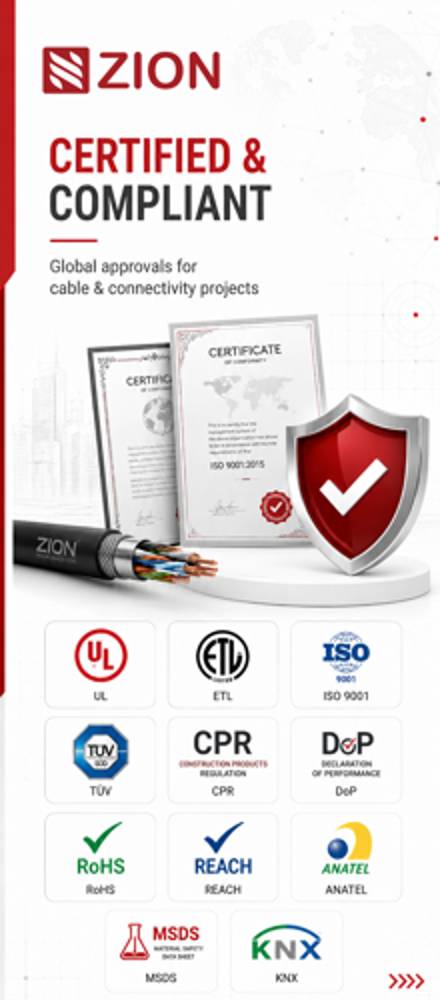
Certification and compliance references for project review, qualification and purchasing documentation.
 Fiber Optic CableAccess and backbone
 Ethernet CableCat5e to Cat8
 Coaxial CableRF and video signal
 Fire, Security & AlarmSafety systems
 Voice, Audio & VideoSignal cabling
 Power & Control CableEnergy and control
Fiber optic cable systems
Outdoor, indoor, FTTH and distribution cable lines for access networks, backbone routes and campus deployments.
 Telecom & ISP NetworksFTTH, PON, ODN
  Data Center InfrastructureServer room cabling
  Building Low-Voltage SystemsBMS, AV, weak current
  Security & Fire ProtectionAlarm, CCTV, access
  Industrial Automation CablePLC, RS485, fieldbus
  Energy & Power InfrastructureSolar, battery, power
 Telecom & ISP Networks
For FTTH / PON access, outdoor fiber deployment, aerial routes, duct routes, direct burial routes, rural broadband and ODN planning.
Tools
Use calculators and planning tools for conduit capacity, PoE voltage drop and fiber optic link loss budget work.