The September 9–11 exhibition in Shenzhen offered concrete examples: silicon photonic chips, NPO and CPO optical engines, specialty fibers and faster network-testing instruments. Together, they suggest a broader story than another increase in the number printed on an optical module. CIOE official report
This article interprets those developments using published organizer and manufacturer information. Exhibition announcements demonstrate technical direction; they do not establish universal availability or the pace of commercial adoption.
1. A Faster Network Starts With the Problem of Moving Data
AI infrastructure places computing, memory and communication in close relationship. Adding processing capacity is useful only when the system can move the required data between its components effectively.
That helps explain why optical innovation is attracting attention beyond traditional telecommunications. The questions include how much connectivity fits into limited space, how much power it consumes, and how it can be manufactured and maintained.
Energy provides an important constraint. The IEA's April 2026 Key Questions on Energy and AI examines data-center growth alongside electricity demand, grid readiness and supply chains. Its perspective is a reminder that infrastructure expansion depends on several systems developing together. IEA report
The implication for optical networking is not that one architecture has already won. It is that bandwidth, efficiency and integration increasingly need to be considered together.
2. Optical Connections Are Moving Closer to Electronic Processing
NVISION's CIOE recap identifies a 1.6T DR8 silicon photonic chip, a 3.2T NPO silicon photonic chip, a 6.4T CPO optical engine and an Optical I/O engine among its exhibits. The organizer separately highlighted HG Genuine's 6.4T NPO optical engine. NVISION show recap · CIOE official report
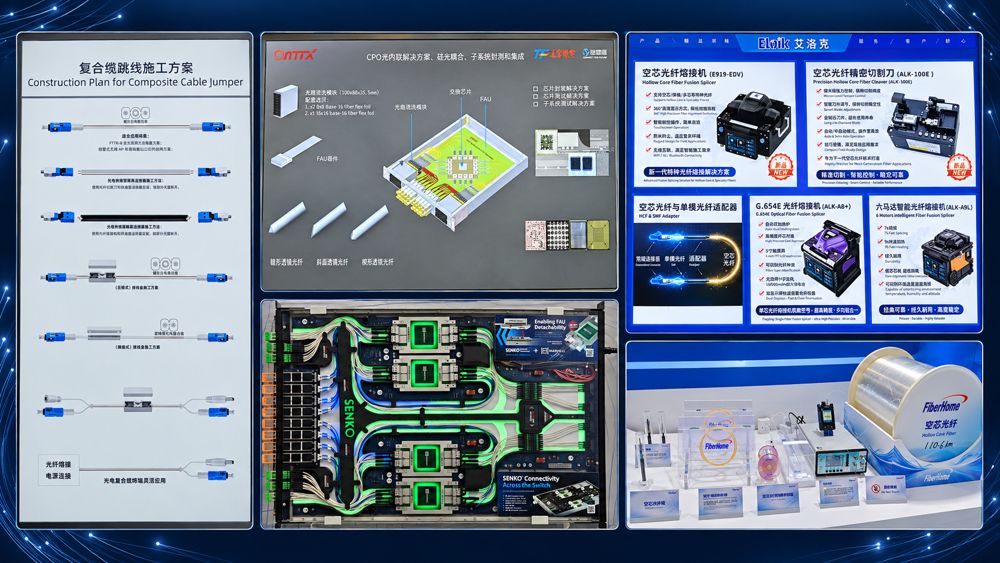
The names describe different component and integration categories. A chip, an optical engine and a finished pluggable transceiver cannot be compared on their headline rate alone.
Near-packaged optics and co-packaged optics bring optical functions closer to electronic processing through different packaging approaches. This shifts part of the engineering discussion from the equipment's front panel toward the board and package.
The potential benefits must be assessed alongside manufacturing complexity, thermal conditions, fiber attachment, reliability and serviceability. For that reason, a plausible near-term picture is coexistence: different architectures serving different systems, rather than a single replacement cycle affecting every network at once.
3. Fiber Innovation Is Following Two Different Paths
One path moves inward, toward dense integration. YOFC's CIOE 2026 program listed a CPO/NPO specialty optical fiber series and a CopackAlign brand launch event. It illustrates how packaging developments also create requirements for the fibers and connections around optical engines. YOFC event program
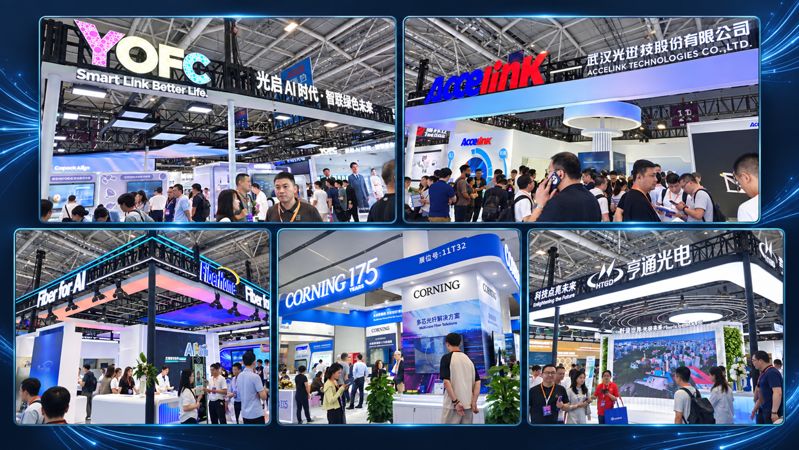
The other path concerns transmission between sites. The organizer highlighted hollow-core fiber engineering work from FiberHome and the first public display of hollow-core fiber from Lingxian Technology. CIOE official report
Outside the exhibition, Microsoft announced collaborations with Corning and Heraeus to expand hollow-core fiber production in 2025. That is a separate industrial signal, rather than evidence that every buyer can now obtain a qualified solution for every route. Microsoft Azure announcement
These developments point toward increasingly specialized fiber applications. Performance has to be evaluated together with connection methods, installation, repair and the complete link design. A promising transmission medium becomes useful infrastructure only when those surrounding requirements can also be met.
4. Testing Is Becoming More Visible in the Innovation Story
The organizer reported Wanliyan's 1.6T portable network tester among the instruments shown at CIOE 2026. Its presence alongside new optical components is a useful reminder that faster hardware needs a corresponding validation ecosystem. CIOE official report
A component demonstration establishes one kind of evidence. Stable operation in an actual system requires additional evidence about configuration, interoperability and operating conditions.
Our reading of this trend is that testing, assembly quality and documentation will remain important sources of differentiation. The performance of the complete connection depends on more than its most advanced component. Cable routing, connector condition, polarity and loss management continue to matter even when the equipment becomes more sophisticated.
5. The Wider Communications Market Will Move at Several Speeds
AI interconnects attract attention, but they do not describe every communications project. ITU's Facts and Figures 2025 estimates that 2.2 billion people remained offline, underscoring the continuing importance of coverage and affordability. ITU report
Meanwhile, Ericsson's June 2026 Mobility Report discusses developments in 5G standalone services, differentiated connectivity and uplink demand. These point to evolving transport requirements beyond the data center. Ericsson Mobility Report
The resulting market is unlikely to follow a uniform upgrade timetable. An AI computing cluster may prioritize density and power. A mobile-site upgrade may be constrained by route availability and resilience. A new access network may put installation cost and maintainability first.
This diversity gives established products a continuing role. Outdoor cables, distribution frames, closures, patching assemblies and installation accessories will develop alongside newer optical architectures. Their value increasingly depends on how well they fit the application and work together.
What Comes After the Exhibition
CIOE 2026 suggests that optical connectivity is becoming more deeply involved in the design of computing infrastructure. Its role extends from specialized connections near processing chips to the networks joining sites and users.
The next stage will be shaped by more than headline speed: repeatable manufacturing, practical deployment, maintainability and commercial qualification will influence which technologies find a lasting place. The distance between an impressive demonstration and a dependable network remains important.
For ZION, this wider picture gives context to its work in fiber cables and connectivity. Its existing outdoor, access-network and high-density patching product ranges provide a practical foundation for helping customers navigate selection and component matching. The useful contribution is to make technical choices clearer and bring suitable products together around real deployment conditions as the industry evolves. ZION fiber cables · ZION MPO assemblies

Discuss Your Fiber Connectivity Project
Share your application, route length, connector and fiber requirements, quantities, installation environment and testing needs to discuss suitable cables and connectivity components.
Request Project Support