
1. Inspect the Delivery and Define the Test Plan
Fiber optic cable can be damaged between factory testing and installation. Poor handling, water ingress, unsuitable storage conditions and damaged reels can compromise an otherwise serviceable cable. A receiving inspection and documented test plan help identify problems before deployment begins.
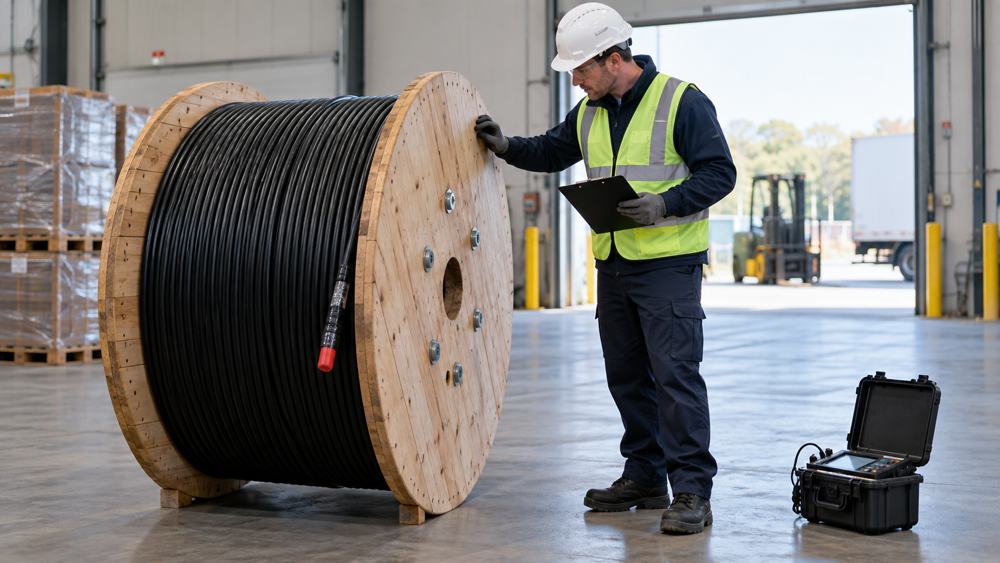
Before unloading, check the visible packaging, drum identification and evidence of impact or movement. Complete the accessible inspection after the drum has been safely unloaded and secured. Do not enter an unstable load or remove load-bearing protection to inspect the cable.
- Record the drum number, product code, fiber type and count, stated cable length and delivery date.
- Photograph damage and retain delivery documents and factory test records.
- Inspect for cracked flanges, displaced battens, loose cable layers, exposed nails, damaged wrapping and missing end seals.
- Hold any suspect drum for investigation before installation.
| Check | What it establishes | Important limitation |
|---|---|---|
| Visual inspection | Accessible damage and packaging condition | Hidden damage may remain undetected |
| Continuity check | Whether the tested fiber provides an optical path | Does not establish acceptable attenuation |
| OTDR test | Fiber length and detectable loss events along the tested fiber | Requires suitable settings and interpretation; does not prove mechanical integrity |
FOA guidance distinguishes continuity checks from OTDR evaluation and calls for testing cable on the reel before deployment. Establish the fibers to test, wavelengths, settings and acceptance criteria in the project test plan. Retain relevant traces, identify the fibers tested and reseal ends opened for testing. A passing optical result alone is not sufficient to release cable with suspected structural damage. See the FOA underground cable installation guidance.
2. Storage Temperature: Read the Exact Product Datasheet
Storage, installation and operating temperatures describe different conditions. The ranges can overlap or differ, and a storage rating is not permission to bend, unwind or install the cable at every temperature within that range.
| Rating | Application |
|---|---|
| Storage temperature | Permitted conditions while stored as specified by the manufacturer |
| Installation temperature | Permitted conditions during the specified installation activities |
| Operating temperature | Permitted conditions in the installed application |
As a product-specific example, Corning ALTOS product 004TU4-T4731D20 lists storage and operation at −40°C to +70°C, with installation at −30°C to +70°C. These values illustrate the distinction between conditions; they are not general limits for outdoor fiber cable or ZION products. See the Corning product specifications.
If storage has left the cable outside its installation range, condition it according to the manufacturer’s instructions before handling or deployment. A warmer warehouse air reading does not prove that the entire drum has reached a suitable temperature. There is no universal conditioning time for every drum size and cable design.
3. Store Conventional Drums Upright and Stable
For a conventional loaded cable drum, upright means the axis is horizontal and the flanges are vertical. Support both flange edges on a firm, level surface and chock the drum against rolling.
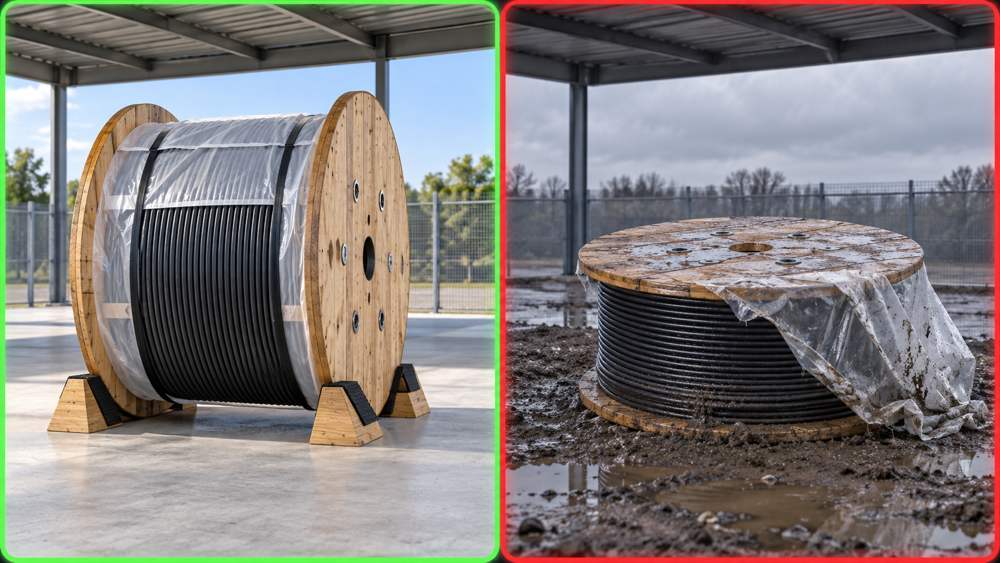
Do not lay a conventional loaded drum on one flange. Prysmian’s optical-cable guidance specifies upright reel handling and retention of the solar wrap during outdoor storage. Retain the supplied protection until needed, and restore it if inspection requires removal. See Prysmian’s optical fiber cable installation considerations.
- Leave access for inspection and lifting.
- Keep adjacent flanges clear of exposed cable.
- Do not stack loaded drums unless the packaging is designed for stacking and the supplier specifies the arrangement.
- Check for cracks, rot, loose fasteners, deformation and damaged axle holes.
4. Control Moisture and Separate Indoor from Outdoor Storage
There is no single relative-humidity limit for all finished fiber optic cables. Apply any humidity and condensation restrictions specified for the actual cable, packaging and accessories.
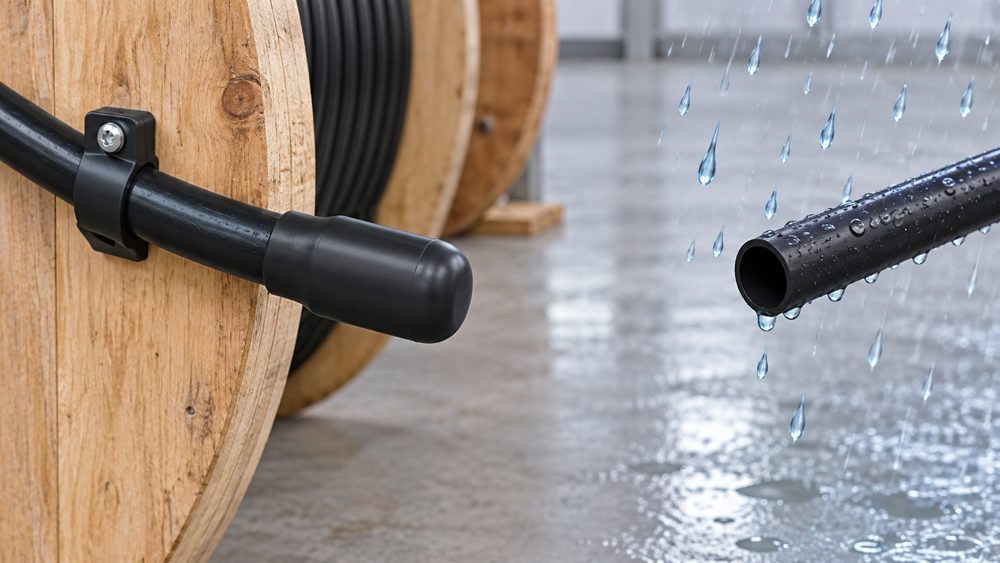
Keep indoor-only cable in a dry, protected indoor location. A tarpaulin does not make indoor cable suitable for outdoor storage. Corning explicitly distinguishes indoor cables from products suitable for outdoor exposure in AEN165 cable storage guidance.
For cable and packaging approved for outdoor storage:
- Keep drums out of standing water and off soft or muddy ground.
- Maintain the specified weather protection and ventilation around any additional cover.
- Inspect after storms, flooding, relocation or visible packaging damage.
- Protect labels and records from weathering.
Keep both cable ends sealed, including the inner end where accessible. After cutting or testing, restore the end seal promptly using the cable manufacturer’s approved cap or sealing system. Elevating an open end is not an alternative to sealing it, and water-blocking materials do not make an open end acceptable for storage.
If an end has been exposed to rain or immersion, record the exposure and obtain a technical assessment before release. Fitting a new cap does not establish that previously admitted moisture has been removed.
5. Shelf Life: Check Duration, Condition and Documentation
Do not assign a universal expiration period to fiber optic cable. Equally, the absence of an expiry date on a label is not evidence of unlimited approved storage.
How long the product may remain under the conditions stated by the manufacturer.
Performance expectations in the intended installed environment.
Contractual coverage with its own conditions and starting date.
Compatibility with the specified fiber, fire-performance and documentation requirements.
Check the manufacturer’s recommended storage duration, inspection or retest requirements, and the purchase contract. Corning AEN165 recommends installation within six months of delivery where possible. This is a manufacturer recommendation in that document, not an industry-wide expiry date or a ZION storage limit.
Before releasing older inventory, review the storage history, cable and drum condition, seals, identification, test records and project requirements. A satisfactory optical test does not establish remaining service life or certify the condition of the jacket and strength members. Use FIFO within stock that is technically suitable and released for the project.
6. Transport and Unload with a Defined Handling Method
Confirm gross drum weight, dimensions, equipment capacity and the approved lifting arrangement before movement. Restrain each load against rolling, sliding and tipping using a transport plan suitable for the vehicle or container. Chocks alone are not a complete restraint system.
- Protect exposed cable from restraints, sharp edges and neighbouring loads.
- Never drop a drum or allow it to roll uncontrolled from a vehicle.
- Use the supplier-approved lifting arrangement and never let wound cable carry the lifting load.
- Roll drums only when permitted, over the shortest practical distance, in the marked ground-rolling direction.
Prysmian’s Baltic drum guide specifies a maximum rolling distance of 5 metres under that guide. This shows why “a short distance” needs a supplier-defined limit; it is not a universal allowance for every drum. See the Prysmian Drum Handling Guide.
The ground-rolling arrow is not a universal pay-off instruction. Set up the reel stand and cable exit path according to the installation procedure. Stop if the drum is unstable, markings are unclear or cable layers shift.
7. Protect Partially Used Drums
Before returning a drum to storage:
- Seal each newly cut end with the approved system.
- Secure the loose end without crushing the jacket or bending it below the specified radius.
- Restore the drum’s protective covering.
- Record the remaining length and how it was determined.
- Retain the original drum and batch identification and link any cut-length identifier to those records.
- Record cutting, testing, exposure, damage and repairs.
Avoid tight wire ties directly on the cable. Distinguish estimated stock length from verified usable length, allowing for damaged sections and termination requirements. Rewinding requires an approved reel size, controlled tension and an appropriate cable path.
8. Pre-Installation Release Checklist
Release the drum only after damage, test failure and other exceptions have been resolved through the project quality process. A documented exception does not itself make cable fit for use.
| Release item | Evidence to confirm |
|---|---|
| Product identity | Correct product code, fiber type, count and construction |
| Available length | Adequate usable cable for the route and required allowances |
| Storage history | Recorded conditions and resolution of exposure or duration concerns |
| Drum and packaging | Suitable condition for safe handling and controlled pay-off |
| Cable and seals | No unresolved visible damage; seal integrity checked where accessible |
| Temperature | Cable ready for installation within its specified range |
| Test evidence | Required tests completed, reviewed and linked to the drum |
| Documentation | Applicable datasheet, factory report and project declarations available |
| Handling limits | Bend radius, pulling limits and installation method confirmed |
Fiber Optic Cable Storage FAQ
Does fiber optic cable have a fixed shelf life?
There is no universal shelf life for every fiber optic cable. Use the product instructions, storage records, condition, test evidence and project requirements to determine whether stored cable remains suitable.
Can a continuity test replace an OTDR test before installation?
No. A continuity check establishes an optical path, while an OTDR can identify fiber length and detectable loss events. The project test plan should define the required method, fibers, wavelengths and acceptance criteria.
Can indoor fiber optic cable be stored outdoors under a cover?
Indoor-only cable should remain in a dry, protected indoor location unless its manufacturer explicitly approves another storage arrangement. A tarpaulin does not change the cable’s environmental rating.
How should a conventional loaded fiber cable drum be stored?
Store it upright with the axis horizontal, both flange edges supported on a firm level surface, and chocks preventing movement. Follow the instructions for the actual drum and packaging supplied.
Plan Storage Before Shipment
For a project enquiry, provide the cable type, expected storage duration, indoor or outdoor location, temperature exposure, drum-size constraints, unloading equipment, quantities and required test documents.
Request Project Support