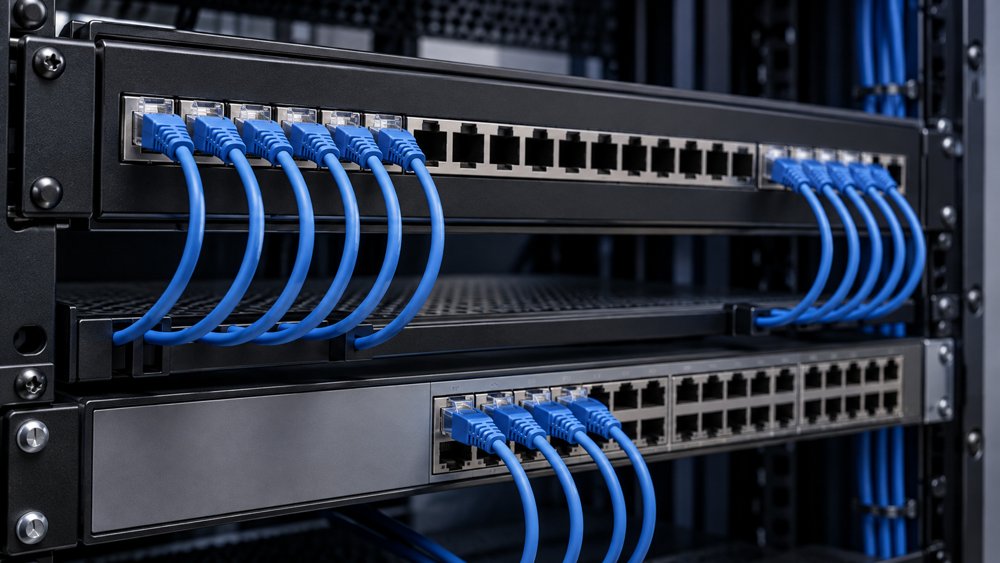
Where the density benefit comes from
Patch cords accumulate quickly in a rack with 24-port or 48-port panels, high-port-count switches and multiple horizontal cable managers. A smaller outside diameter can reduce congestion around ports, improve access to labels and make short routes easier to organize.
The ZION Cat6A U/UTP patch-cord family lists three conductor sizes:
| Conductor | Published cable OD | Typical selection reason |
|---|---|---|
| 24AWG | 6.0 ± 0.2 mm | General patching and greater conductor margin |
| 26AWG | 5.4 ± 0.2 mm | Balance between flexibility and cable size |
| 28AWG | 5.0 ± 0.2 mm | Short connections in dense racks |
The smaller diameter helps most when many cords share the same routing path. Specify the solid-conductor horizontal run and the stranded patch cords as separate parts of the channel.
Why PoE needs a separate review
A smaller conductor has higher resistance than a larger conductor of the same material and length. When a patch cord carries PoE, resistance contributes to voltage drop and heat. Closely bundled powered cords can retain more heat, particularly in warm cabinets or restricted pathways.
28AWG is not automatically unsuitable for PoE. The decision depends on the cord’s documented power capability and the installed conditions. Record:
- The PSE type and maximum power delivered at the port.
- Patch-cord length at both ends of the channel.
- The number of simultaneously powered cords in each bundle.
- How long the cords run together in that bundle.
- Cabinet ambient temperature and available ventilation.
- Jacket temperature rating and connector suitability.
- Channel resistance, resistance unbalance and the powered device’s voltage requirements.
TIA published TSB-184-A-1 guidance for power delivery over 28AWG cords. Apply bundle guidance to the actual power level, cable construction and installation. For high-power or densely bundled PoE, compare a larger-gauge cord before standardizing on 28AWG. The ZION PoE bundle-heat guide gives broader cable-selection context.
How to check channel length
The usual 100 m structured-cabling channel is commonly described as up to 90 m of permanent link plus patch and equipment cords. That familiar split does not automatically apply unchanged with 28AWG cords. Slim cords can have higher insertion loss per metre, so the permitted permanent-link length may need to be reduced.
A published Fluke Networks planning example uses a 1.95 length factor for 28AWG patch cords:
The permanent link must also remain within its own applicable limit. This example helps plan a channel; approval depends on the selected components and project test requirements.
| Total 28AWG cord length | Calculated permanent-link length | Additional check |
|---|---|---|
| 6 m | 90.3 m | Apply the permanent-link limit; 90 m is the planning ceiling in this example. |
| 8 m | 86.4 m | A 90 m permanent link would need to be shortened. |
| 10 m | 82.5 m | Confirm the full channel design and test results before specifying. |
Count all 28AWG cords in the channel, including rack-side and work-area or equipment-side cords. If the channel mixes cord constructions or operates at elevated temperature, confirm the applicable loss calculation. The installed channel must pass the project’s specified Cat6A test limit.
There is no useful single-number answer to “What is the maximum length of a 28AWG patch cord?” The available length depends on the permanent link, other cords, channel performance and power-delivery conditions.
A practical selection workflow
For short connections where rack congestion matters and the channel, PoE and length conditions have been reviewed.
For longer cords, high-power links, tight powered bundles or permanent links close to their allowed length.
Before ordering, put the following in the project schedule:
| Item | What to specify |
|---|---|
| Channel | Cat6A requirement, shielding design and test limit |
| Cord | Exact model, AWG, jacket, finished length and connector type |
| Length | Permanent-link length and total cord length at both ends |
| PoE | Maximum port power, powered-port count and device requirements |
| Routing | Bundle size, shared bundle length, ambient temperature and ventilation |
| Evidence | Product data sheet, applicable power rating and channel test record |
For ZION’s 7241010 Cat6A U/UTP 28AWG configuration, the published cable OD is 5.0 ± 0.2 mm. Common order lengths run from 0.5 m to 5 m. Confirm the exact ordered construction and PoE conditions before using it as a standard project item.
Frequently asked questions
Can a 28AWG patch cord be used for PoE?
Potentially, yes. Check the specific cord’s documented power capability, connector, length, bundle arrangement and temperature conditions. A Cat6A label alone does not approve every PoE installation.
Does a 28AWG cord make a 100 m channel impossible?
No single physical channel length applies to every design. The higher insertion loss of 28AWG cords may require a shorter permanent link or less total cord length. Calculate the proposed configuration and test the installed channel.
Can I use a 28AWG cord as horizontal cable?
Use the slim stranded cord for patching or equipment connections. Select an appropriate solid-conductor cable for the permanent horizontal run.
Should every cord in a dense rack be 28AWG?
Select by port density and link conditions. A mixed schedule can reserve slim cords for short, congested paths while using larger-gauge cords where length or PoE load calls for more margin.
Specify the complete connection
A useful RFQ states the rack port count, cable category, patch-cord lengths, permanent-link length, PoE power level, bundle arrangement, ambient temperature and required test documentation. With those inputs, the cord gauge can be selected for the whole channel rather than by cable diameter alone.
Prepare a channel-ready RFQ
Share the port count, cord lengths, permanent-link length, PoE power, bundle arrangement, ambient temperature and required test documents for the proposed Cat6A connection.
Request Project Support



 Fiber Optic Cable
 Fiber Optic Tools
 Ethernet Cable
 Coaxial Cable
 Fire & Security Cable
 Voice, Audio & Video
 Power & Control Cable