Quick Answer: How Do IEC 60332, IEC 60754, and IEC 61034 Differ?
IEC 60332 addresses flame propagation under defined cable test conditions. IEC 60754 addresses gases evolved during combustion, including halogen acid gas content and acidity- or conductivity-related measurements in different parts. IEC 61034 addresses smoke density by measuring light transmission through smoke under defined conditions. Passing one test does not establish compliance with the other two.
For purchasing, translate broad terms such as “flame retardant” or “LSZH” into a list of required standard parts, editions, test criteria, product scope, and supporting reports. This prevents one result from being used to imply unrelated performance.
Three Standard Families, Three Test Questions
The simplest comparison is to ask what each test observes and what must not be inferred from that observation.
| Standard family | Main test question | Do not infer from it alone |
|---|---|---|
| IEC 60332 | How does a cable or group of cables propagate flame under the specified configuration? | Low smoke, halogen-related behavior, circuit integrity, or fire survival. |
| IEC 60754 | What gases or acidity-related behavior are measured from cable materials during combustion? | Flame propagation, low smoke visibility, or circuit integrity. |
| IEC 61034 | How much light passes through smoke produced under the specified chamber conditions? | Halogen content, flame classification, or circuit integrity. |
Specification action: cite the exact part and edition. The family number does not identify the specimen arrangement, procedure, or acceptance requirement needed by a project.
What IEC 60332 Tests About Flame Propagation
The IEC 60332 series contains multiple parts for cables under fire conditions. For example, IEC 60332-1-2:2025 describes a vertical flame-propagation procedure for a single insulated wire or cable using a defined flame. The IEC 60332-3 series addresses vertically mounted bunched wires or cables; IEC 60332-3-10 covers apparatus for that group of methods.
A single-cable result should not be generalized to grouped installation behavior. Buyers should identify whether the project calls for a single cable, bunched cables, a category within the relevant series, or another product requirement. The report should match the requested part and the cable construction being supplied.
What IEC 60754 Tests About Combustion Gases
IEC 60754 is a family of material-combustion gas tests. IEC 60754-1 addresses determination of halogen acid gas content for specified cable materials, while IEC 60754-2 addresses acidity by pH measurement and conductivity. Other parts have their own scope and analytical approach.
These methods do not establish how a complete cable propagates flame or how much smoke obscures visibility. The report scope is especially important because some IEC 60754 methods are intended for individual components or combinations of materials rather than a simple finished-cable label.
What IEC 61034 Tests About Smoke Density
IEC 61034-1 describes apparatus for measuring smoke emission from cables burned under defined conditions. Light transmittance through the smoke provides a basis for comparing cables or checking a stated requirement when used with the applicable procedure and criteria.
A smoke-density result does not show whether the cable is halogen-free, how it behaves in a vertical flame-spread test, or whether it maintains circuit function during fire. Those are separate questions and require separate evidence.
Why an LSZH Claim Needs More Than One Result
“Low smoke zero halogen” combines at least two different performance ideas. Low smoke relates to smoke generation or light transmission under a stated method. Halogen-related behavior concerns materials and gases evolved under another stated method. Flame propagation is another characteristic again.
Identify the required IEC 60332 part, specimen arrangement, and acceptance criteria.
Identify the applicable IEC 60754 part, material scope, method, and supported claim.
Identify the IEC 61034 procedure, tested cable, light-transmission result, and requirement.
Do not use “flame retardant,” “low smoke,” “halogen-free,” and “fire resistant” as interchangeable terms. A cable may have evidence for one characteristic without having evidence for the others.
How Buyers Should Review Test Reports and Declarations
Evidence review should connect the exact claim to the exact cable and applicable test. The goal is not merely to collect document titles, but to confirm scope.
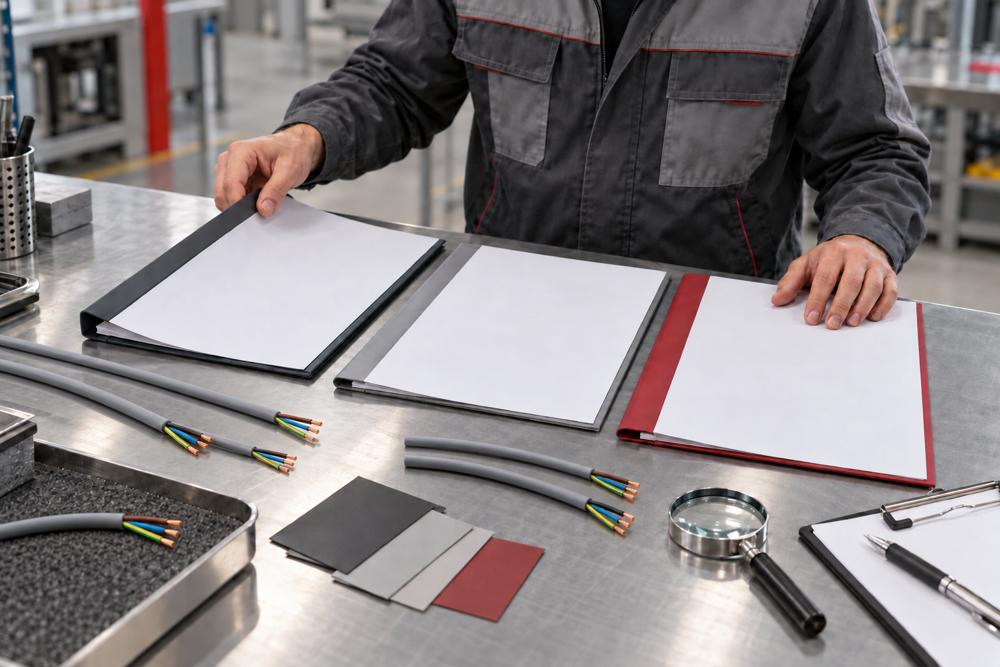
- Confirm the exact standard. Record the part number, edition, amendment status, and any project-specific acceptance criterion.
- Match the product. Check model, construction, material, size, and the range expressly covered by the report.
- Review the specimen. Distinguish tests on an individual material, a completed cable, one cable, or a cable bundle.
- Check the document source. Record laboratory identity, accreditation or recognition if required, report number, issue date, and status.
- Separate declarations and certifications. Understand whether the document is a supplier declaration, third-party test report, or certification document.
- Control the wording. Use only the claim that the report and applicable requirement actually support.
Build a ZION Control Cable Shortlist Before Compliance Review
ZION's Flex Control Cable category and Flex Control Cable / Data Cable product list can support an initial review of LiYY, LiYCY, LiYY TP, LiYCY TP, YY, CY, and SY families. Product-family names do not by themselves confirm IEC 60332, IEC 60754, IEC 61034, LSZH, or other fire-performance claims for every model and size.
| Selection question | How to evaluate a candidate |
|---|---|
| Which fire-related claims are required? | List each characteristic separately and attach the exact part, edition, and acceptance requirement. |
| Is the cable shielded? | Confirm signal sensitivity, screen construction, and termination without assuming shielding changes fire performance. |
| Will the cable move? | Request static or dynamic mechanical data independently from fire-test evidence. |
| Does the construction match the report? | Compare conductor count, size, insulation, filler, shield, jacket, diameter, and stated product scope. |
| Are machine-side terminations involved? | Review connector, overmold, and assembly requirements; relevant options may also appear under Sensor & Actuator Cables. |
Information Needed for Cable Selection and Evidence Review
Send a requirements schedule that separates circuit performance, installation conditions, and fire-related evidence. This allows the supplier to identify a candidate and disclose where model-specific documentation is needed.
- Application, building or machine location, and circuit function
- Required IEC 60332, IEC 60754, and IEC 61034 parts and editions
- Acceptance criteria and local project, building, or market requirements
- Cable model, conductor size, core or pair count, shielding, and jacket
- Rated voltage, operating current, route length, and termination details
- Fixed, occasional-flex, continuous-flex, or torsional movement
- Temperature, oil, chemicals, abrasion, and installation exposure
- Required report, declaration, certification, and laboratory status
- Product-family or size-range extension rules accepted by the project
- Quantity, destination, drawings, existing datasheet, and delivery documents
The Control Cable product category is a starting point for family comparison. Final suitability depends on the exact cable documentation and the requirements of the equipment, project, market, and relevant authority.
Frequently Asked Questions
Does a cable that passes IEC 60332 qualify as LSZH?
Not from that result alone. IEC 60332 addresses flame propagation under defined conditions, while smoke density and halogen- or acidity-related behavior require separate evidence.
Is low smoke the same as halogen-free?
No. Low-smoke performance and halogen-related behavior are different characteristics measured by different methods. A specification should state the required tests and acceptance criteria.
Can IEC 60332, IEC 60754, and IEC 61034 replace local building requirements?
No. Project, building, machinery, market, and authority requirements must be evaluated separately from these cable test methods.
What should a buyer request from a cable supplier?
Request the exact standard part and edition, tested product or documented family, specimen details, size scope, laboratory identity, report status, result, and wording supported by the evidence.



 Fiber Optic Cable
 Fiber Optic Tools
 Ethernet Cable
 Coaxial Cable
 Fire & Security Cable
 Voice, Audio & Video
 Power & Control Cable