Quick answer
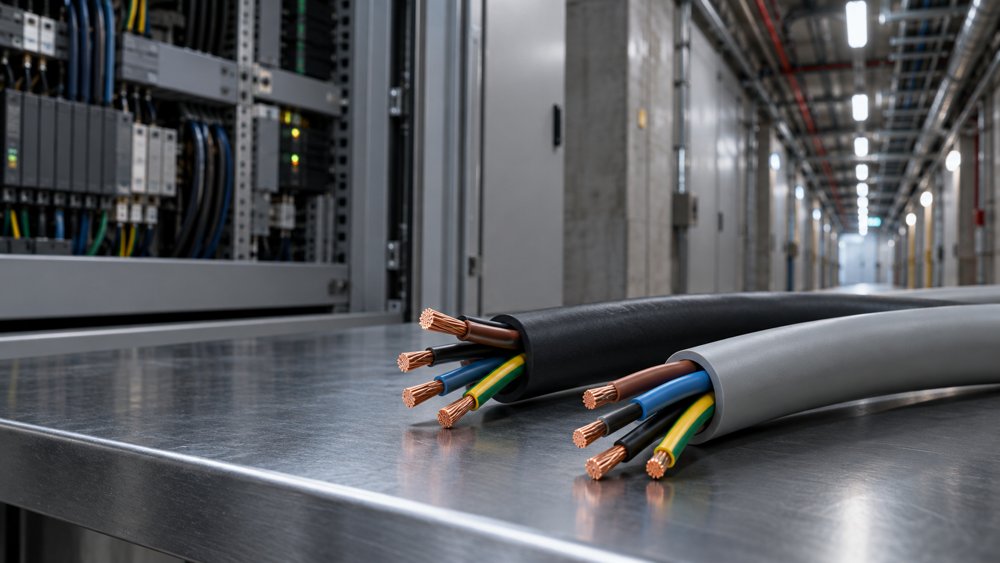
PVC and LSZH are not two directly comparable fire ratings. PVC identifies a halogen-containing polymer family commonly used in cable insulation and sheathing. LSZH—also written LS0H or LSHF in some markets—is a performance-oriented description used for compounds or cable constructions intended to produce limited smoke and low levels of halogen-acid or acidic gases under specified test conditions. HFFR means halogen-free flame-retardant; it is related but should not be treated as an exact synonym unless the stated low-smoke requirements are also verified.
Choose between them by starting with the required cable performance, not the label. Confirm the applicable flame-spread test or reaction-to-fire class, smoke requirement, gas-acidity or halogen requirement, installation rules, and mechanical and environmental duties. Then verify the exact cable construction and its supporting documentation.
Neither “PVC” nor “LSZH” alone proves that a cable is flame-retardant, fire-resistant, suitable for continuous flexing, oil-resistant, UV-resistant, or compliant with a particular building code.
Start by separating the claims
Several different fire-performance concepts are often compressed into the single term “LSZH.” A technically defensible specification treats them separately.
| Question | What it evaluates | Typical evidence |
|---|---|---|
| What materials are used? | Polymer family and cable construction | Bill of materials, compound declaration, and product datasheet |
| Does the cable limit flame spread? | Flame propagation on one cable or a defined cable bundle | Applicable part of IEC 60332 or the required regional classification |
| How much smoke is produced? | Smoke density under defined fire-test conditions | IEC 61034-2 result or an applicable regional smoke classification |
| How acidic or halogen-rich are the gases? | Halogen-acid content and potential corrosivity measured by pH and conductivity | IEC 60754-1 and/or IEC 60754-2 as required by the cable specification |
| Does the circuit operate during fire? | Circuit integrity for a defined time and test condition | Applicable IEC 60331 test or another specified fire-resistance standard |
These claims are not interchangeable. A cable can pass a flame-propagation test without being low smoke. A low-smoke material is not automatically halogen-free. An LSZH cable is not automatically fire-resistant and does not necessarily maintain circuit integrity during a fire.
PVC and LSZH describe different things
PVC is a defined polymer family, but cable-grade PVC is not one universal formulation. Plasticizers, stabilizers, fillers, flame-retardant additives, and the complete cable design affect flexibility, temperature range, oil resistance, abrasion resistance, and fire-test performance. It is therefore inaccurate to assign one set of properties to every PVC control cable.
LSZH is not one polymer chemistry or one universal certification. Commercial LSZH cable compounds may be based on different thermoplastic or cross-linked systems. The term should be supported by named test methods and acceptance criteria rather than treated as a stand-alone rating.
A low-smoke, halogen-free outer sheath does not by itself prove that every insulation, bedding, tape, filler, or separator in the finished cable meets the same requirement. Where whole-cable performance is required, request evidence for the complete construction or the exact assessment method specified by the governing cable standard.
Practical comparison
| Decision factor | PVC control cable | LSZH control cable |
|---|---|---|
| Material description | Halogen-containing PVC compound | Low-smoke, halogen-free compound systems verified against specified criteria |
| Fire behavior | Depends on formulation and complete construction; flame-retardant grades are available | Depends on formulation and complete construction; LSZH alone does not prove a flame rating |
| Smoke and gas concern | Conventional PVC can produce dense smoke and hydrogen chloride when burned; use exact-cable test data | Intended to limit smoke and acidic or halogen-containing gases under specified tests |
| Flexibility and handling | Many flexible formulations are available | Flexibility, tear resistance, installation temperature, and bend performance vary by formulation |
| Oil, chemical, abrasion, and UV resistance | Product-specific | Product-specific; do not infer these properties from LSZH alone |
| Documentation | Datasheet, flame rating, environmental ratings, approvals, and installation data | The same documents, plus applicable smoke and gas-test evidence |
This comparison describes common specification priorities, not guaranteed performance for every product.
Where each option may fit
PVC control cable may be appropriate inside industrial machines, control cabinets, and protected plant areas when the machine standard, building rules, project specification, and risk assessment permit it. Confirm oil exposure, coolant contact, abrasion, operating temperature, installation temperature, and movement duty.
LSZH control cable is often considered for occupied or difficult-to-evacuate spaces, enclosed public infrastructure, transport systems, tunnels, equipment rooms, and locations where smoke obscuration or corrosive combustion gases could increase risk or damage sensitive equipment. These are common design drivers, not automatic permissions.
A cable that runs from inside a machine into a building cable route may be subject to more than one set of requirements. Confirm where the machine boundary ends and whether the building portion requires a separate cable type or documented reaction-to-fire class.
Standards and test evidence to request
- IEC 60332-1-2 evaluates vertical flame propagation on a single insulated wire or cable under defined conditions.
- IEC 60332-3 series evaluates vertical flame spread on defined bundles of cables. The category and installed volume of non-metallic material matter.
- IEC 61034-2 measures smoke density from cables burning under defined conditions.
- IEC 60754-1 determines the amount of halogen acid gas evolved from cable materials, excluding hydrofluoric acid from its stated scope.
- IEC 60754-2 evaluates the potential corrosivity of combustion gases by measuring pH and conductivity.
- IEC 60331 series addresses circuit integrity under specified fire conditions. It is a different claim from flame retardancy or LSZH performance.
Do not write only “IEC 60332 compliant” or “IEC 60754 compliant.” State the applicable part, test category where relevant, acceptance criterion, and whether the evidence covers the exact cable construction and size range.
EU CPR is a separate decision
For power, control, and communication cables placed on the EU market for permanent installation in construction works and subject to reaction-to-fire requirements, the relevant construction-products framework and cited harmonised specification must be checked. EN 50575 has been used for these cable applications, with Euroclasses such as B2ca, Cca, Dca, Eca, or Fca and, where applicable, additional smoke, flaming-droplet, and acidity classifications.
A declaration such as Cca-s1b,d1,a1 communicates defined reaction-to-fire performance; the word “LSZH” does not replace that declaration.
The EU framework is transitioning from Regulation (EU) No 305/2011 to Regulation (EU) 2024/3110. Product families migrate as applicable technical specifications are introduced or updated, while installation requirements remain the responsibility of EU Member States. Confirm the current legal route, cited harmonised specification, declaration, CE marking, and required Euroclass for the project.
Mechanical and environmental checks still matter
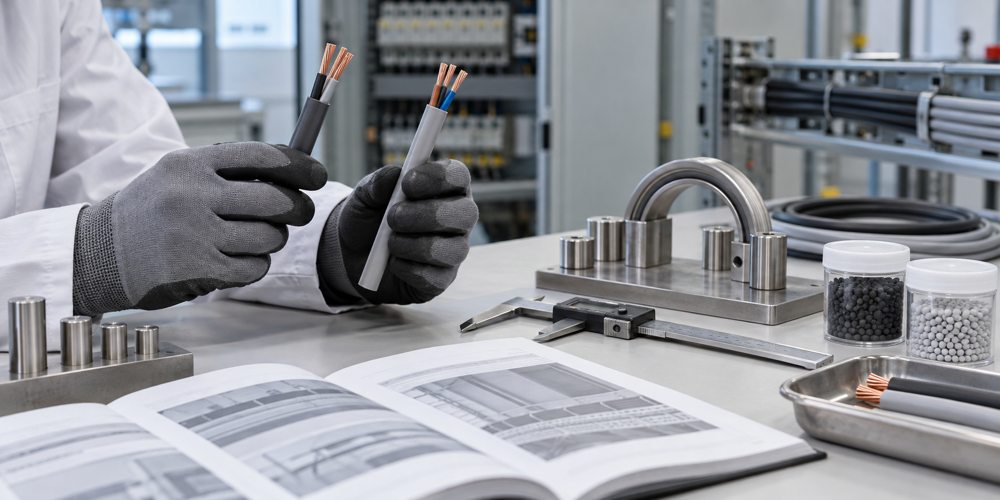
Selecting LSZH for fire-related reasons does not remove the need to verify normal service conditions. The same LSZH description can appear on products with very different mechanical properties, and the same is true for PVC cable families.
- Fixed installation, occasional movement, or continuous-flex duty.
- Conductor class, cable flexibility, and minimum bend radius.
- Pulling tension and installation temperature.
- Operating temperature and low-temperature impact or bending behavior.
- Oil, coolant, chemical, moisture, abrasion, and UV exposure.
- Indoor, outdoor, buried, tray, conduit, or free-air installation.
- Voltage rating, conductor size, screening, and electrical performance.
- Required product, machine, railway, marine, building, or regional approvals.
A defensible specification process
- Define the installation boundary. Identify whether the cable stays inside a machine, enters a building route, serves a safety circuit, or crosses multiple regulated areas.
- Name the fire-performance requirement. State the exact flame-spread test, reaction-to-fire class, smoke class, acidity or halogen criterion, and circuit-integrity requirement where applicable.
- Define normal operating conditions. Record temperature, movement, bend radius, oil, chemicals, abrasion, UV, moisture, and installation method.
- Match the complete cable construction. Confirm that insulation, fillers, tapes, bedding, screen, and sheath are covered by the required claim.
- Check size and family coverage. Ensure the report, classification, or declaration applies to the required core count, conductor size, diameter, and construction.
- Request traceable documents. Obtain the current datasheet, declaration, certificate or classification report, and relevant test evidence for the exact part number.
- Resolve conflicts before ordering. Fire performance, flexibility, chemical resistance, dimensions, and approvals may require a different compound or cable family.
Common specification errors
- Writing “LSZH flame-retardant” without naming the required flame test or Euroclass.
- Treating low smoke, halogen-free, flame-retardant, and fire-resistant as synonyms.
- Claiming that LSZH smoke is “non-toxic.” IEC 60754 and IEC 61034 do not establish that broad claim.
- Assuming “zero halogen” is an absolute material statement without a referenced method and acceptance limit.
- Applying a sheath-compound result to the complete cable without checking the other non-metallic components.
- Assuming every PVC cable has the same smoke, flame, oil, or temperature performance.
- Choosing LSZH while overlooking flex life, low-temperature handling, oil resistance, or installation pulling limits.
- Declaring a cable “CPR compliant” without the applicable Euroclass and product documentation.
- Applying one test report or declaration to every size and construction in a cable family.
Frequently asked questions
Is LSZH always required indoors?
No. Indoor installation alone does not define the requirement. The answer depends on the jurisdiction, building or transport rules, evacuation strategy, cable route, project specification, and required reaction-to-fire performance.
Is LSZH automatically flame-retardant?
No. Low-smoke and halogen-related claims do not prove flame propagation performance. Request the specified IEC 60332 result, CPR Euroclass, or other required regional flame rating for the exact cable.
Is LSZH automatically CPR compliant?
No. LSZH terminology and CPR reaction-to-fire classification are different. Confirm whether the construction-products framework applies, then request the applicable declaration, CE-marking information, and Euroclass for the exact product.
Does LSZH mean the smoke is non-toxic?
No. “Low smoke” concerns measured smoke density, while IEC 60754 methods address halogen-acid content or gas acidity and conductivity. These results should not be expanded into an unqualified “non-toxic smoke” claim.
Is PVC unsuitable for every public building or enclosed space?
No universal conclusion can be made from the material name alone. The permitted cable depends on national installation rules, project fire strategy, route, occupancy, and the verified classification of the finished cable.
What should be sent to ZION for cable selection?
Provide the installation country, route and building or machine context, required standards and fire classification, voltage and conductor sizes, core count, screening requirement, movement duty, temperature range, oil or chemical exposure, UV or moisture exposure, and the documents required for approval.
Official references used for technical review
- IEC 60332 series, Tests on electric and optical fibre cables under fire conditions.
- IEC 60754-1, Determination of the halogen acid gas content.
- IEC 60754-2, Determination of acidity by pH measurement and conductivity.
- IEC 61034-2, Measurement of smoke density of cables burning under defined conditions.
- IEC 62821-1, Halogen-free, low-smoke thermoplastic insulated and sheathed cables—general requirements.
- European Commission, Construction Products Regulation overview.
- Regulation (EU) 2024/3110 and Commission Delegated Regulation (EU) 2026/331.
Prepare a part-number-level cable review
Send the installation country, cable route, required fire classification, voltage, core count, conductor size, screening, movement duty, temperature, environmental exposure, destination market, and required approval documents.
Request Project Support



 Fiber Optic Cable
 Fiber Optic Tools
 Ethernet Cable
 Coaxial Cable
 Fire & Security Cable
 Voice, Audio & Video
 Power & Control Cable