How Do You Select Control Cable for a Packaging Machine?
Select each cable route by answering five questions: what circuit it serves, which voltage and conductor arrangement it requires, whether EMI shielding is needed, whether the route is fixed or moving, and which temperature, abrasion, oil, chemical or washdown conditions apply.
Packaging machines rarely use one universal cable. A protected PLC cabinet may use conventional multicore control cable, a noise-sensitive sensor route may need screened or twisted-pair construction, and a moving carriage may require a cable with documented continuous-flex performance. Motor power, encoder and industrial communication connections must follow their own equipment requirements.
Divide the Packaging Machine into Cable Zones
Start with the machine layout and electrical schematic. Mark each route as fixed, exposed, occasionally moving or continuously moving, then identify the circuit carried through that zone.
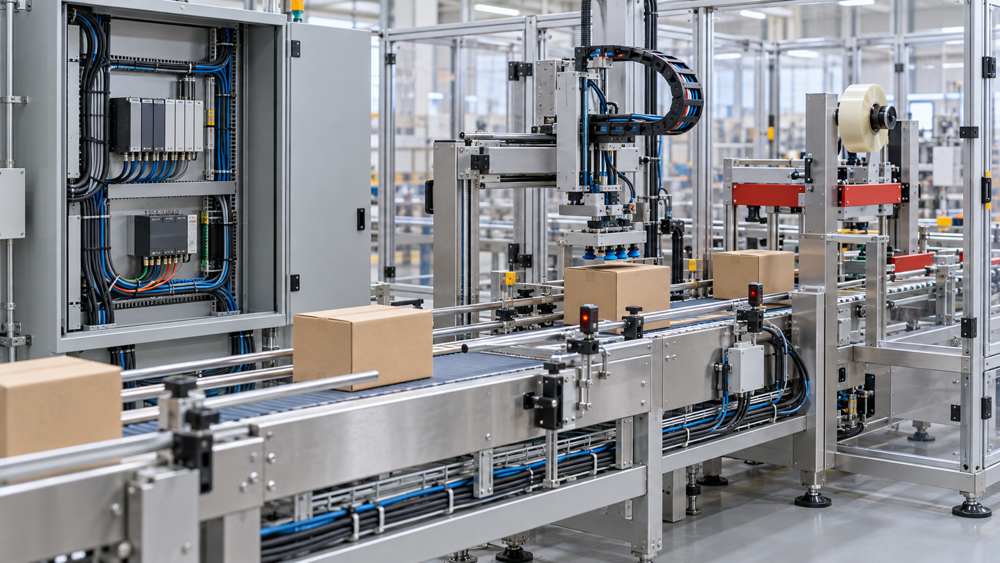
| Machine zone | Typical circuits | Main selection concern |
|---|---|---|
| Control cabinet | PLC I/O, relays and terminals | Voltage, conductor count, identification and routing |
| Infeed conveyor | Sensors, switches and actuators | Signal reliability and abrasion protection |
| Filling or processing | Sensors, solenoids and instruments | EMI and environmental exposure |
| Sealing station | Temperature sensors and actuators | Route temperature and signal integrity |
| Servo or VFD section | Motor power, feedback and control | Drive compatibility and EMC separation |
| Moving carriage | Control, sensor and feedback wiring | Dynamic bending or torsion performance |
| Safety guards | Interlocks and monitoring circuits | Approved safety architecture and installation |
Match the Cable to Each Machine Subsystem
PLC control cabinets
Protected cabinet wiring usually prioritizes voltage rating, conductor cross-section, identification, routing and termination. LiYY or YY may be evaluated for general low-interference control circuits, while LiYCY or CY may suit compatible routes that require screening.
Photoelectric and proximity sensors
Confirm the sensor voltage, output configuration, conductor arrangement, route length, connector and EMI exposure. A suitable sensor and actuator cable can serve standard device connections; selected analogue circuits may require twisted pairs or screening.
Solenoid valves and pneumatic actuators
Match conductor size and voltage drop to coil current and cable length. Consider switching transients at the circuit level, including the protection specified for the valve and controller.
Servo drives and VFD systems
Drive sections can introduce interference into nearby control and measurement wiring. Screened control cable may suit compatible control signals, but it does not automatically replace the motor power, encoder, feedback or communication cable specified by the drive manufacturer.
HMI and operator panels
Stationary switches and indicators may use general control wiring. Adjustable arms or moving operator stations require a defined motion profile, while communication interfaces need protocol-compatible cable. Safety circuits follow the approved machine safety design.
LiYY, LiYCY, YY, CY and SY: What Changes?
These common flex control cable families provide different combinations of conductor arrangement, shielding and mechanical protection.
| Cable family | General construction | Preliminary application direction |
|---|---|---|
| LiYY | Unshielded multicore control/data cable | Protected cabinet and selected signal/control wiring |
| LiYCY | Copper-braid screened control/data cable | Compatible screened PLC and instrument routes |
| LiYY TP | Unshielded twisted-pair control/data cable | Selected paired signal circuits |
| LiYCY TP | Twisted pairs with copper-braid screening | Selected noise-sensitive paired circuits |
| YY | Unshielded multicore control cable | General machinery control wiring |
| CY | Copper-braid screened control cable | Compatible screened machinery control wiring |
| SY | Steel-wire-braid protected control cable | Routes requiring additional mechanical protection |
Copper braid and steel-wire braid serve different purposes: CY-type copper screening supports EMC control in suitable circuits, while SY steel-wire braid adds mechanical protection. Neither the family name nor the word “flexible” proves washdown, high-temperature, communication or continuous-motion suitability.
Flexible Cable vs. Continuous-Flex Cable
Installation flexibility describes how a cable can be handled or bent under its permitted conditions. Continuous-flex performance describes repeated dynamic movement and requires a construction evaluated for that duty.
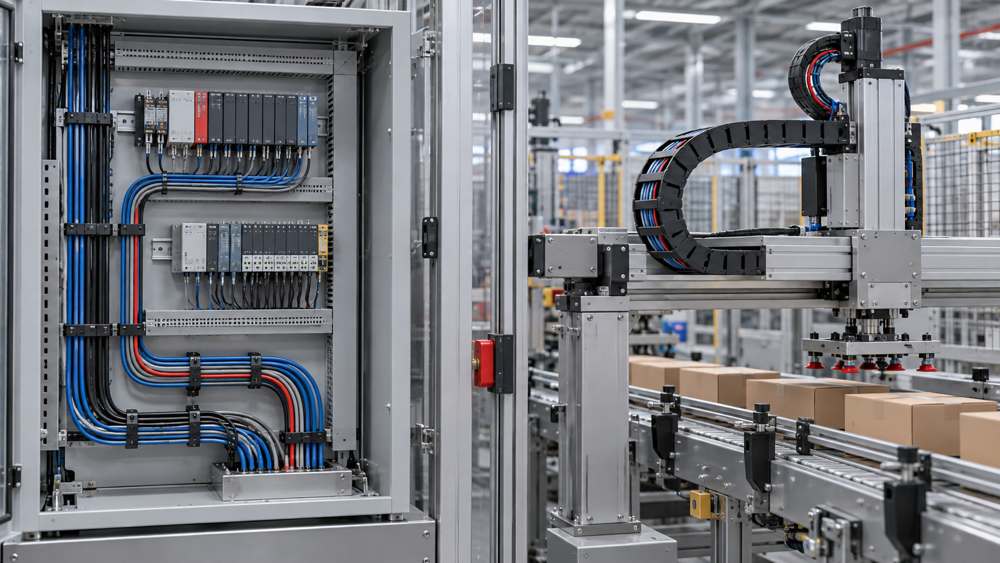
For a moving carriage, gantry, sealing head or drag chain, specify:
- Minimum dynamic bend radius and cable carrier geometry
- Travel length, acceleration and operating speed
- Expected cycles and the test conditions used to support them
- Torsion, temperature, abrasion and chemical exposure
- Installation, guidance and strain-relief requirements
Standard LiYY, LiYCY, YY, CY and SY descriptions do not establish drag-chain suitability. Use exact product documentation that covers the required motion profile.
How to Manage EMI in Packaging Machine Wiring
Unstable analogue readings, communication errors or unexpected input changes can occur when sensitive circuits share an unfavorable electromagnetic environment with motors, drives and switching equipment. Cable selection is one part of the remedy.
Keep sensitive signal wiring away from motor power and inverter-output cables according to the installation plan.
Evaluate LiYCY, CY or LiYCY TP where copper-braid screening matches the circuit and equipment instructions.
Apply the bonding method defined by the equipment manufacturer and system EMC design.
Twisted pairs can improve balance, but protocol-specific interfaces still require their specified electrical characteristics.
Choose the Jacket for the Real Environment
PVC can be an economical choice for protected industrial control wiring when its documented temperature and mechanical properties fit the route. LSZH may be specified where smoke and halogen-related fire requirements matter, but the designation does not establish chemical, washdown or continuous-flex performance.
Food, beverage, pharmaceutical and cleaning-intensive lines may expose cables, glands and connectors to water, detergents, disinfectants, oils and process chemicals. Confirm compatibility with the actual substances, concentration, temperature and cleaning frequency. For sealing stations, evaluate the cable-route temperature rather than the temperature of the packaged product or heater setpoint.
Example: Automatic Carton Packaging Line
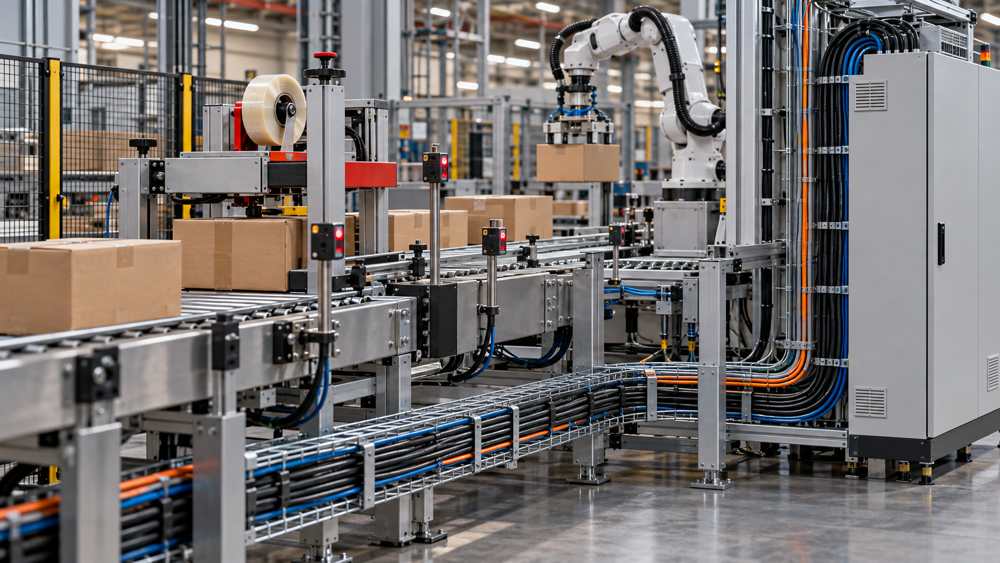
Consider an automatic line with an infeed conveyor, product sensors, pneumatic pushers, folding equipment, a sealing station and discharge conveyor. A central PLC controls the line while motors and VFDs drive the conveyors.
| Cable zone | Circuit | Preliminary selection direction |
|---|---|---|
| Main PLC cabinet | Standard control I/O | LiYY or YY where electrical conditions permit |
| Photoelectric sensor route | Discrete sensor signals | Suitable sensor/actuator cable |
| Analogue measurement | Low-level feedback | Evaluate LiYY TP or LiYCY TP |
| Valve station | Solenoid controls | Appropriately rated multicore control cable |
| VFD-adjacent control route | Noise-sensitive control | Evaluate screened LiYCY or CY |
| Conveyor drive power | Motor supply | Drive-manufacturer-specified motor/VFD cable |
| Folding or sealing carriage | Repeatedly moving signals | Verified continuous-flex construction |
| Exposed machine frame | Control wiring exposed to damage | Suitable mechanical protection, including SY where appropriate |
The final schedule follows the complete schematic, mechanical layout, environmental requirements and product data. The broader power and control cable solution can support product-family evaluation for machinery projects.
Build a Packaging Machine OEM Cable Specification
A route-by-route cable schedule improves purchasing consistency, assembly documentation and after-sales maintenance. It also separates standard cabinet wiring from screened, exposed and dynamic applications.
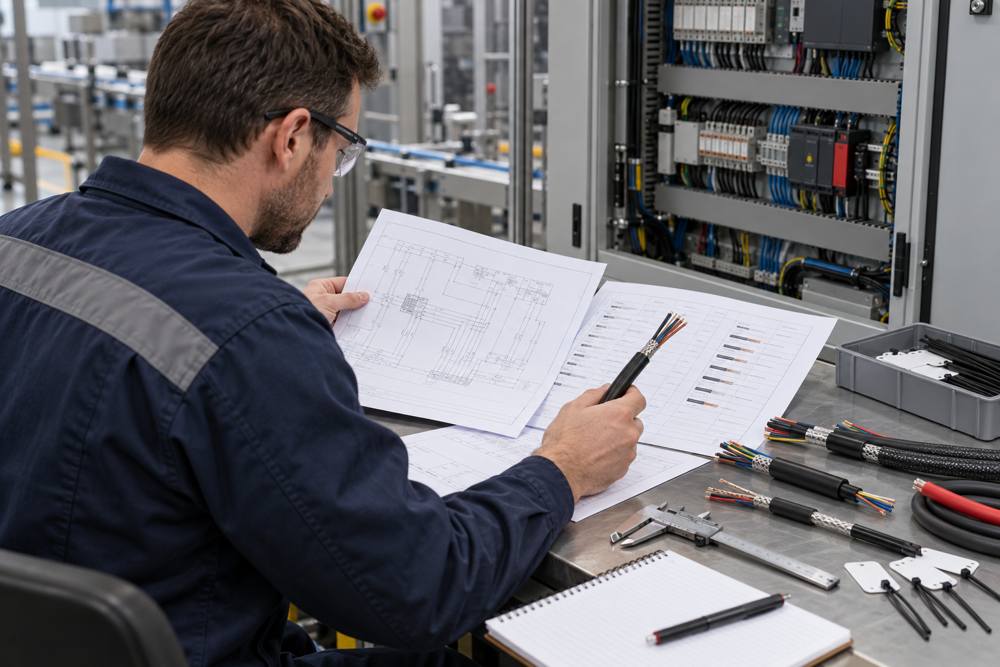
| Specification field | Information to provide |
|---|---|
| Machine subsystem | Conveyor, filler, sealer, HMI, cabinet or moving carriage |
| Circuit function | Power, control, analogue, digital or communication |
| Electrical requirements | Rated voltage, conductor size, core or pair count and protective conductor |
| Shielding | Unshielded, overall braid, pair screen and termination plan |
| Jacket and environment | Material, temperature, oil, chemicals, water and abrasion |
| Movement | Fixed, occasional movement, continuous flex, bend radius, travel and speed |
| Termination | Bare ends, plugs, glands or harness requirements |
| Compliance | Applicable standards, approvals, test evidence and documentation |
| Purchasing | Route length, total quantity, marking and packing method |
OEMs can standardize approved groups for cabinet control, screened analogue signals, sensor connections and verified dynamic-motion wiring. Standardization should still preserve differences in voltage, circuit function, environment and movement.
Common Packaging Machine Cable Selection Mistakes
Sensor, drive, communication, safety and moving routes can require different electrical and mechanical properties.
Route sensitive circuits according to the approved EMC and separation plan.
Copper EMC screening, steel-wire mechanical protection and individually screened pairs serve different functions.
Dry-cabinet suitability does not prove resistance to washdown chemicals or disinfectants.
Suppliers need bend radius, travel, speed, cycles and torsion to assess dynamic suitability.
Identification, service loops, termination access and replacement routing affect long-term serviceability.
Frequently Asked Questions
What is the best control cable for a packaging machine?
There is no single best cable for every subsystem. Select separate cables for PLC control wiring, sensors, motor-drive areas, exposed routes and moving assemblies according to circuit and installation duty.
Can CY cable be used throughout a packaging machine?
CY may suit certain screened control circuits, but other sections can require unshielded control cable, protocol-specific communication cable, mechanical protection or documented continuous-flex performance.
What is the difference between LiYY and LiYCY cable?
LiYY is an unshielded control/data cable family, while LiYCY includes copper-braid screening. Select according to signal requirements, EMI exposure and the exact electrical and environmental ratings.
Is SY cable suitable for moving packaging machines?
SY provides steel-wire-braid mechanical protection, but this does not establish continuous-motion or drag-chain suitability. Verify dynamic performance for the exact product and motion profile.
Are ordinary flexible control cables suitable for drag chains?
Not necessarily. Installation flexibility does not prove repetitive bending endurance. Use a cable with documented continuous-flex performance for the required bend radius, travel, speed and cycle duty.
What information should an OEM provide when requesting a quotation?
Provide the cable schedule, machine subsystem, circuit function, voltage, conductor configuration, shielding, route length, movement, environment, standards, quantity and documentation requirements.



 Fiber Optic Cable
 Fiber Optic Tools
 Ethernet Cable
 Coaxial Cable
 Fire & Security Cable
 Voice, Audio & Video
 Power & Control Cable