RF Cable Assemblies for an Ambulance Convoy
Author: Site Editor Publish Time: 10-09-2016 Origin: Site

RF Cable Assemblies for a 2016 Senegal Ambulance ConvoyA historical volunteer-project account shows how replacement coaxial cable assemblies supported 27 MHz radio communication for a multi-vehicle ambulance journey from the Netherlands to Senegal.
■Historical Project Background
According to the original volunteer account, Fieke and Nico van Stiphout joined an initiative connected with Modou Ba to prepare a four-wheel-drive vehicle as an ambulance for Darou Fall in Senegal. The vehicle interior was being rebuilt with a cleanable lining, while emergency equipment, exterior lights, and identification markings were also planned.
The journey was organized with the volunteer development organization Go for Africa. The project account described a planned departure from Bakel in the Netherlands on 14 February 2016, with the ambulance travelling as part of a convoy to West Africa.
■Why Convoy Communication Mattered
The account described a convoy of 14 vehicles that could travel in smaller groups of four or five. Radio communication was therefore important for coordinating vehicle movements and maintaining contact when the convoy was divided.
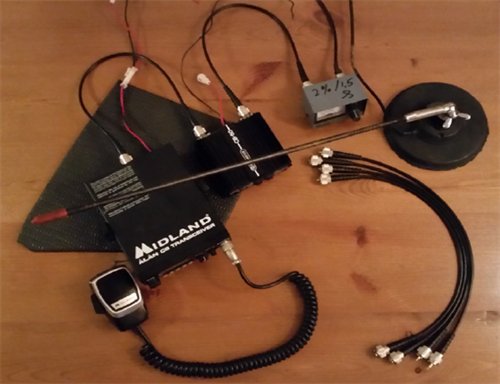
Because the budget was limited, the group sourced second-hand 27 MHz radio equipment. During preparation, the volunteers found that the existing RF cable assemblies were faulty, creating a practical problem between the radios, amplifiers, antenna-tuning equipment, and vehicle antennas.
■Donated RF Cable Assembly Support
After the volunteers explained the charity project and the equipment problem, COAX Connectors Ltd supplied a set of replacement coaxial cable assemblies. The project account reported that these assemblies helped complete the connections between the 27 MHz radios, amplifiers, and antenna-tuning equipment used by the driving group.
■RF Cable Assembly Checks for Similar Projects
For comparable mobile-radio projects, a cable assembly should be selected as part of the complete RF system rather than as an isolated component. If the equipment requires a 50-ohm RF path, review the available 50 Ohm coaxial cable constructions against the radio, amplifier, connector, installation, and environmental requirements.
01Confirm the required cable impedance and connector interfaces for every device in the RF path.
02Choose a practical cable length and route that protects the assembly from sharp bends, crushing, heat, and abrasion.
03Inspect terminations, connector retention, and cable continuity before installation and again before departure.
04Tune and test the antenna system after final installation, using the complete radio, amplifier, cable, and antenna configuration.



 Fiber Optic Tools
Products 6 families
Solutions 6 markets
Resources Tools & docs
Certificate
Certification and compliance references for project review, qualification and purchasing documentation.

 Fiber Optic CableAccess and backbone
 Ethernet CableCat5e to Cat8
 Coaxial CableRF and video signal
 Fire, Security & AlarmSafety systems
 Voice, Audio & VideoSignal cabling
 Power & Control CableEnergy and control
Fiber optic cable systems
Outdoor, indoor, FTTH and distribution cable lines for access networks, backbone routes and campus deployments.
 Telecom & ISP NetworksFTTH, PON, ODN
 Data Center InfrastructureServer room cabling
 Building Low-Voltage SystemsBMS, AV, weak current
 Security & Fire ProtectionAlarm, CCTV, access
 Industrial Automation CablePLC, RS485, fieldbus
 Energy & Power InfrastructureSolar, battery, power
Telecom & ISP Networks
For FTTH / PON access, outdoor fiber deployment, aerial routes, duct routes, direct burial routes, rural broadband and ODN planning.
Tools
Use calculators and planning tools for conduit capacity, PoE voltage drop and fiber optic link loss budget work.