What is the GYXTZW fiber optic cable?
Author: James Xu Publish Time: 26-09-2018 Origin: https://www.zion-communication.com/
What Is GYXTZW Fiber Optic Cable? GYXTZW describes a compact outdoor central loose-tube cable with metallic reinforcement. This guide explains its construction, applications, specification limits, and relationship to ZION's GYXTW product family.
GYXTZW refers to a central loose-tube outdoor cable with metallic reinforcement. ZION's product catalog lists a closely matching construction under GYXTW. Cable model codes can vary by manufacturer and market, so the exact code, drawing, datasheet, fiber category, sheath material, mechanical ratings, and approved installation method should be confirmed in the quotation.
■What Does the GYXTZW Name Refer To?
GYXTZW is described as a central loose-tube outdoor optical cable with water-blocking compound, a steel-polyethylene bonded layer, two parallel steel reinforcing wires, and an outer sheath. This construction closely aligns with the GYXTW family shown in ZION's fiber optic cable product catalog.
Important naming check: The extra “Z” does not by itself establish a fire-performance classification. ZION's linked GYXTW product pages describe PE outdoor sheaths. If flame performance is required, request the exact sheath compound, test standard, classification, and supporting report.
■Central Loose-Tube Cable Structure
The optical fibers sit inside one central loose tube, commonly made from a high-modulus polymer. The loose tube allows controlled fiber movement and helps isolate the fibers from part of the strain applied to the cable. A filling compound or another declared water-blocking system limits longitudinal water migration. A bonded metallic layer improves moisture and crush protection, parallel steel wires support the specified tensile load, and the outer sheath protects the cable in its intended outdoor environment.

Central loose tube: Creates a compact cable for a defined fiber-count range. Confirm the available count and tube capacity on the selected product sheet.
Water blocking: Filling compound or another declared barrier helps restrict water movement. Confirm the material and preparation procedure before splicing.
Metallic protection: The steel-polyethylene bonded layer and reinforcing wires improve mechanical performance but introduce grounding, bonding, lightning, and electrical-separation considerations.
Outer sheath: The material and rating must match the route. Do not infer indoor fire performance, UV resistance, chemical resistance, or direct-burial approval from the model name alone.
■Where Can This Cable Construction Be Used?
A correctly specified central-tube light-armored cable can suit outdoor telecom access, campus links, CCTV backhaul, industrial communication, ducts, conduits, tunnels, and approved lashed aerial routes. ZION's current GYXTW PSP-armored central-tube optical cable is a product-specific example for duct and other declared outdoor installation methods.
Do not assume that every cable in this family is self-supporting, directly buriable, suitable for unlimited aerial spans, or approved for building interiors. Route approval depends on the exact installation tensile load, long-term tensile load, crush resistance, minimum bend radius, support method, water penetration performance, temperature range, sheath rating, and local requirements. A building entrance may require transition to an approved indoor or indoor/outdoor cable.
■Fiber Type, Count, and Color Identification
The cable code describes construction; it does not by itself define optical performance. G.652.D single-mode fiber is a common option for outdoor access and telecom links, but the required fiber category must come from the link budget, operating wavelengths, bend conditions, equipment interfaces, and network-owner specification. The current ITU-T G.652 recommendation covers single-mode fiber and cable optimized around 1310 nm and also used in the 1550 nm region.
A commonly used 12-color sequence is blue, orange, green, brown, gray, white, red, black, yellow, violet, pink, and aqua. The final sequence, fiber count, numbering, and tube identification must match the cable datasheet, project standard, and splice plan.

■How to Read the Optical Specifications
Fiber attenuation, dispersion, mode-field diameter, cut-off wavelength, and PMD limits are not universal cable values. They must be checked against the applicable fiber recommendation, the selected manufacturer's datasheet, the finished-cable test report, and the project acceptance criteria.
A G.652.D designation does not by itself guarantee 10 Gbit/s over 3000 km or 40 Gbit/s over 80 km. System reach depends on transmitter power, receiver sensitivity, wavelength, modulation, connectors, splices, splitters, attenuation margin, chromatic dispersion, PMD, amplifier design, and equipment-specific limits. Build a complete optical link budget and dispersion assessment for the actual system.
■Information to Confirm Before Ordering
Exact cable code and cross-sectional drawing, including what the “Z” denotes in the supplier's nomenclature
Fiber category, fiber count, color-code convention, attenuation limits, and test wavelengths
Route type: duct, conduit, tunnel, lashed aerial, tray, protected burial, or another pathway
Cable diameter and mass, tensile and crush ratings, impact performance, and minimum bend radius
Water-blocking method, temperature range, UV exposure, rodent risk, and sheath material
Grounding, bonding, lightning, and separation requirements for metallic components
Required standard edition, fire or environmental classification, reports, sheath marking, drum length, and packing
For a wider comparison of outdoor cable structures and current model availability, review ZION's outdoor duct fiber optic cable selection page.
■Frequently Asked Questions
Is GYXTZW the same as GYXTW?
GYXTZW and GYXTW are used for closely related central loose-tube constructions, but the codes should not be assumed to be interchangeable for an order. Confirm the supplier's exact code, cross-sectional drawing, sheath material, mechanical ratings, and datasheet.
Is this an armored fiber optic cable?
The described construction uses a steel-polyethylene bonded layer and parallel steel wires, so it is commonly treated as light armored. Confirm the actual metallic layers and declared mechanical ratings on the selected product drawing.
Can it be installed overhead?
It may suit an approved lashed aerial route, but it should not automatically be treated as self-supporting. Confirm tensile ratings, span, support hardware, wind and ice loads, and the manufacturer's installation instructions.
Does GYXTZW guarantee G.652.D fiber?
No. The cable name refers to construction, while the optical fiber category must be specified separately. Verify the selected fiber, attenuation limits, wavelength range, and test report.



 Fiber Optic Tools
Products 6 families
Solutions 6 markets
Resources Tools & docs
Certificate
Certification and compliance references for project review, qualification and purchasing documentation.

 Fiber Optic CableAccess and backbone
 Ethernet CableCat5e to Cat8
 Coaxial CableRF and video signal
 Fire, Security & AlarmSafety systems
 Voice, Audio & VideoSignal cabling
 Power & Control CableEnergy and control
Fiber optic cable systems
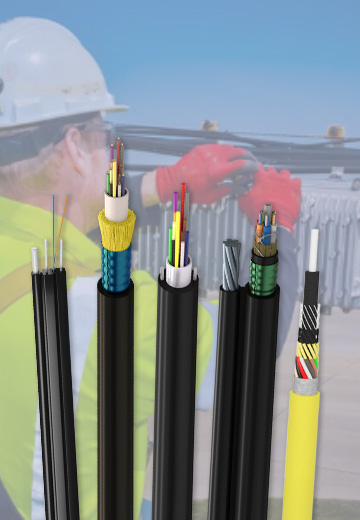
Outdoor, indoor, FTTH and distribution cable lines for access networks, backbone routes and campus deployments.
 Telecom & ISP NetworksFTTH, PON, ODN
 Data Center InfrastructureServer room cabling
 Building Low-Voltage SystemsBMS, AV, weak current
 Security & Fire ProtectionAlarm, CCTV, access
 Industrial Automation CablePLC, RS485, fieldbus
 Energy & Power InfrastructureSolar, battery, power
Telecom & ISP Networks
For FTTH / PON access, outdoor fiber deployment, aerial routes, duct routes, direct burial routes, rural broadband and ODN planning.
Tools
Use calculators and planning tools for conduit capacity, PoE voltage drop and fiber optic link loss budget work.