3 most important types of fiber cables
Author: James Xu Publish Time: 01-12-2018 Origin: zion communication
Three Fiber Optic Cable Structures
How stranded loose-tube, central-tube, and tight-buffered constructions differ—and what to specify before ordering.
Fiber optic cables can be grouped in several ways: by optical fiber type, cable construction, installation environment, strength system, armor, or jacket. For an early project decision, construction is a useful starting point. Three common families are stranded loose-tube cable, central loose-tube cable, and tight-buffered cable. Each organizes and protects the fibers differently, so the right choice depends on route conditions, fiber count, termination method, handling, and applicable standards—not on structure name alone.
1. Stranded Loose-Tube Fiber Cable
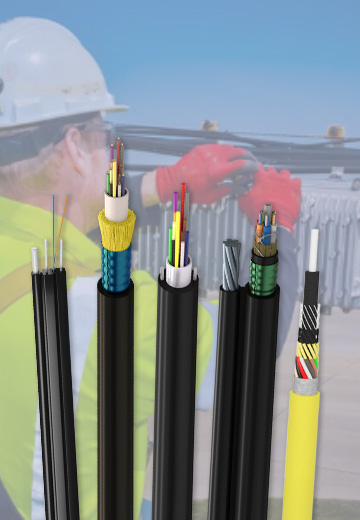
A stranded loose-tube cable places fibers inside several protective tubes that are stranded around a central strength member. The tubes provide organized fiber groups, while the stranding and excess fiber length help the cable accommodate installation tension, temperature changes, and bending within the limits of the design.

This structure is widely used for outside-plant routes that need multiple fiber groups or higher fiber counts. Depending on the exact design, it can be combined with water-blocking materials, metallic or dielectric strength members, armor, messenger systems, or single and double jackets for duct, aerial, or direct-buried applications.
Stranded construction is not automatically suitable for every outdoor route. The cable data sheet must still confirm tensile load, crush resistance, minimum bend radius, temperature range, water penetration performance, installation method, and compatibility with the planned closures and hardware. ZION's outdoor multi-tube fiber optic cable range provides examples of this structure for project-specific comparison.
2. Central Loose-Tube Fiber Cable
A central-tube cable places the fibers in one tube near the cable axis. Strength members and protective layers are arranged around that tube. With fewer structural elements than a multi-tube design, the cable can be compact and straightforward to access, particularly for low-to-moderate fiber-count routes.

Central-tube designs are available for duct, aerial, direct-buried, access, and other applications when the surrounding jacket and reinforcement are engineered for that environment. Compact diameter can help with pathway occupancy, but the installer must still check pulling tension, tube access, mid-span work requirements, and the cable's response to the actual route.
For routes where a single central loose tube fits the fiber count and access plan, review ZION's outdoor central-tube fiber cable options. Use the model data sheet to confirm the reinforcement, water blocking, jacket, and installation rating rather than assuming all central-tube cables share the same protection.
3. Tight-Buffered Fiber Cable
In a tight-buffered cable, a protective buffer is applied closely around each optical fiber. Buffered fibers may be gathered under one jacket in a distribution cable or individually strengthened and jacketed inside a breakout cable. This construction supports direct handling and termination without opening a gel-filled or dry loose tube.

Tight-buffered designs are common for indoor building distribution, equipment rooms, pigtails, patch cords, and short interconnection runs. Distribution cable offers a smaller overall size, while breakout cable provides more individual subunit protection and easier direct connectorization at the cost of larger diameter and weight.
A tight buffer does not, by itself, establish flame rating, outdoor suitability, water resistance, or mechanical load capacity. Confirm the complete construction and project requirements. ZION's indoor fiber optic cable range includes tight-buffered and other building-cabling constructions for comparison.
Structure Comparison
Stranded loose tube: multiple buffer tubes around a strength member; useful when the route needs organized fiber groups, scalable counts, and robust outside-plant construction.
Central loose tube: fibers share one central tube; often compact and practical for low-to-moderate counts where the access and splicing plan suits one fiber group.
Tight buffered: each fiber has a close protective buffer; convenient for indoor handling, direct termination, distribution cable, breakout cable, pigtails, and patching.
These are construction families, not universal performance rankings. A compact central-tube cable may be the best fit for one duct route, a stranded design may suit a higher-count backbone, and a tight-buffered cable may simplify an indoor termination plan. The final choice follows the route, installation method, mechanical loads, fire requirements, fiber count, and maintenance strategy.
Fiber Type Is a Separate Decision
Cable structure describes how fibers are protected; it does not identify the optical fiber inside. A stranded, central-tube, or tight-buffered cable may be built with different fiber types when the design permits. The fiber specification must match the optical system, wavelength plan, reach, transceivers, splice plan, and applicable project standard.
ITU-T G.652.D single-mode fiber is widely used for general telecom transmission around the 1310 nm and 1550 nm regions.
ITU-T G.657 single-mode fiber is designed with improved bending-loss performance for access, building, high-density, and other bend-sensitive installations; the exact category still matters.
OM1, OM2, OM3, OM4, and OM5 multimode fibers serve different short-reach building and data-center applications and must be matched to the Ethernet or storage application.
Jacket, Water Blocking, and Armor
After selecting the structure and fiber type, specify how the cable will survive its environment. Jacket materials such as PE, PVC, LSZH, or track-resistant formulations serve different installation and regulatory needs. A material name alone does not prove a flame classification, sunlight rating, chemical resistance, or suitability for a building pathway.
Water-blocking yarns, tapes, or filling compounds address moisture migration in different ways. Steel wire, corrugated steel tape, aluminum-polyethylene laminate, aramid yarn, and glass-reinforced elements can provide strength, crush resistance, moisture protection, rodent deterrence, or dielectric performance depending on the design. More layers are not automatically better: each layer should answer a defined route risk and remain compatible with grounding, handling, closure entry, and installation tools.
Information Needed Before Ordering
application and route: indoor, outdoor, duct, direct buried, aerial, tray, riser, or equipment interconnection;
fiber type, fiber count, wavelength, link distance, and optical system;
preferred structure: stranded loose tube, central tube, tight-buffered distribution, or breakout;
installation loads, span or pulling conditions, bend limits, and pathway size;
water blocking, armor, rodent protection, dielectric construction, and grounding requirements;
jacket material, flame or smoke requirement, UV exposure, temperature, and chemical environment;
termination method, connectors, splice closures, breakout hardware, and cable entry dimensions;
required standards, test reports, drum length, marking, packaging, and delivery documentation.
Frequently Asked Questions
Is loose-tube cable always for outdoor use?
No. Loose-tube structure describes fiber organization. Outdoor, indoor, or indoor/outdoor suitability depends on the complete cable construction, jacket, water blocking, flame rating, and product documentation.
What is the difference between central-tube and stranded loose-tube cable?
Central-tube cable places fibers in one central tube. Stranded cable uses several tubes arranged around a strength member, allowing separate fiber groups and typically a wider range of scalable counts.
Is tight-buffered cable easier to terminate?
It often supports direct handling and connectorization more conveniently than loose-tube cable, but the exact distribution or breakout construction and termination hardware determine the work process.
Does cable structure determine single-mode or multimode fiber?
No. Structure and optical fiber type are separate specifications. Confirm both the cable construction and the exact fiber standard required by the system.
Is a double jacket always better than a single jacket?
Not automatically. A double jacket may add protection for a defined route, but it also affects diameter, weight, flexibility, preparation, and cost. Select the construction from the actual mechanical and environmental requirements.



 Fiber Optic Tools
Products 6 families
Solutions 6 markets
Resources Tools & docs
Certificate
Certification and compliance references for project review, qualification and purchasing documentation.

 Fiber Optic CableAccess and backbone
 Ethernet CableCat5e to Cat8
 Coaxial CableRF and video signal
 Fire, Security & AlarmSafety systems
 Voice, Audio & VideoSignal cabling
 Power & Control CableEnergy and control
Fiber optic cable systems
Outdoor, indoor, FTTH and distribution cable lines for access networks, backbone routes and campus deployments.
 Telecom & ISP NetworksFTTH, PON, ODN
 Data Center InfrastructureServer room cabling
 Building Low-Voltage SystemsBMS, AV, weak current
 Security & Fire ProtectionAlarm, CCTV, access
 Industrial Automation CablePLC, RS485, fieldbus
 Energy & Power InfrastructureSolar, battery, power
Telecom & ISP Networks
For FTTH / PON access, outdoor fiber deployment, aerial routes, duct routes, direct burial routes, rural broadband and ODN planning.
Tools
Use calculators and planning tools for conduit capacity, PoE voltage drop and fiber optic link loss budget work.