Identify which length you are comparing
Delivered cable length is the physical cable quantity agreed in the purchase order. Jacket meter marks provide position references along the sheath. Tester-reported length is an estimate derived from electrical measurements. Keep these three records separate until the measurement conditions are known.
Also check feet and meters. Exactly 1,000 ft is 304.8 m, while exactly 305 m is slightly longer. Commercial descriptions often pair these labels, but the purchase order should state the contractual unit, nominal length and agreed tolerance. The 0.2 m conversion difference does not explain a large discrepancy.
The ZION 7112202 U/UTP Cat6 PVC product page lists several supply lengths. Specify the selected package in the order instead of assuming that every box or spool uses the same length convention.
Understand NVP before changing the setting
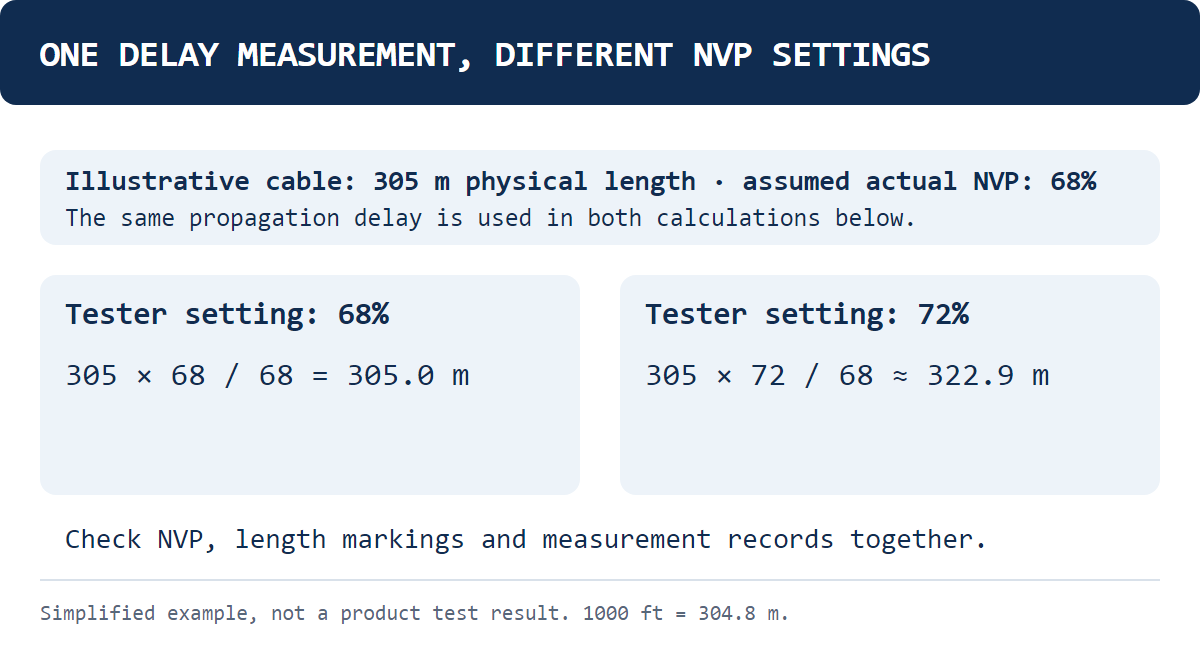
NVP means nominal velocity of propagation: the signal velocity expressed relative to the speed of light. In a simplified time-domain reflection model, estimated length equals signal velocity multiplied by round-trip time, divided by two. Holding the timing measurement constant, a higher NVP setting produces a longer calculated length.
For illustration only, assume a cable whose appropriate effective NVP is 68% is measured using 72%. A true 305 m length could be displayed near 305 × 72 ÷ 68 = 322.9 m in this simplified model. The 17.9 m difference comes from the assumed velocity mismatch; it is not evidence of extra supplied cable. Actual instruments may apply additional pair and measurement processing.
NVP is not a data-rate rating and is not a “better cable” score. Do not copy a value from another product simply because both cables say Cat6. Construction, material and pair geometry matter.
Set a defensible measurement baseline
Use the manufacturer’s value for the exact cable where available, and follow the tester’s instructions for the selected measurement mode. If a known-length calibration is required, measure the reference cable physically and use the same construction as the cable under investigation. Follow the instrument-specific minimum reference length and end-connection instructions.
Fluke Networks describes entering the datasheet value or determining NVP from a known length for its DSX CableAnalyzer. Its DSX guidance specifies at least 30 m/100 ft for that procedure. This is a model-specific instruction, not a universal sample length for every tester.
Record the original setting before changing it. Adjusting NVP merely until a disputed box reads 305 m is circular: it makes the target quantity the calibration reference. An independently measured reference is needed to investigate the discrepancy.
Investigate a mismatch in a repeatable order
- Photograph the unopened package identification where available, then record part number, batch, stated length and unit.
- Record the tester model, software version, cable profile, NVP, test mode and measurement range. Confirm the instrument supports the length being measured.
- Check adapters, accessible cable ends and wiremap. A break or connection issue may affect which endpoint the instrument detects.
- Save results for all pairs rather than copying one displayed number. Different pair construction and reporting conventions can produce different readings.
- Compare start and end jacket marks, their direction and units. Investigate discontinuities rather than assuming the printing is an independent calibrated length reference.
- If the difference remains, agree a physical measurement method and acceptance tolerance with the supplier, preserving the sample and original records.
A 305 m supply package is not a 305 m installed Ethernet channel approval. Quantity verification and installed-link performance testing have different purposes and acceptance criteria.
Send a useful length-discrepancy report
Send the order reference, cable model, batch number, package label, beginning and ending marks, raw test file, NVP setting, instrument details and reference-measurement method. Describe whether the concern is a complete box, an offcut or an installed run. Avoid discarding the remaining cable before the comparison is complete.
When comparing another construction such as ZION 7112206 U/UTP Cat6 LSZH cable, request the matching technical information rather than reusing the previous cable profile. Define the physical-length acceptance method when placing the order, so a later disagreement can be resolved against an agreed basis.
Frequently Asked Questions
Does a high NVP mean higher Ethernet speed?
No. NVP describes signal propagation velocity, not the supported Ethernet data rate.
Should all four pairs show exactly the same length?
Not necessarily. Pair construction and tester reporting can affect the readings. Review all pairs and the instrument guidance.
Can I change NVP until the box reads 305 m?
That does not independently verify quantity. Establish NVP from the exact cable data or an independently measured reference following the tester instructions.
Discuss Your Cable Requirements
Send the cable model, application, quantity, destination market and technical questions for a specification-based discussion.



 Fiber Optic Cable
 Fiber Optic Tools
 Ethernet Cable
 Coaxial Cable
 Fire & Security Cable
 Voice, Audio & Video
 Power & Control Cable