Separate route, cable and fiber quantities
Route kilometers describe the geographic installation path. The purchased cable length may be greater because of routing details, vertical sections, service slack and installation allowances. Several cables may also share one route.
Cable kilometers describe the length of the finished cable product, regardless of how many fibers it contains. One kilometer of a 12-fiber cable is one cable-kilometer; one kilometer of a 96-fiber cable is also one cable-kilometer.
Fiber kilometers, also called fiber-km or core-km in some commercial schedules, aggregate individual fiber lengths. For nominal quantity accounting, multiply cable length by fiber count. This total is different from the length of an individual spool or a usable communications route.
Calculate each construction separately
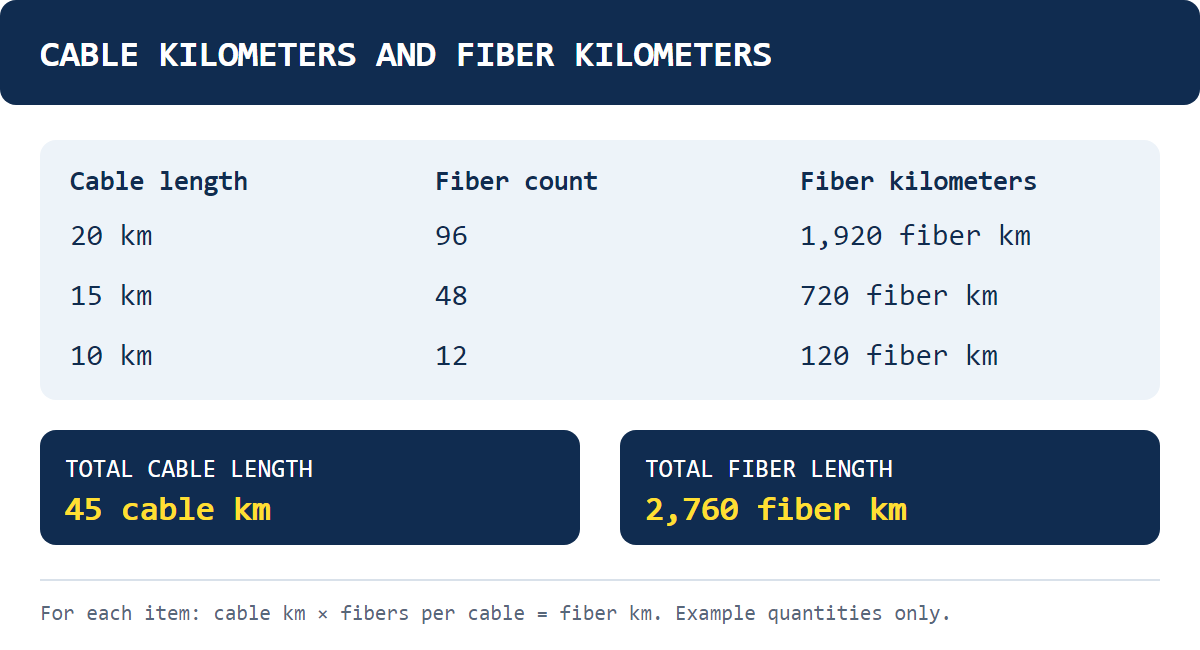
The nominal relationship is: fiber-km = cable-km × fibers per cable. For a mixed order, calculate each line and then add the results. Do not multiply total cable length by one selected fiber count.
Illustrative procurement example:
- 20 cable-km of 96-fiber cable = 1,920 fiber-km.
- 15 cable-km of 48-fiber cable = 720 fiber-km.
- 10 cable-km of 12-fiber cable = 120 fiber-km.
- Total finished cable: 45 cable-km. Nominal aggregate fiber quantity: 2,760 fiber-km.
These are accounting examples, not a customer order or a product quotation. The same aggregate fiber-km can be arranged into very different cable counts and route lengths. It therefore cannot replace the original line items.
For a product family such as ZION GYXTW central-tube armored optical cable, specify the required fiber count and finished cable length together. The family name alone does not define the ordered count or construction variant.
Keep finished cable and uncabled fiber orders distinct
A cable manufacturer buying ZION optical fiber products may order individual coated fibers on spools for a manufacturing process. That is a different deliverable from a jacketed multi-fiber cable. A spool designation also needs its unit: 50 km on one individual-fiber spool is not the same as a 50 km drum of multi-fiber cable.
For uncabled fiber, identify the fiber specification, coating and coloring requirements, accepted spool lengths, spool format and acceptance documentation. For finished cable, identify the fiber count, cable construction, jacket, mechanical requirements and drum schedule. A shared fiber designation does not make the two products commercially interchangeable.
The simple count-times-length formula is a nominal accounting relationship. Actual fiber length inside a loose-tube cable can differ from sheath length because of the cable design and excess fiber length. Raw-material purchases must also account for manufacturing and process allowances. Agree whether the contract uses nominal core-km or another measured basis.
Define drum lengths independently of the total
Twenty cable-kilometers can be supplied in many drum arrangements. In an illustrative schedule, ten drums of 2 km and five drums of 4 km both total 20 cable-km. They are not necessarily interchangeable for installation: route sections, joint locations, drum handling and continuous-length requirements may favor one arrangement.
List drum quantity, nominal cable length per drum, minimum continuous length, permitted length tolerance and whether shorter lengths are acceptable. Identify which end lengths or test tails are included in the invoiced quantity. Do not assume a total quantity authorizes arbitrary short sections.
Calculate the drum schedule against cable-km. Fiber-km can remain a secondary planning column, but it must not accidentally become the drum-length unit.
Make the price basis explicit in the RFQ
Write the price unit in full: USD per cable-meter, USD per cable-kilometer, USD per fiber-kilometer, or USD per spool with a stated length. Confirm whether the price includes the finished cable structure, drum, specified tests and packing. A bare-fiber unit price cannot be compared directly with a finished-cable unit price.
A clear finished-cable line might read: “12-fiber single-mode cable, approved construction and fiber specification, total 10 cable-km, five continuous 2 km drums; quote per cable-km.” A fiber-material line should instead state individual fiber supply, total fiber-km and the allowed spool schedule.
Before confirming an order, reconcile the RFQ, quotation, purchase order and packing list. Each should use the same product definition and counting unit. Add a separate conversion column if needed; do not overwrite the original unit with an unlabeled “km.”
Frequently Asked Questions
How many fiber-km are in 1 km of 12-fiber cable?
Nominally 12 fiber-km. The delivered cable length is still 1 cable-km.
Are route-km and cable-km always equal?
No. Multiple cables, vertical routing, slack and installation allowances can make purchased cable length different from the route length.
Can fiber-km determine the number of drums?
Not alone. You also need the fiber count, finished cable length and agreed continuous length per drum.
Discuss Your Cable Requirements
Send the cable model, application, quantity, destination market and technical questions for a specification-based discussion.



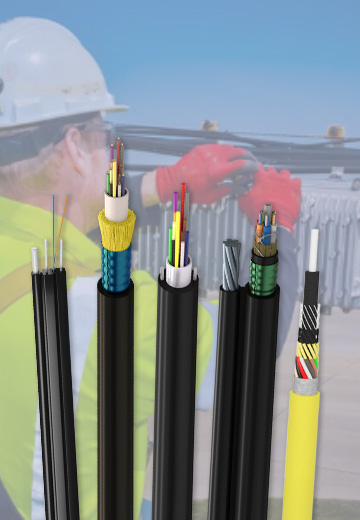 Fiber Optic Cable
 Fiber Optic Tools
 Ethernet Cable
 Coaxial Cable
 Fire & Security Cable
 Voice, Audio & Video
 Power & Control Cable