Build the range from customer jobs
Separate inquiries from purchase evidence. A request for a catalog shows interest; a paid order, repeated quotation for the same construction or a documented installer requirement is stronger evidence for stocking. Record application, cable specification, quantity, buying frequency and the reason an offer was won or lost.
Group demand by real jobs: indoor office cabling, building pathways with a specified fire classification, outdoor installations, or projects with a designed shielding requirement. A country name alone does not determine the right cable. Different buildings and customers in the same market may require different approvals.
Use the ZION U/UTP Cat6 range to shortlist construction families, then reduce the list using your customers’ accepted specifications. The catalog is a selection resource; it is not an instruction to stock every listed model.
Create core, conditional and order-based groups
Core stock: a small set of approved constructions with repeat demand, a predictable package and a clearly identified customer group. For suitable general indoor applications, 7112202 U/UTP Cat6 PVC cable is one product to evaluate against the local pathway requirements.
Conditional stock: a second construction supported by a recurring requirement, such as 7112206 U/UTP Cat6 LSZH cable where customers specify that material. Confirm the required fire classification separately; the LSZH material description alone is not a universal installation approval.
Order-based supply: unusual colors, special printing, uncommon package lengths or application-specific constructions without demonstrated turnover. Quote these against a confirmed requirement instead of assuming they should share the core inventory budget.
Do not create a lower-price tier by silently changing conductor material or an agreed compliance requirement. Give materially different products distinct descriptions and obtain acceptance for their intended application.
Control SKU multiplication before the first order
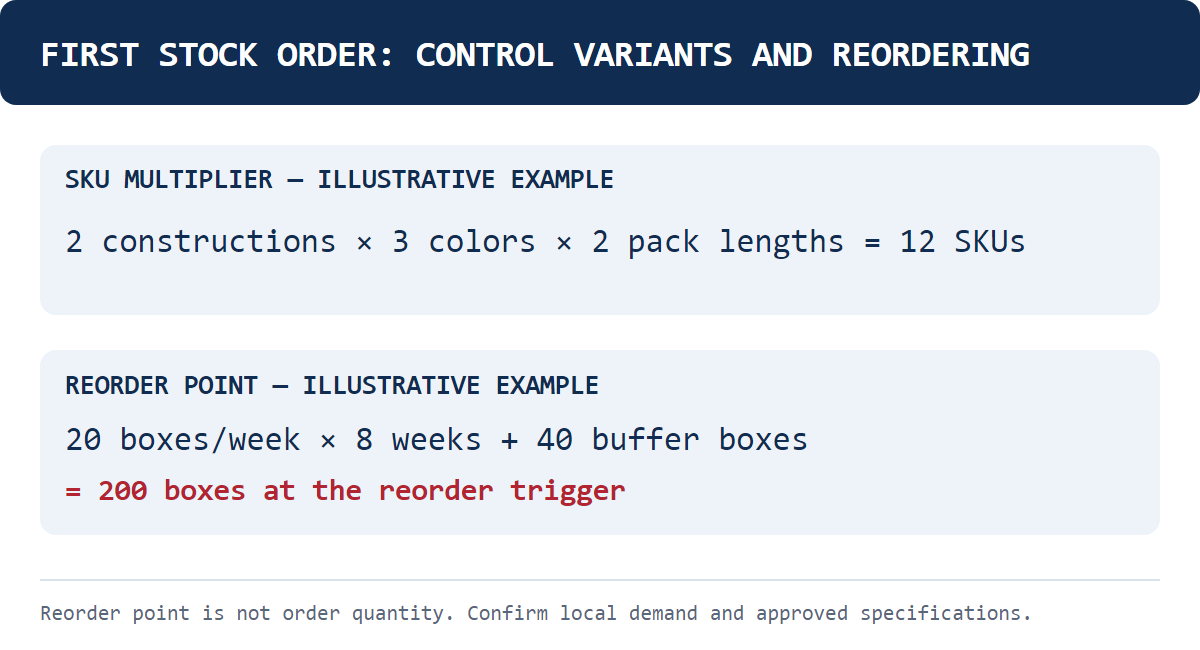
Each independent choice can multiply the inventory. In a purely illustrative example, two constructions × three colors × two packaging formats create 12 SKUs. Adding a second private-label version doubles that to 24 even though the application coverage may barely change.
Keep a required specification separate from an optional presentation choice. A required jacket classification deserves its own controlled SKU. An extra carton design should earn its place through demand or a committed customer. Avoid stocking multiple nearly identical items that warehouse staff cannot distinguish reliably.
Maintain a master record for each SKU: supplier part number, specification revision, conductor, shielding, jacket and classification, color, net length, packaging, brand artwork and barcode. A substitution should update the technical approval and sales description, not merely the purchase price.
Set opening quantities and reorder triggers
Estimate demand over the replenishment period and add a buffer justified by uncertainty. Include production confirmation, transport, receiving inspection and any approval delay in the lead-time assumption. Do not use the supplier’s production duration as if it were the complete time to available stock.
Illustrative calculation: expected demand of 20 boxes per week over an eight-week replenishment period gives 160 boxes of lead-time demand. Adding a separately justified 40-box buffer gives a reorder point of 200 boxes. These figures are hypothetical, not a ZION MOQ, lead time or sales forecast.
Apply the trigger to inventory position: usable on-hand stock plus confirmed incoming stock minus committed demand. A reorder point is not automatically the order quantity. Determine the purchase quantity from budget, replenishment frequency, supplier terms and storage capacity. For intermittent demand, review actual orders and open opportunities rather than relying on a smooth weekly average.
Review sell-through without losing technical control
Track sales by SKU, not only total cable revenue. Useful measures include boxes sold, stock age, missed orders, returns, gross margin after logistics and reasons for product substitution. Review slow movers before placing the next replenishment order.
When a customer asks for a different jacket or shield, record the requirement before expanding the range. Several inquiries may come from one exceptional project rather than a durable market segment. Conversely, repeated lost orders for the same approved construction may justify adding it to core stock.
Send ZION a shortlist with destination market, customer applications, required specifications, expected quantities by SKU, packing and branding choices, and the desired replenishment window. This supports a focused quotation without inventing a universal “best-selling” mix for every distributor.
Frequently Asked Questions
How many Cat6 SKUs should a new distributor stock?
There is no universal number. Start with documented repeat demand and approved applications, then expand when turnover or committed orders supports it.
Should every available color be stocked?
No. Separate required identification colors from optional choices and use demand evidence to decide which belong in stock.
Is the reorder point the purchase quantity?
No. It is a trigger based on inventory position. Order quantity depends on commercial terms, budget, storage and replenishment policy.
Discuss Your Cable Requirements
Send the cable model, application, quantity, destination market and technical questions for a specification-based discussion.



 Fiber Optic Cable
 Fiber Optic Tools
 Ethernet Cable
 Coaxial Cable
 Fire & Security Cable
 Voice, Audio & Video
 Power & Control Cable