Hybrid solar and ESS projects may require battery cable in addition to PV cable. Battery cable is used on high-current DC paths between battery banks, inverters, chargers or DC cabinets, so selection should focus on current, route length, voltage drop, flexibility, insulation, polarity color and terminal method. Buyers should not replace battery cable with PV cable or general wire without engineering confirmation. Before quotation, provide battery layout, current, voltage, cable length, terminal type and installation environment.
Where battery cable is used in hybrid solar systems
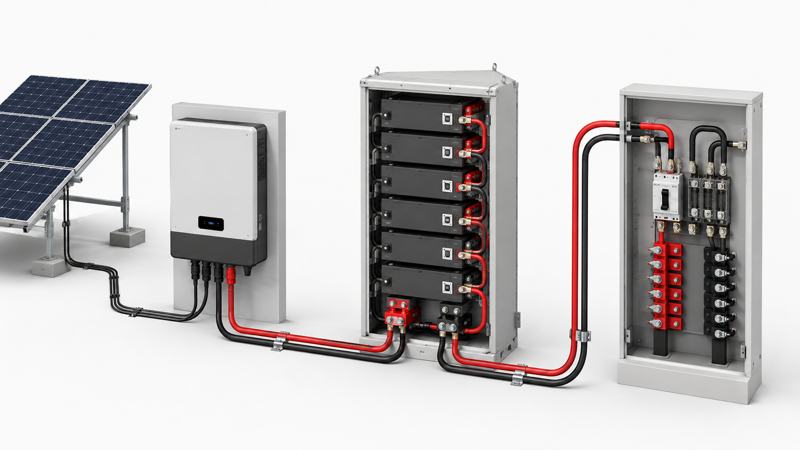
Battery cable belongs to the storage and high-current DC side of the system. It should be listed separately from PV string cable and solar extension cable.
| Position | Cable function | Buyer must confirm |
|---|---|---|
| Battery bank to inverter | DC power transmission | Current, voltage, terminal type |
| Battery cabinet internal link | Interconnection | Flexibility, bending space, color |
| Charger to battery | Charging route | Current, heat and protection |
| DC distribution cabinet | Power routing | Cable size and termination |
| Backup power system | DC connection | Safety and maintenance access |
Battery cable is not the same as PV cable
PV cable and battery cable work in different parts of the system. Substitution without engineering review can create installation, insulation, termination or approval issues.
| Item | Battery cable | Solar PV cable |
|---|---|---|
| Main use | Battery and DC power connection | PV module and DC-side solar route |
| Key concern | High current, flexibility, terminals | Outdoor exposure, PV standard, UV |
| Common location | Battery bank, cabinet, inverter area | Roof, array field, combiner, inverter |
| Procurement input | Current, terminal, length, polarity | Standard, voltage, size, route |
| Substitution risk | Wrong insulation or terminal behavior | Wrong outdoor or standard compliance |
Battery cable RFQ checklist
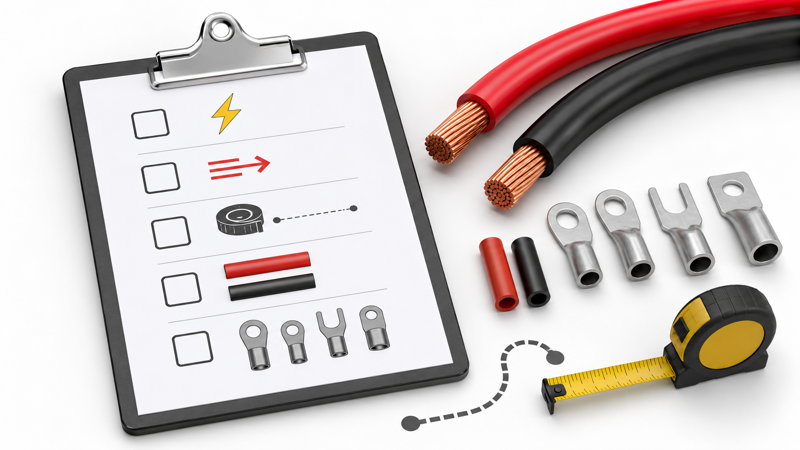
Battery cable RFQs should include current path and installation layout. Cabinet space, terminal type and bending area are especially important for compact systems.
| RFQ field | Why it matters |
|---|---|
| Current | Main sizing factor |
| Voltage | Must match system design |
| Cable length | Affects voltage drop |
| Flexibility | Important in cabinet and battery layout |
| Color | Polarity management |
| Terminal / lug | Installation compatibility |
| Insulation | Environment and safety requirement |
| Quantity | Quotation and packing |
Related ZION products and solution pages
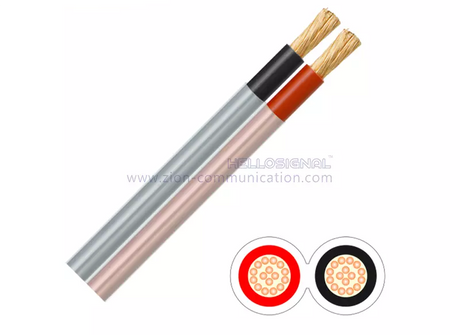
Battery Cable Product Category
Main product family for DC battery routes, battery banks, inverters and DC cabinets.
Battery Cable Solution
Selection page for battery banks, UPS strings, DC cabinets and flexible DC power routes.
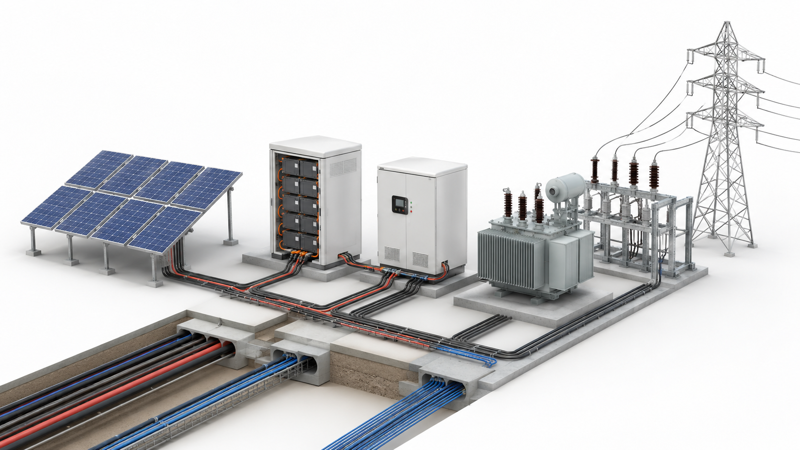
Energy & Power Infrastructure Cable Solutions
Parent solution for solar PV, battery and power infrastructure cable families.
Procurement note
For battery-side cabling, price comparison should come after current path, cable length, terminal type and installation space are defined. The final cable size should be approved by the electrical designer or system integrator.
- Separate battery cable from PV cable in the BOM.
- Provide terminal or lug details when available.
- Confirm cabinet bending space and route length.
- Use polarity colors based on project requirements.
FAQ
Is battery cable the same as solar PV cable?
No. Battery cable and PV cable serve different system positions. Battery cable focuses on high-current DC battery routes, while PV cable focuses on PV DC-side outdoor routes.
What information is needed to select battery cable?
You need current, voltage, cable length, installation space, terminal type, insulation requirement, color and quantity.
Can battery cable be used in ESS cabinets?
Battery cable may be used in battery banks or DC cabinet routes when it matches the system design and safety requirements. Final selection should be approved by the project engineer.
Why does flexibility matter for battery cable?
Battery cabinets and inverter areas often have limited bending space. Flexible cable can make installation easier and reduce mechanical stress.
Should battery cable be red and black?
Red and black are commonly used for polarity, but final color should follow project standard or customer requirement.
Can ZION quote PV cable and battery cable together?
ZION can review combined solar and battery cable lists and provide quotation support based on confirmed requirements.
Sources and references
Use ZION Battery Cable product page and Battery Cable Solution. Final size must be based on project current, voltage drop, local code and engineering approval. Do not add ESS-specific certification without documentation.