Ethernet cable jacket Types - How to choose a flame retardant Ethernet cable
Author: Site Editor Publish Time: 27-08-2020 Origin: Site
Ethernet Cable Jacket Types: How to Choose CMP, CMR, CM, and LSZH Choose the installation rating first, then confirm the jacket compound, environmental exposure, transmission category, and documented certification.
An Ethernet cable jacket is the outer sheath that protects the conductors and helps define where the cable may be installed. The most important selection rule is that a jacket material and a fire-safety listing are not the same thing. CMP, CMR, CM, and CMX are North American communications-cable type designations tied to installation use and fire testing. PVC, FEP, PE, and low-smoke halogen-free compounds describe materials or material families. Cat5e, Cat6, Cat6A, Cat7, and Cat8 describe transmission performance categories. A project specification often needs all three kinds of information.
The practical answer: use CMP for listed plenum or environmental-air spaces, CMR for listed vertical riser runs, and CM for general-purpose building pathways where the applicable code permits it. Use CMX only within its limited-use scope. Treat outdoor, wet-location, sunlight-resistant, direct-burial, oil-resistant, and low-smoke halogen-free requirements as separate checks unless the complete cable is specifically marked for them.
Choose by Installation Space Before Jacket Material
Start with the cable route, not with a material name. Identify whether the run passes through an environmental-air space, a vertical shaft between floors, a general-purpose pathway, a dwelling, or an outdoor or underground environment. Then check the locally adopted electrical and building codes, the authority having jurisdiction, and the project specification. The required cable type depends on the actual pathway and jurisdiction, not simply on whether a ceiling is present.
A suspended ceiling void is not automatically a plenum. It becomes an environmental-air space when it is used to move return or supply air under the applicable code definition. Conversely, a cable inside a listed raceway or a pathway isolated from environmental air may be governed by different rules. Confirm the mechanical plan and cable route instead of deciding from room appearance alone.

The route diagram shows the common CMP, CMR, and CM hierarchy, but it does not replace a code review. A higher indoor fire rating does not automatically provide sunlight resistance, water resistance, direct-burial suitability, chemical resistance, or the mechanical protection required outdoors.
CMP, CMR, CM, and CMX Ratings Explained
CMP: communications plenum cable
Type CMP cable is listed for ducts, plenums, and other spaces used for environmental air. The NFPA 262 test evaluates flame travel and smoke generation of the complete cable construction. The commonly cited limits are a maximum flame spread of 1.52 m (5 ft), peak optical density no greater than 0.50, and average optical density no greater than 0.15. These are test criteria for the listed cable construction, not generic properties of every material used in a jacket.
CMR: communications riser cable
Type CMR cable is listed for vertical runs in shafts or between floors. Its fire-performance evaluation is associated with ANSI/UL 1666, which addresses vertical flame propagation in a riser. CMR is not a substitute for CMP in an environmental-air space unless another permitted wiring method or exception applies.
CM or CMG: general-purpose communications cable
Type CM and CMG cable are intended for general-purpose building use, excluding plenums and risers unless a specific code provision permits the installation. They are suitable for many horizontal runs in ordinary spaces, but the pathway must still comply with the locally adopted code.
CMX: limited-use communications cable
Type CMX has a limited-use scope, including specified dwelling and raceway applications. CMX by itself should not be treated as a universal outdoor or direct-burial rating. UL guidance notes that a Type CMX cable additionally marked Outdoor is suitable for outdoor installation on dwellings. Underground, wet-location, sunlight-resistance, and direct-burial suitability must be confirmed from the complete product marking and certification.
Fire Rating Is Not the Same as Jacket Compound
A complete cable earns an installation type through evaluation of its finished construction. The same broad material family can appear in cables with different ratings, and a manufacturer may blend compounds to meet mechanical, electrical, smoke, and flame requirements. Do not infer CMP, CMR, or CM solely from the appearance of the jacket or from a material name in a quotation.
PVC: a broad family of thermoplastic compounds widely used for communications-cable jackets. Formulations and complete-cable performance vary.
FEP and other fluoropolymers: often used where low flame spread, smoke performance, or temperature capability is needed, including some plenum constructions. The material name alone is not a CMP listing.
PE: commonly selected for moisture resistance and outdoor jackets, but outdoor or direct-burial suitability still depends on the complete cable design and marking.
LSZH or LSHF: describes low-smoke and halogen-free performance. It does not automatically mean plenum-rated, riser-rated, CPR-compliant, or suitable for every jurisdiction.
UL treats “low smoke” and “halogen free” as separate performance characteristics that both require evaluation. When a project calls for LSHF, request the exact standard, test results or certification mark, and the complete cable designation. This prevents a material marketing term from being mistaken for an installation approval.
CMP vs. CMR vs. CM: A Practical Decision Guide
Map the entire route. Mark environmental-air spaces, floor penetrations, shafts, general pathways, outdoor transitions, wet areas, and underground sections.
Identify the governing code. Confirm the adopted NEC edition or other national standard, local amendments, project specifications, and authority having jurisdiction.
Choose the required installation type. CMP is the normal starting point for environmental-air spaces, CMR for risers, and CM for permitted general-purpose routes.
Add environmental ratings. Check outdoor, sunlight-resistant, wet-location, direct-burial, oil, chemical, temperature, rodent, crush, and abrasion requirements separately.
Specify data performance. Select Cat5e, Cat6, Cat6A, or another category based on the channel design, bandwidth, PoE load, shielding, and connector system.
Verify the marked product. Review the reel label, surface print, certification record, datasheet, and any test documentation required by the project.
Within the NEC communications-cable hierarchy, a listed CMP cable can generally substitute for CMR or CM, and CMR can generally substitute for CM, subject to the applicable code and installation conditions. This substitution hierarchy only addresses the relevant building fire classification. It does not create outdoor, wet-location, direct-burial, or chemical-resistance properties that the product does not have.
International Projects: IEC, CPR, and LSZH
CMP, CMR, CM, and CMX are North American type designations. They should not be presented as direct equivalents of IEC flame tests or European CPR reaction-to-fire classes. IEC 60332-1-2 evaluates flame propagation on a single vertical cable under defined conditions, while the IEC 60332-3 series addresses vertically mounted bunched cables. Passing one test does not prove performance under every installation arrangement.
For cables placed on the EU market for regulated construction uses, confirm the applicable harmonised specification, declared reaction-to-fire performance, CE marking, and Declaration of Performance. National rules determine which performance class is required for a building or occupancy. If a project also requests LSZH, smoke, acidity, or flaming-droplet classifications, list those requirements explicitly rather than relying on the words “flame retardant.”
Common Ethernet Cable Jacket Selection Mistakes
Calling every ceiling void a plenum: verify whether the space actually handles environmental air.
Treating LSZH as a universal fire rating: LSZH characteristics and installation approval answer different questions.
Assuming CMX means direct burial: look for the specific outdoor, sunlight, wet-location, or direct-burial marking required.
Selecting only by Cat6 or Cat6A: category performance does not determine the permitted building space.
Checking only a web listing: verify the exact part number, reel label, surface print, and certification record before approval.
Information to Include in an Ethernet Cable RFQ
A useful request for quotation should identify the route and required evidence, not just a cable category. For current product families, review ZION's LAN/Ethernet cable products catalog and confirm the exact construction for the project.
Country, city, applicable code, and project standard
Installation route: plenum, riser, general pathway, tray, conduit, outdoor, wet, or underground
Required type designation, fire test, CPR class, or other certification
Transmission category, conductor size and material, solid or stranded construction, and shielding
PoE application, bundle size, ambient temperature, and pathway fill conditions
Jacket compound or LSHF requirement, color, printing, and sequential length marking
Packaging, reel length, quantity, datasheet, certification record, and test-report requirements
FAQ
Can CMP cable be used in a riser or general-purpose space?
Generally, CMP is higher in the NEC communications-cable substitution hierarchy and may replace CMR or CM for the fire-classification requirement. The complete installation must still satisfy local code and any environmental or mechanical requirements.
Is LSZH Ethernet cable the same as CMP cable?
No. LSZH or LSHF describes evaluated smoke and halogen characteristics. CMP is a North American plenum installation type based on fire and smoke performance of the complete cable. A cable may carry both claims only when it has the corresponding evaluations and markings.
Does a Cat6 rating tell me where the cable can be installed?
No. Cat6 describes transmission performance. The installation type, environmental ratings, conductor construction, shielding, and local code compliance must be specified separately.
What should I verify before approving flame-retardant Ethernet cable?
Verify the exact part number, intended installation space, governing code, marked cable type, environmental ratings, transmission category, conductor construction, certification record, reel label, and any project-specific fire or smoke documentation.



 Fiber Optic Tools
Products 6 families
Solutions 6 markets
Resources Tools & docs
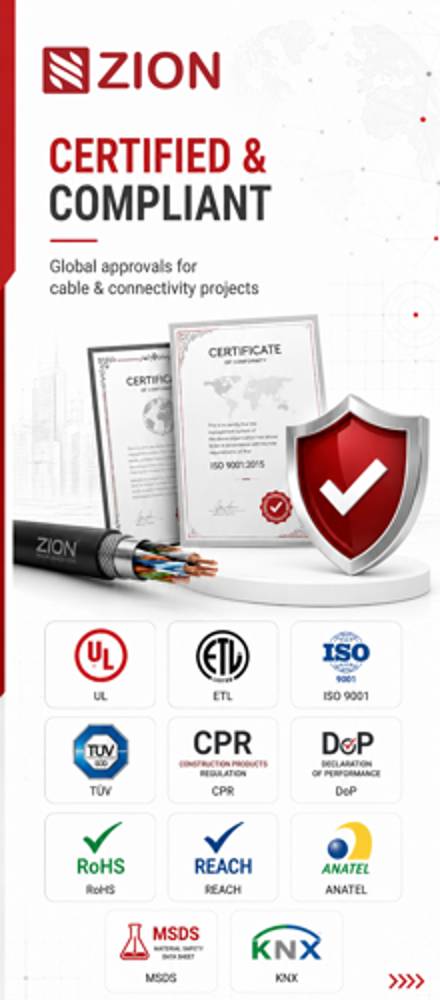
Certificate
Certification and compliance references for project review, qualification and purchasing documentation.
 Fiber Optic CableAccess and backbone
 Ethernet CableCat5e to Cat8
 Coaxial CableRF and video signal
 Fire, Security & AlarmSafety systems
 Voice, Audio & VideoSignal cabling
 Power & Control CableEnergy and control
Fiber optic cable systems
Outdoor, indoor, FTTH and distribution cable lines for access networks, backbone routes and campus deployments.
 Telecom & ISP NetworksFTTH, PON, ODN
 Data Center InfrastructureServer room cabling
 Building Low-Voltage SystemsBMS, AV, weak current
 Security & Fire ProtectionAlarm, CCTV, access
 Industrial Automation CablePLC, RS485, fieldbus
 Energy & Power InfrastructureSolar, battery, power
Telecom & ISP Networks
For FTTH / PON access, outdoor fiber deployment, aerial routes, duct routes, direct burial routes, rural broadband and ODN planning.
Tools
Use calculators and planning tools for conduit capacity, PoE voltage drop and fiber optic link loss budget work.