Direct Answer: When Should You Choose FPLP?
Choose FPLP fire alarm cable when a power-limited fire alarm circuit will be installed in a plenum or other environmental air-handling space. In practical project terms, the selection driver is pathway risk: smoke generation, flame spread, inspection compliance and the cost of rerouting after a failed review.
For procurement teams, the question is not whether FPLP is always the premium option. The more useful question is whether the building pathway makes plenum performance necessary or whether a riser or general-purpose fire alarm cable can satisfy the route.
What FPLP Fire Alarm Cable Means in Building Design
FPLP stands for power-limited fire alarm plenum cable. It is designed for fire alarm system circuits installed in environmental air spaces where smoke and flame behavior matter more than in ordinary indoor pathways. The cable type is selected mainly by where it will be installed, not by whether the fire alarm panel is addressable, conventional, shielded or unshielded.
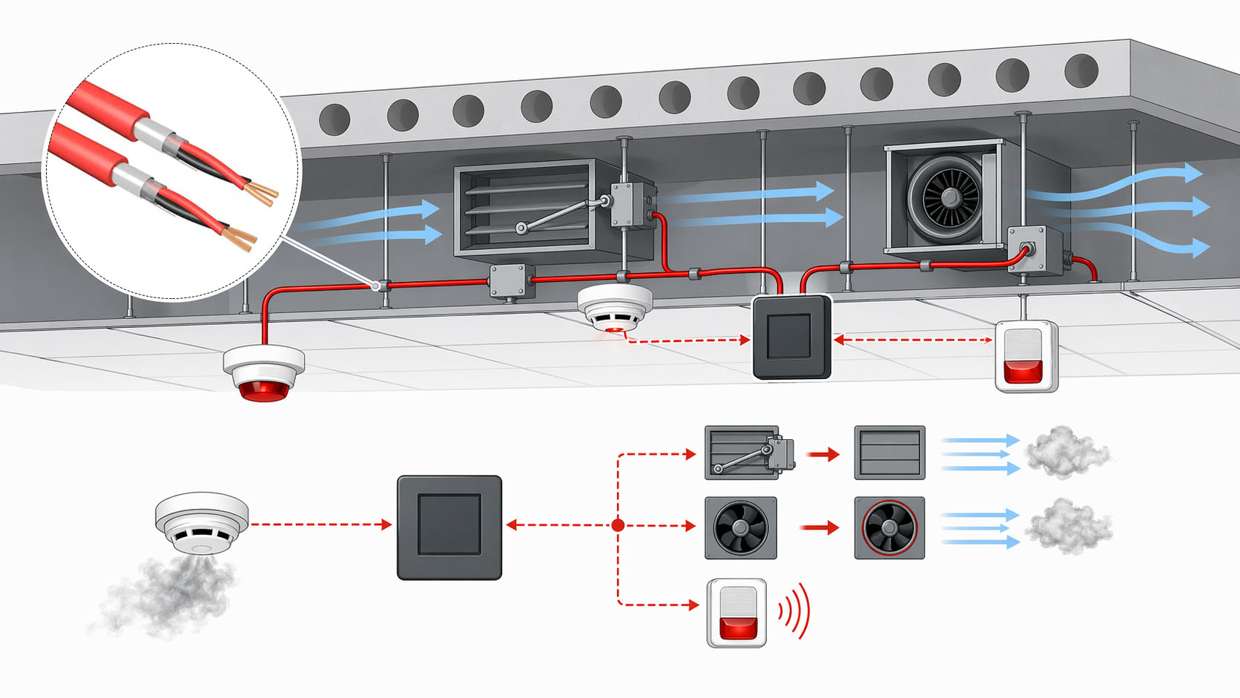
From a buying perspective, FPLP solves a specific compliance problem: it allows the fire alarm circuit to run through plenum spaces without forcing late-stage redesign of pathway method, raceway strategy or ceiling routing. That is why it is often treated as a risk-control choice on projects where ceiling pathways are complex or not fully finalized during early procurement.
| Item | Meaning for engineers and buyers |
|---|---|
| FPLP | Plenum-rated power-limited fire alarm cable |
| Main selection trigger | The installation pathway is a plenum or environmental air-handling space |
| Main project value | Lower smoke-risk mismatch, cleaner inspection path and lower rerouting exposure |
| Common misunderstanding | Plenum rating does not automatically mean outdoor, wet-location, direct-burial or chemically harsh environment suitability |
What Counts as a Plenum Space?
A common selection mistake is assuming that every above-ceiling area is automatically a plenum. In practice, what matters is whether the space is used to move environmental air. If a ceiling or raised-floor cavity functions as part of the building HVAC return-air path, smoke behavior becomes more critical and FPLP becomes the safer and more code-conscious choice.
This distinction affects both cost and schedule. Over-specifying every fire alarm run as FPLP raises material cost. Under-specifying a true plenum run can create failed inspections, replacement work and project-management friction. The first step is to verify pathway function, not just building type.
FPL vs FPLR vs FPLP Fire Alarm Cable
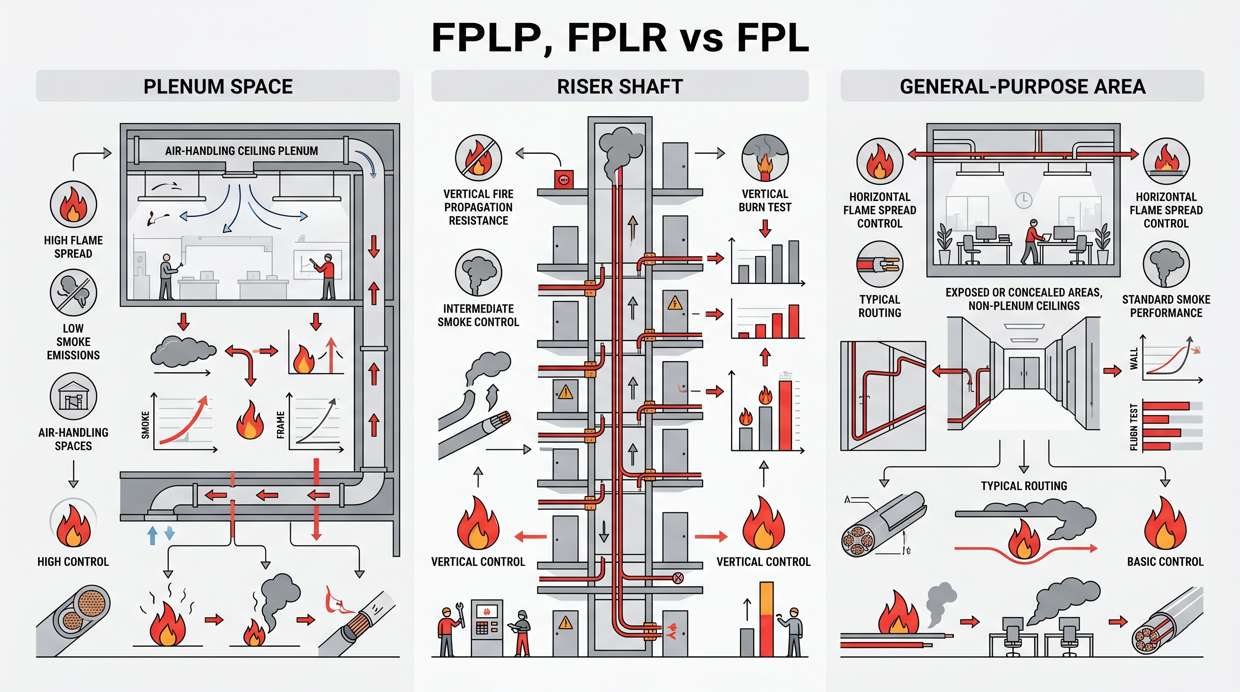
The simplest way to compare FPL, FPLR and FPLP is by installation environment. FPLP is the plenum-rated option, FPLR is the riser-rated option and FPL is the general-purpose option for standard indoor spaces where plenum or riser conditions do not apply.
| Cable type | Typical pathway | Main performance focus | Project logic |
|---|---|---|---|
| FPLP | Plenum or environmental air spaces | Low smoke and controlled flame spread | Choose when ceiling or floor air spaces are part of the cable route |
| FPLR | Vertical riser shafts between floors | Vertical flame propagation control | Choose when the run is between floors but not in plenum air space |
| FPL | General indoor non-plenum, non-riser spaces | Standard general-purpose fire alarm cable performance | Choose when the pathway is simpler and the adopted code allows it |
FPLP is often used as the low-risk choice when route uncertainty is high because it helps avoid the problem of later discovering that part of the cable run enters a plenum space.
Project Conditions Where FPLP Makes Sense
After the direct answer is clear, the next step is to judge whether the project conditions justify FPLP across a route, zone or full cable package. FPLP becomes more valuable when installation uncertainty, return-air ceiling space, inspection exposure or owner risk tolerance makes smoke-control performance more important than the lowest first-cost cable choice.
| Project condition | Should FPLP be considered? | Why it matters |
|---|---|---|
| Cable exposed in environmental air space | Yes | This is the clearest FPLP use case |
| Pathway may change during installation | Usually yes | It reduces rerouting and reinspection risk |
| Return-air ceilings in offices, hospitals or schools | Often yes | Smoke behavior in shared air spaces matters more |
| Owner prioritizes lowest compliance risk | Often yes | FPLP may reduce expensive downstream mistakes |
When FPLP May Not Be Necessary
FPLP is not automatically the most cost-efficient choice for every fire alarm project. If the cable route stays entirely outside plenum spaces and the design only requires riser or general-purpose performance, a lower category may be more economical while still meeting project needs.
The key point is that FPLP is a pathway-driven solution, not a generic upgrade label. Over-specifying it across an entire project can increase material cost without delivering equal practical benefit when the routes are already well controlled.
Selection Factors Beyond the Fire Rating
Once the pathway rating is clear, the quotation still needs construction-level details. Shielding, conductor size, solid or stranded design, jacket marking and document scope are separate decisions that affect compatibility, installation and approval.
Record whether the route requires FPL, FPLR or FPLP and identify the approval source for that decision.
Use shielding decisions to address noise environment and equipment requirements, not to replace fire/pathway rating.
Confirm conductor construction, conductor size and route length against the fire alarm system design.
Check model-specific data sheets, certificate scope, jacket print and batch documentation before approval.
| Risk area | What can go wrong | Project impact | Control action |
|---|---|---|---|
| Code mismatch | Wrong cable type for actual pathway | Inspection failure and replacement work | Verify pathway function early |
| Procurement waste | FPLP specified everywhere without need | Unnecessary cost increase | Separate pathways by actual use class |
| Environment mismatch | Indoor plenum cable used in wet, outdoor or harsh conditions | Premature failure or noncompliance | Check wet, UV, burial, chemical and mechanical exposure separately |
| Late route change | Original cable type no longer matches final pathway | Delay, rework and coordination friction | Use FPLP upfront when route uncertainty is high |
Project Information Needed Before Requesting a Quote
A clear RFQ should connect engineering requirements with procurement details. Instead of asking only for “fire alarm cable,” define the route, rating, electrical construction and document package that the project will use for approval.
- Describe the fire alarm system, equipment, route and installation environment.
- Record the required FPL, FPLR or FPLP rating and the source of that requirement.
- Confirm conductor size, conductor type, number of conductors, shielding and jacket needs.
- Define applicable product standard, certificate scope, jacket marking and acceptance documents.
- Confirm quantity, unit length, packaging, labeling, destination and required delivery window.
Teams comparing supplier options can review the related UL 1424 FPLP shielded fire alarm cable page before finalizing construction details and document requirements.
Frequently Asked Questions
Is FPLP the same as plenum fire alarm cable?
Yes. In normal project language, FPLP means plenum-rated power-limited fire alarm cable for fire alarm circuits routed through plenum or other environmental air-handling spaces.
What is the difference between FPL, FPLR and FPLP?
FPL is generally used for ordinary indoor fire alarm cable routes, FPLR is selected for riser pathways between floors, and FPLP is selected for plenum or environmental air spaces where smoke behavior and flame spread are more critical.
Can FPLR cable be used in a plenum space?
Do not treat FPLR as a substitute for FPLP in exposed plenum pathways. Confirm the actual route and local code requirement before approving the cable type.
Does FPLP mean shielded cable?
No. FPLP describes the fire and pathway rating. Shielding is a separate construction choice based on noise environment, circuit design and equipment requirements.
What information is needed before requesting a quotation?
Prepare the cable rating, route type, conductor size, solid or stranded construction, shielded or unshielded design, jacket marking, required documents, quantity, length, packaging and delivery requirements.
Prepare a Cleaner Fire Alarm Cable RFQ
Share the route type, required cable rating, construction details, approval documents and delivery requirements so ZION can support the project with a clearer quotation and technical discussion.
Request Project Support



 Fiber Optic Cable
 Fiber Optic Tools
 Ethernet Cable
 Coaxial Cable
 Fire & Security Cable
 Voice, Audio & Video
 Power & Control Cable