
1. What distinguishes an inline closure from a dome closure?
An inline, also called horizontal, closure typically has an elongated housing with cable-entry positions on opposing ends. That geometry is convenient when cables approach a joint from two directions. It does not restrict the closure to straight-through splicing: branch arrangements depend on usable ports, sealing kits and internal routing.
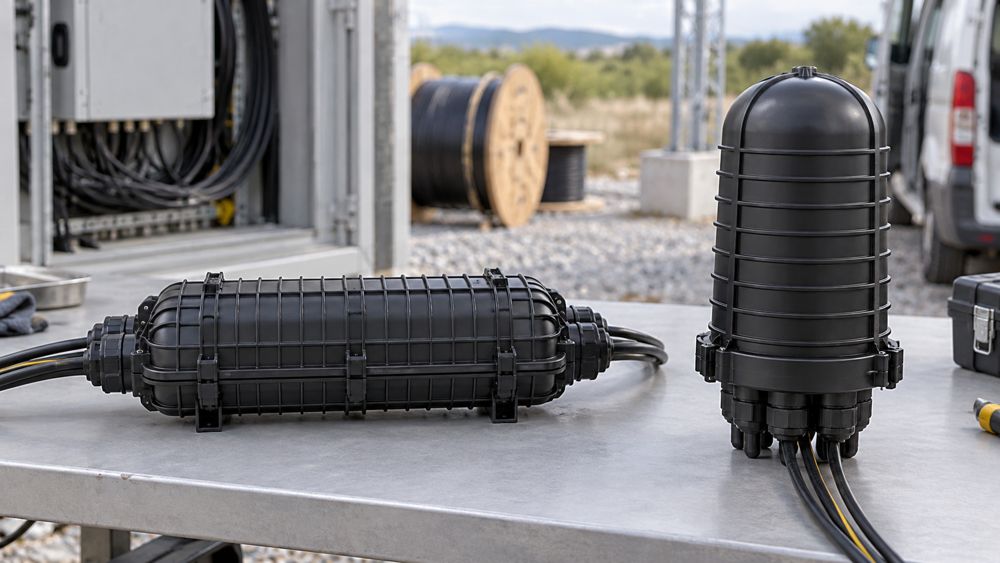
A dome closure usually has a base, a removable dome and splice trays inside. Cables enter through the base side, making a compact entry group possible for feeder and branch cables. “Dome” describes the housing style; the approved mounting orientation comes from the model's installation instructions.
| Selection factor | Inline / horizontal | Dome / single-ended |
|---|---|---|
| Typical cable entry | Opposing ends | One base end |
| Space to check | Body length and cable bend space at both ends | Base exit space and room to lift the dome |
| Through or branch splicing | Depends on ports, seals and fiber routing | Depends on ports, seals and fiber routing |
| Splice capacity and ingress rating | Model- and configuration-specific | Model- and configuration-specific |
| Re-entry | Check opening and resealing procedure | Check opening and resealing procedure |
2. Which layout fits the cable route?
Cables arriving from opposite directions: Start with an inline layout. Check whether the enclosure fits the handhole, tray or aerial support, then allow enough bend and strain-relief space at both ends. Verify each entry seal against the actual cable outer diameter (OD).
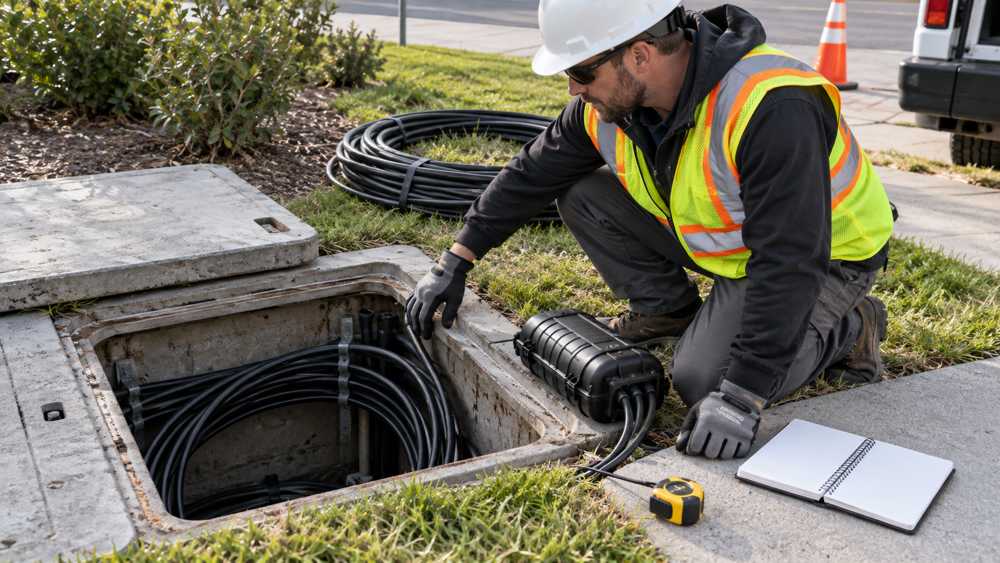
A feeder with several branch cables: Start with a dome base layout. Count usable entries now and after expansion. Check whether adding a cable would disturb existing seals, whether trays can be grouped by route, and whether technicians can remove the dome in the available space.
Mid-span access without cutting the main cable: Ask specifically for an express or uncut-cable entry arrangement, plus space for uncut buffer tubes and slack. Splice capacity alone does not establish mid-span suitability. Some dome families provide an oval express port, but support must be verified on the chosen model and entry kit.
An FTTH node with a PLC splitter: Confirm the splitter's mounting position, split ratio, pigtail route, connector type and adapter count. Splice positions, adapters and splitter outputs are different quantities.
3. Is either housing style more waterproof or easier to reopen?
Housing shape alone does not determine sealing performance. ZION lists both its inline ZC-FH011 and dome ZC-FV106M as IP68. This shows that both formats can carry that stated rating; it does not make their performance identical under every immersion condition. For a wet handhole, request the test conditions and report for the exact closure, cable and sealing configuration, including immersion depth or pressure and duration.
The same model-level approach applies to maintenance. Compare the shell lock, cable-entry seals, tray access and resealing procedure. Mechanical, heat-shrink and other seals are configuration choices, not automatic properties of dome or inline housings.
A listed port opening is not the sealable cable-OD range. Provide each cable's measured jacket OD and confirm the matching seal and blanking components for unused ports.
4. How do two published ZION models compare?
The following figures are from the public product pages and are useful for initial screening. Confirm the final datasheet and bill of materials (BOM) before ordering.
| Published specification | ZC-FH011 | ZC-FV106M |
|---|---|---|
| Form | Inline / horizontal | Dome |
| Listed splice capacities | 24 / 48 / 96 fibers | 96 / 144 / 288 fibers |
| Tray capacity | Up to 24 fibers per tray | Up to 24 or 48 fibers per tray, depending on configuration |
| Listed port configuration | 2+2 | 2+4 |
| Housing material | PC | PP |
| Stated protection rating | IP68 | IP68 |
| Cable-entry sealing stated in technical table | Not specified | Mechanical seal |
Sources: ZC-FH011 product page and ZC-FV106M product page. The “2+2” and “2+4” figures reproduce the page's port notation; they do not prescribe a cable-flow direction. The larger capacity listed for this dome example is not a universal dome-versus-inline rule.
For an FTTH splitting point, the ZC-FV108M-PLC page has a “36/48 cores” title, while its specification table lists a 48-fiber arrangement with two 24-fiber trays and a maximum of 36 adapter positions. Treat these as separate specifications and confirm the supplied trays, PLC splitter, adapters and accessories in the BOM.
5. What should go into the RFQ?
Send the mounting location and available dimensions; cable quantity, construction and measured OD for every feeder and branch; the splice count now and after expansion; whether express mid-span access is required; splitter and connector requirements; expected standing-water or immersion exposure; re-entry frequency; and required brackets, plugs, splice protectors and other accessories.
For a wet handhole, define the ingress requirement with testable details: which model and entry-seal configuration, which cable diameters, and what water depth or pressure and duration are required. That makes the IP rating easier to evaluate against the project conditions.
Frequently asked questions
Can an inline closure support branching?
Yes, when its port count, entry seals and internal routing support the planned branch cables. An inline shape is not limited to through joints.
Is a dome closure always easier to reopen?
No. Compare the opening steps, tray access and the sealing parts or consumables required after re-entry on the specific model.
Does a 96-fiber cable always need a 96-splice closure?
No. Size the closure around actual splice positions, storage of uncut fibers, branch count and future expansion, not only the cable's fiber count.
Does housing shape change transmission speed?
The housing shape does not set network speed. Splice loss, bend control and link test results are the relevant acceptance checks.
Select a closure for the actual site
Map the cable approach first, then check entry seals, fiber management, space and maintenance. Review the ZION fiber optic splice closure range and send a cable schedule, site dimensions or photos, and the desired configuration to compare models and obtain a quotation.
Compare a closure against your site requirements
Send the cable schedule, measured cable diameters, site dimensions, splice and splitter requirements, and expected water exposure to request a suitable configuration and quotation.
Request Project Support