What the separator actually does
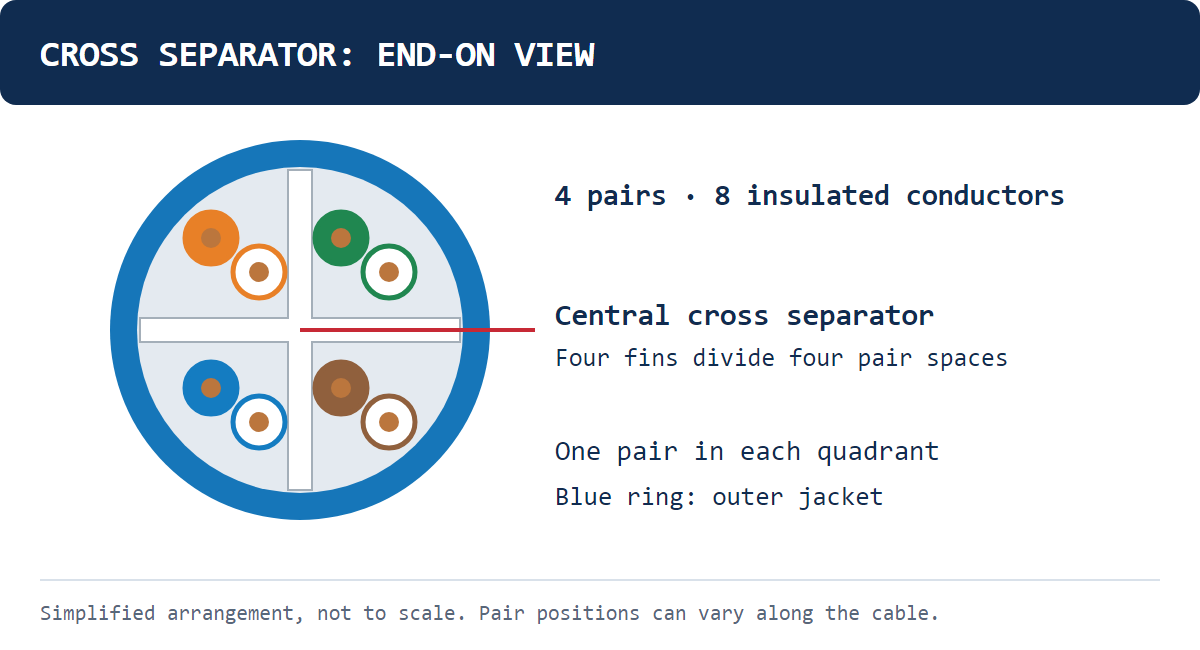
A cross-shaped filler occupies the center of the cable and separates adjacent pairs. It helps the design maintain pair spacing. Crosstalk performance also depends on pair lay, insulation geometry, conductor consistency and the complete cable construction. A cut end is useful for identifying components, but it cannot show how the cable performs over its specified frequency range.
For a concrete construction example, ZION 7112202 U/UTP Cat6 PVC cable lists a cross filler. Use the construction drawing and approved datasheet for the exact order when checking a tender. The drawing should identify the filler, conductor, insulation, jacket and nominal dimensions rather than showing only a generic Cat6 illustration.
Why a Cat6 design may omit the spline
A cable designer can use a different arrangement of materials and pair geometry to achieve the intended transmission performance. ZION also lists a 7112205NOS spline-free U/UTP Cat6 CMP option. That is evidence of a distinct product construction, not a reason to substitute it automatically for a cross-filled PVC or LSZH cable.
Compare the actual designs rather than assuming that one is always thinner, more flexible, easier to terminate or better for every installation. Those properties depend on the full material stack and dimensions. Jacket classification, conductor details, test evidence and connector compatibility remain separate checks.
Separate three approval questions
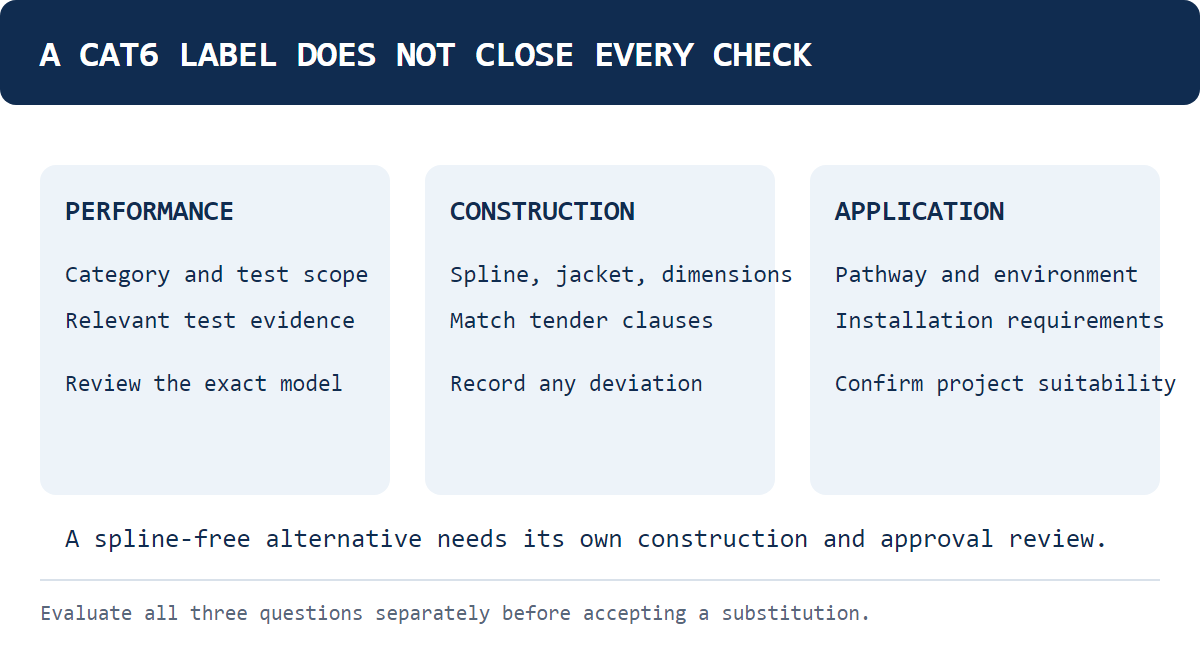
Performance: Does the proposed cable have suitable evidence for the required category, test scope and specified standard edition? A component report and an installed-link report answer different questions.
Construction: Does the offer match the prescribed conductor, separator, shield, jacket and dimensional limits? A cable may have relevant performance evidence while still differing from a mandatory construction clause.
Application: Is the selected cable appropriate for the pathway and installation? A fire classification or jacket material cannot be inferred from the presence of a spline. Likewise, a separator is not a substitute for shielding where the system design requires shielding.
Handle a restrictive tender without hiding deviations
Consider an illustrative tender requiring a central PE cross separator and an outside diameter no greater than 6.3 mm. A proposal that includes a separator but exceeds the diameter limit is still a deviation. A spline-free proposal that fits the space is also a deviation if the separator clause is mandatory. Neither issue disappears because the quotation says “Cat6.”
Prepare a clause-by-clause response: quote the requested requirement, state the offered value or construction, identify the supporting drawing or report, and mark any difference. Submit an alternative as a separate option with its own approval status. Obtain the authorized purchaser’s written acceptance before treating it as the ordered design.
Check maximum permitted dimensions against the supplier’s stated tolerance, not only a nominal diameter. If the tender wording is ambiguous, ask whether the separator is a mandatory design feature or a reference description before closing the technical offer.
Use a construction-specific order description
A useful order description identifies the approved cable part number and revision, conductor material and gauge, pair count, separator requirement, jacket and fire requirement, diameter and tolerance, packing length, marking and required test documents. State whether construction substitutions are prohibited or require written approval.
If the project specifies low-smoke zero-halogen materials, ZION 7112206 U/UTP Cat6 LSZH cable provides a separate product starting point. Confirm the exact structure and applicable fire evidence for that model; changing the jacket label does not resolve a separator or diameter mismatch.
Before production release, compare the signed specification, sample cross-section and purchase-order description. Use the same revision reference on all three. This reduces the risk of a technically approved option being replaced by a similarly named item during purchasing.
Frequently Asked Questions
Is a Cat6 cable without a spline automatically noncompliant?
No. Assess the exact cable against the required performance and construction criteria. A tender that explicitly requires a spline creates an additional project requirement.
Can a photograph replace a transmission test report?
No. A photograph can help identify construction, but it cannot verify transmission performance.
Can the supplier change the separator after sample approval?
Treat a separator change as a construction change and follow the agreed written approval process before production.
Discuss Your Cable Requirements
Send the cable model, application, quantity, destination market and technical questions for a specification-based discussion.



 Fiber Optic Cable
 Fiber Optic Tools
 Ethernet Cable
 Coaxial Cable
 Fire & Security Cable
 Voice, Audio & Video
 Power & Control Cable