Start with the route, not the cable code
Backhaul projects often request “outdoor armored fiber” before the route survey is complete. That shortcut can add unnecessary metal, reduce duct utilization, complicate pulling and grounding, or still leave the cable under-protected. Begin by defining the installation environment, duct condition, pulling length, water exposure, crush and rodent risk, shared utilities, repair access and required fiber count.
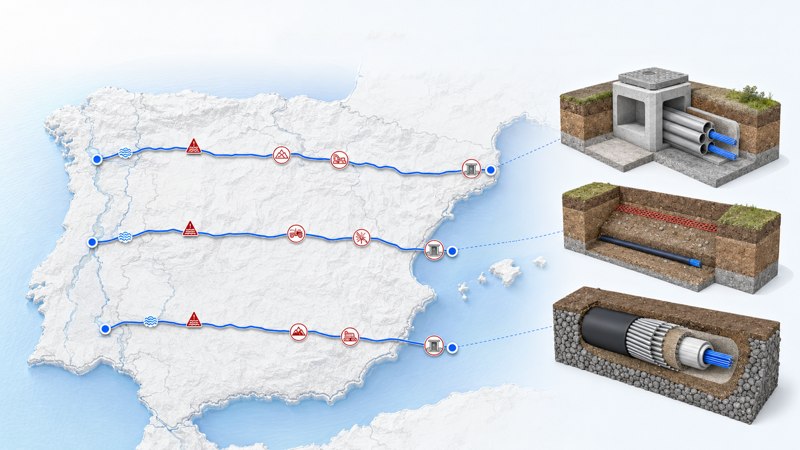
Divide the route into homogeneous sections and record the hazards and installation constraints for each one. The cable schedule can then state where a lightweight duct design is sufficient, where burial protection is needed and where armor or an all-dielectric alternative addresses a specific risk.
Duct cable
Duct cable relies on the conduit system for much of its external protection. It may use metallic or all-dielectric construction depending on the route. Lower diameter and weight can simplify pulling and improve duct utilization, but the conduit does not eliminate the need to define tensile strength, crush resistance, water blocking, sheath material, cable diameter and drum length.
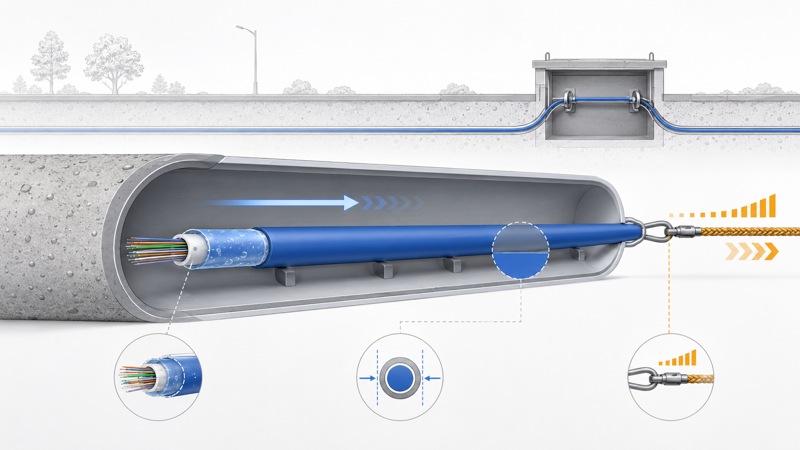
Confirm the duct inner diameter, existing fill, chamber spacing, bend path, pulling direction and whether flooding is intermittent or persistent. These details affect cable diameter, stiffness, pulling method, joint locations and the amount of installation tension the project must accommodate.
Direct-buried cable
Direct burial exposes the cable to soil pressure, stones, moisture, excavation and rodents. The construction may therefore require armor or layered sheath protection. The RFQ should define trench conditions, burial depth, bedding, warning and protection methods, joint-chamber design and route marking.
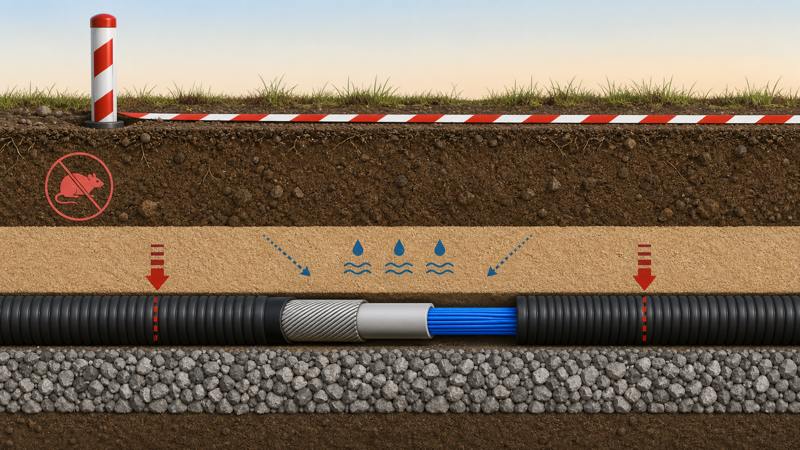
“Direct buried” describes an environment, not a complete installation instruction. Soil and backfill quality, crossings, third-party excavation risk and access for repair all influence the protection system and the cable construction selected for a particular segment.
Armored cable
Armor is a response to a defined mechanical risk. Corrugated steel tape, steel wire and non-metallic reinforcement serve different purposes and change cable diameter, flexibility, weight and installation behavior. The required design should follow the expected crush, impact, tensile and rodent exposure rather than a generic preference for armored cable.
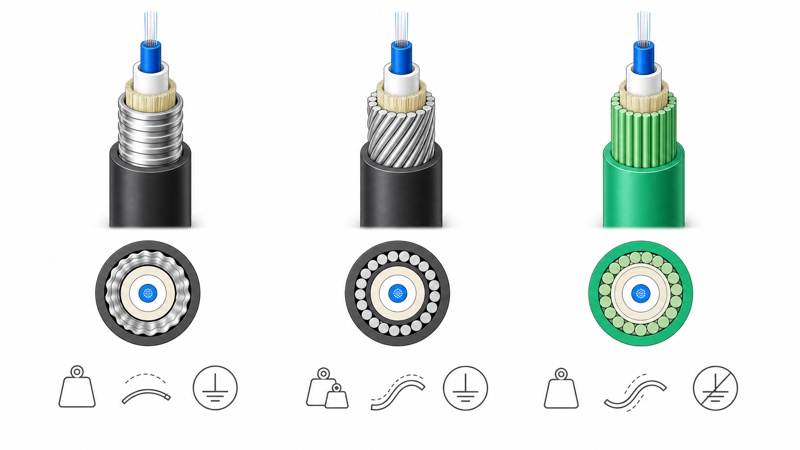
Metallic armor introduces grounding, bonding, corrosion and induced-voltage questions. For shared power corridors or locations where metal is restricted, an all-dielectric design may be more suitable. Flooded or high-crush ducts can still justify additional protection, but the selected reinforcement must remain compatible with duct size, bends and pulling limits.
Transition sections
One Iberian backhaul route may contain duct, buried, road-crossing, bridge, shared-utility and building-entry sections. The design should state where cable types change, where closures are placed, whether mid-span access is required and how optical and mechanical continuity is maintained.
Building-entry fire-performance requirements are separate from outside-plant armor. The route schedule should identify the transition enclosure, permitted indoor cable length, splice or patch arrangement, labeling and the test references that connect each outside section to the indoor handoff.
Distributor selection matrix
Use this matrix as a starting point for qualification. It does not replace the route survey, mechanical calculations or the owner’s approved installation method.
| Route condition | Likely starting point | Confirm before selection |
|---|---|---|
| Protected, serviceable duct | Compact duct cable | Duct fill, bends, pulling distance, water exposure, crush rating and drum length |
| Prepared direct-buried trench | Direct-buried construction with route-specific protection | Soil, bedding, burial depth, stones, rodents, crossings and excavation risk |
| High-crush or mechanically exposed section | Armored or reinforced construction | Expected load, armor type, diameter, flexibility, corrosion and installation method |
| Shared power corridor or metal restriction | All-dielectric reinforced construction | Electrical separation, induced-voltage policy, tensile requirement and mechanical risk |
| Mixed route or building entry | Segmented cable schedule with defined transitions | Closure positions, fire performance, indoor handoff, labeling and end-to-end testing |
Project Checklist for Buyers and Distributors
Attach a route questionnaire to the RFQ so suppliers and distributors quote the same installation assumptions, construction boundaries and delivery plan.
Record duct size, occupancy, bends, chambers, cleanliness and any known collapse or obstruction points.
Confirm section length, pull direction, bend path, intermediate access, installation method and allowable load.
State whether exposure is temporary or persistent and define the required longitudinal and radial water protection.
Describe soil, stones, traffic, utility work, pest history and the mechanical risk at each route section.
Confirm grounding, bonding, corrosion, lightning, induced-voltage and shared-power-corridor constraints.
Mark cable-change points, closures, chambers, building entries, mid-span access and restoration boundaries.
Align drum lengths with section access and pulling limits, then define sequential marking and drum identification.
List required test directions, wavelengths, acceptance limits, fiber schedule, labels and final document format.
Frequently Asked Questions
How do I choose between duct, direct-buried and armored fiber cable?
Start with the surveyed installation environment. Confirm pathway protection, pulling distance and tension, water exposure, crush and rodent risks, metallic restrictions, repair access and transition points before selecting the cable construction.
Can one standard fiber cable specification cover every Iberian route?
No. Duct condition, buried sections, shared corridors, data-center entrance rules, fire-performance requirements, bend radius, pulling load and documentation expectations can all change the specification.
What information helps ZION support a project quotation?
Share the route segments, installation method, pathway dimensions, fiber type and count, mechanical risks, metallic or all-dielectric preference, drum-length constraints, closure needs, testing requirements and handover documents.



 Fiber Optic Cable
 Fiber Optic Tools
 Ethernet Cable
 Coaxial Cable
 Fire & Security Cable
 Voice, Audio & Video
 Power & Control Cable