Quick answer
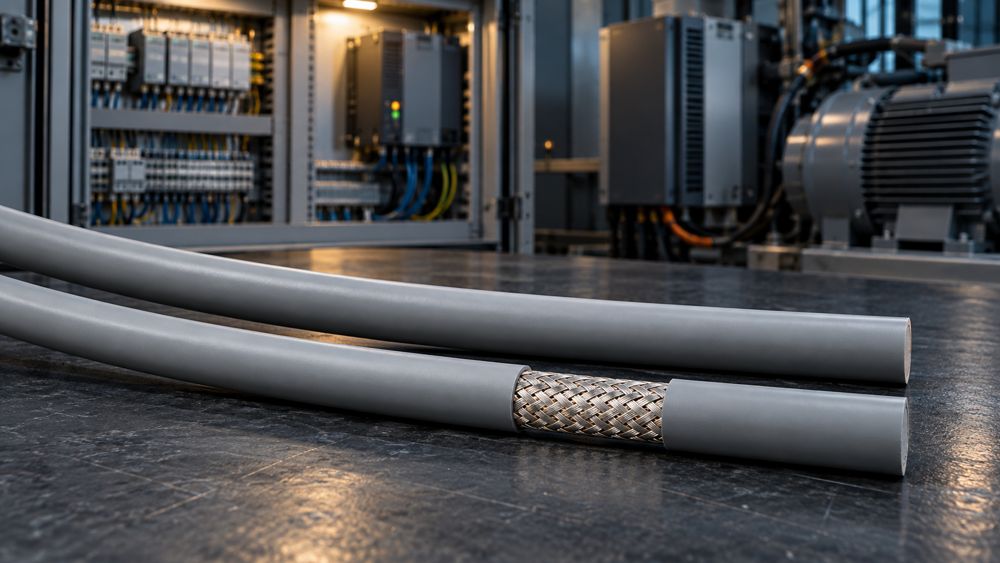
ZION's standard LiYY control/data cable uses stranded bare-copper conductors, PVC core insulation, layered stranding, and a PVC outer sheath without an overall metallic screen. ZION's standard LiYCY control/data cable adds PETP wrapping and an overall tinned-copper braid beneath the PVC sheath.
LiYY is therefore the simpler candidate when the equipment does not require a screened cable and the route has a controlled coupling risk. LiYCY is the relevant candidate when the EMC design calls for an overall braid. Neither name, by itself, confirms suitability for a particular protocol, drive output, safety circuit, outdoor route, drag chain, or market approval.
What the names do—and do not—prove
LiYY and LiYCY identify broad construction families used for low-frequency data, measuring, signal, and control connections. They are not universal performance classes. Different manufacturers and product variants can have different conductor counts, cross-sections, diameters, voltage data, temperature ranges, flame performance, approvals, and movement limits.
The “C” in LiYCY is reflected in the metallic braid, but the name does not state screen coverage, transfer impedance, coupling resistance, or the frequency range over which a required shielding performance is achieved. If EMC performance is critical, request the relevant measured screen data and verify the complete termination concept.
LiYY and LiYCY at a glance
For ZION's linked standard products, the key difference is the overall tinned-copper braid in LiYCY. That added layer changes the EMC function, termination work, and—when equal conductor count and cross-section are compared—normally the diameter, copper content, weight, and cost.
| Selection point | LiYY | LiYCY |
|---|---|---|
| Overall screen | None on the linked standard product | Tinned-copper braid over PETP wrapping |
| Typical decision | General signal/control route with no documented screen requirement | Signal/control route whose EMC design requires an overall braid |
| Termination | No screen termination; conductor termination and strain relief still apply | Screen bonding and connector/gland compatibility must be defined |
| Physical comparison | Compare the selected part number | Typically larger and heavier only when equivalent core designs are compared |
| Main selection risk | Coupling risk may be underestimated | The braid may be specified without screen-performance data or a bonding plan |
When LiYY may be suitable
LiYY can be considered for control panels, machine interconnections, relay circuits, and discrete I/O when the equipment documentation does not require a screened cable and the route is managed for electromagnetic coupling. The installation must also remain within the exact cable's verified voltage, temperature, bend-radius, mechanical-stress, and movement conditions.
Protected routing with project-defined separation from motor, drive, switching, and power conductors.
No specified screen requirement, with voltage, conductor size, core count, jacket, and environmental data confirmed.
Route length alone does not prove that an unshielded cable will be reliable. The interference source, coupling path, signal sensitivity, and equipment immunity all influence the result.
When LiYCY may be suitable
LiYCY is a candidate for low-frequency signal, measuring, and control circuits when the equipment instructions or EMC plan require an overall braided screen. Examples may include non-protocol analog or sensor circuits routed in an electrically noisy area, provided the exact cable's capacitance, core arrangement, voltage, and other electrical data also satisfy the interface.
The overall braid does not create twisted pairs, individual-pair screening, controlled impedance, or protocol compliance. It also does not eliminate coupling. Routing, separation, bonding, equipotential conditions, cabinet entry, and the connected equipment remain part of the EMC result.
For high-frequency interference control, a short, low-impedance, large-area connection—often implemented with a suitable 360-degree clamp or EMC gland—is generally preferable to extending the braid as a long pigtail. The actual bonding-at-one-end or bonding-at-both-ends decision must follow the equipment documentation, signal circuit, safety rules, and site equipotential-bonding design.
A practical selection process
Use the following sequence to move from the circuit requirement to a cable family and then to an exact part number.

- Identify the circuit type and document whether it is discrete I/O, analog measurement, sensor, serial communication, encoder, fieldbus, or another defined interface.
- Map the route and locate motors, drives, switching devices, power conductors, and other likely interference sources.
- Check the connected equipment manufacturer's cable, screening, separation, and grounding requirements.
- Confirm voltage, conductor size, core count or pair count, capacitance or impedance limits where relevant, temperature, jacket, movement duty, and compliance needs.
- If LiYCY is selected, define the screen-termination hardware, bonding points, and acceptance checks before installation.
Common mistakes
- Selecting LiYCY without defining where and how the overall braid will be bonded, or using a long pigtail in a high-frequency EMC path.
- Assuming an unshielded cable will be reliable simply because the route is short.
- Treating either family as a continuous-flex or torsion cable without model-level dynamic test data.
- Assuming plain LiYCY is interchangeable with LiYCY-TP, a fieldbus cable, an encoder cable, or another interface-specific construction.
- Comparing family names instead of the exact electrical, mechanical, environmental, EMC, and approval data.
- Using screening as a substitute for route separation, bonding, grounding, source control, or equipment-level EMC measures.
Information needed to specify a ZION cable
For a model-level review, send the interface or signal type, operating voltage, conductor size, core or pair count, route length, nearby power and switching equipment, required screen or pair construction, jacket preference, movement cycle, minimum bend radius, environmental conditions, destination market, and required standards. Drawings or a route sketch can clarify the relationship between the control circuit and nearby power equipment.
The ZION Flex Control Cable range provides the verified product-family starting point. Final selection should use the datasheet for the proposed part number.
Frequently asked questions
Is LiYCY always better than LiYY?
No. A shield adds value only when the application needs it and the shield is installed correctly. LiYY may be the simpler and more economical choice on a controlled, low-interference route.
Does LiYCY eliminate electrical noise?
No. Shielding is one part of an EMC design that also includes routing, separation, bonding, grounding, and equipment design.
Can LiYY or LiYCY be used in a drag chain?
Only when the exact product is rated and tested for the required continuous-flex duty. The word “flexible” alone is not evidence of drag-chain life.
Is standard LiYCY suitable for a VFD motor output cable?
Not by designation alone. Standard LiYCY is presented here as a signal and control cable. A VFD motor output circuit requires a cable whose voltage, current capacity, insulation system, EMC construction, thermal rating, and drive-manufacturer requirements are documented for that duty.
Prepare the cable selection data for review
Submit the interface, voltage, conductor size, core or pair count, route, interference sources, movement duty, environment, quantity, drawings, and required standards so ZION can review whether LiYY, LiYCY, a twisted-pair variant, or another cable family matches the application.
Request Project Support



 Fiber Optic Cable
 Fiber Optic Tools
 Ethernet Cable
 Coaxial Cable
 Fire & Security Cable
 Voice, Audio & Video
 Power & Control Cable