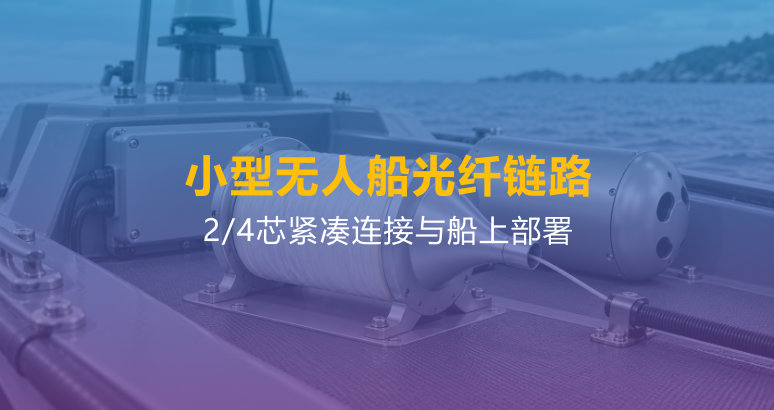
The Next Commercialization Question: How Does Data Return When the Robot Travels Farther?
Underwater environments are difficult for wireless communication.
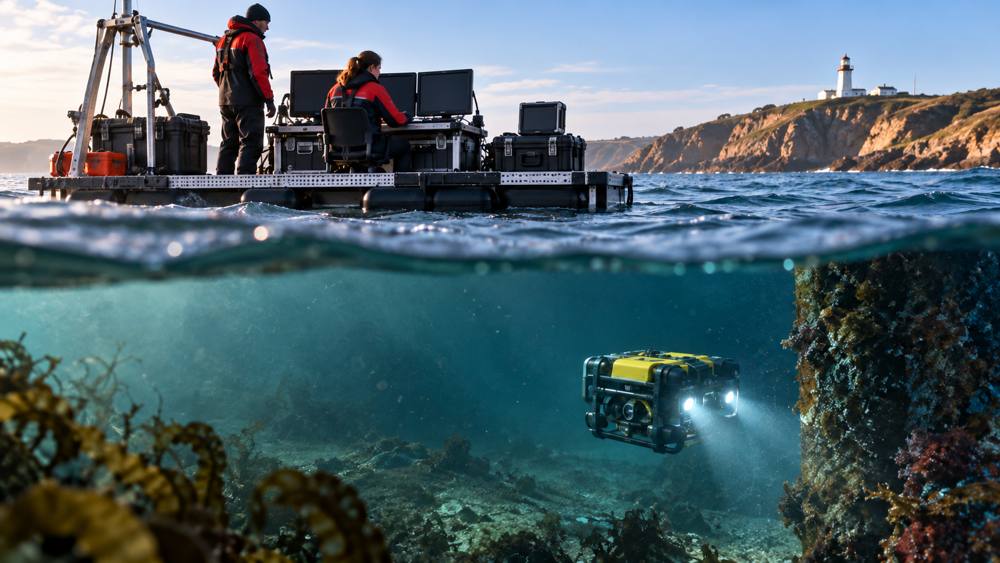
Radio signals attenuate rapidly in seawater. Acoustic links can cover useful distances, but their bandwidth, latency, and stability generally do not support continuous HD video, dense sensor streams, and low-latency human control at the same time. Conventional work-class ROVs therefore rely on an umbilical that combines power, communications, and mechanical connection.
That architecture is mature and well suited to long-duration, high-power, heavy-duty work. As more underwater platforms carry batteries and travel beyond the practical operating radius of a heavy tether, the mass, drag, winch, and vessel requirements of a conventional umbilical can become constraints.
A different system architecture is therefore receiving more attention:
- Onboard batteries or another independent source power the robot;
- Fine optical fiber carries video, data, and control signals only;
- Fiber is preloaded on a spool and pays out as the vehicle moves; and
- A real-time optical path remains between the underwater platform and a surface or remote receiving terminal.
This is more than making a conventional ROV umbilical thinner. It separates power from communications. The robot gains more freedom to travel, while the operating team retains live observation, mission adjustment, and abnormal-condition response.
Woods Hole Oceanographic Institution’s Nereid Under Ice illustrates the architecture. The battery-powered vehicle carries a 20 km fiber-optic microtether approximately 250 μm in diameter for real-time control, environmental data, and HD video and can release the tether when it needs to operate autonomously. Research on the Fiber Optic Reel System in the NOAA Institutional Repository also demonstrates the value of a compact reel for live HD video, sensor data, and gigabit Ethernet telemetry.
These research systems are not direct evidence of ZION product performance. They demonstrate that underwater robots are not limited to either a heavy powered umbilical or completely disconnected autonomous operation. Fine deployable fiber creates another real-time communication path between those extremes.
Five High-Match Mission Types Are Emerging
A deployable underwater fiber optic spool is not a universal accessory for every underwater robot. It is most valuable when the platform can power itself but the mission cannot lose real-time connection.
Complex-Terrain Research: Observe First, Then Decide
Under-ice regions, caves, wrecks, subsea canyons, and rugged terrain create competing demands for mobility and communication.
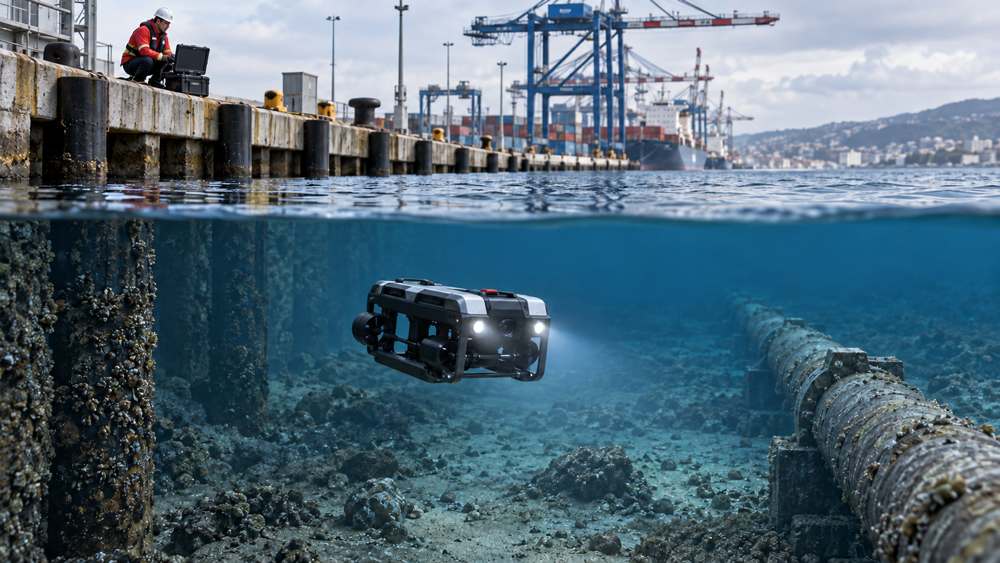
A heavy umbilical can restrict lateral range and introduce drag or snagging near obstacles. A fully autonomous vehicle has fewer physical constraints, but researchers may be unable to change the observation target, sampling point, or survey route based on live findings.
Fine deployable fiber offers a middle path. The vehicle pays out fiber as it advances instead of towing the full length of a heavy cable. Teams on shore or aboard a vessel can monitor video, sonar, and environmental data and modify the mission after identifying unusual terrain, organisms, or objects.
In these missions, the value of real-time communication extends beyond returning a picture. It increases the information gained from an expensive dive.
Extended-Range Inspection by Self-Powered ROVs
Port infrastructure, nearshore engineering, subsea routes, and underwater structures may require a robot to travel continuously along the asset. When the vehicle carries its own batteries, communications drag and payout equipment may limit range before energy does.
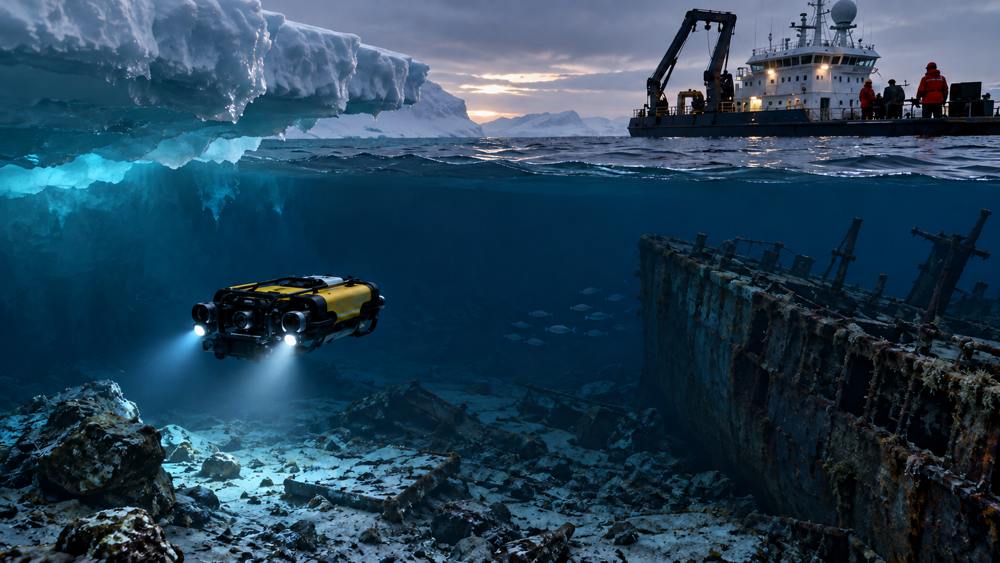
ZION deployable underwater fiber optic spools are available in 1–30 km options. Listed fiber diameters are 0.5 mm and 0.65 mm, with nominal masses of 248 g/km and 430 g/km. For a compatible self-powered platform, the light communications path can reduce the mobility impact of a conventional heavy cable while returning camera, sonar, attitude, and health data.
The boundary is clear: the fiber spool carries communications. It does not power the robot and must not be used as a lifting, towing, or recovery line. A mission requiring continuous surface power or heavy intervention remains better suited to an electro-optical umbilical.
AUV and UUV Supervision: Autonomy Does Not Mean No Visibility
AUVs and UUVs perform mapping, search, and data collection along planned routes, but a purely autonomous mission may leave operators waiting until recovery to review the complete data set. Route deviation, target changes, sensor faults, and environmental changes can then go uncorrected.
Deployable fiber can support supervised autonomy:
- The vehicle continues to execute its route and onboard algorithms;
- Critical video, sonar, and health information returns in real time;
- Operators revise waypoints, priorities, or return behavior when needed; and
- After a break or intentional release, the vehicle changes to its predefined autonomous mode.
The purpose is to add real-time judgment and risk control during high-value or difficult-to-repeat missions, rather than replace autonomy with continuous manual control.
Underwater Research and Temporary Observation
Ocean research frequently uses cameras, environmental sensors, vertical profilers, and temporary observation nodes. Some systems store data until recovery, while permanent observatories require planned subsea infrastructure.
A fiber spool can create a mission-specific path for cameras, sensors, and mobile test equipment. The optical medium is immune to electromagnetic interference, which is useful around propulsion motors, lighting, power converters, and multiple instruments.
For a research team, the main benefit is a shorter feedback cycle. Instrument faults, deployment errors, and abnormal signals can be identified while the mission is active, reducing the risk of discovering unusable data after the cruise.
Ports, Nearshore Projects, and Marine Engineering Trials
Harbor monitoring, nearshore observation, marine engineering trials, and underwater equipment commissioning often have a defined project window, a short deployment period, and complex field conditions. They need stable data without always justifying a permanent communication network.
A deployable spool can connect a robot, mobile observation point, or temporary sensor node. FC/UPC or LC/UPC optical interfaces and optical, Ethernet, or serial terminal options support integration with cameras, controllers, and field data equipment.
Its commercial value lies in configuring a communication system for a mission instead of building a permanent link for every temporary project.
Popular Underwater Applications That Should Not Be Forced into This Architecture
Product fit depends on platform power, mission distance, recovery method, and mechanical load, not simply on whether the equipment operates underwater.
| Mission Type | Fit | Main Reason |
|---|---|---|
| Extended-range observation or mapping by a battery-powered ROV | High | Needs live data while reducing the mass and drag of a long communication line |
| AUV/UUV supervision and mission redirection | High | Autonomous navigation and real-time human oversight can coexist |
| Research telemetry and temporary underwater observation | High | Values HD video, sensor data, and fast deployment |
| Ports, nearshore sites, and marine engineering trials | Conditional | Distance, depth, connection, and deployment method require confirmation |
| Hull-cleaning robots | Usually not preferred | Often short range with frequent recovery and a need for abrasion-resistant reusable tethering |
| Routine short-range aquaculture inspection | Mission dependent | A conventional recoverable tether may be more economical over tens of meters |
| Work-class heavy-duty ROVs | Usually unsuitable | Require surface power, load capacity, and recovery functions |
| Vehicles recovered by pulling the communication line | Unsuitable | Nominal tensile strength is not allowable working tension or recovery load |
Clear boundaries make the product easier to evaluate as a solution to a specific communication problem instead of a universal replacement for underwater cable.
From Fiber to a Complete Link: How the ZION Product Enters the System
ZION positions the Underwater Fiber Optic Spool as a deployable communication system. In addition to the preloaded payout spool, a project can match optical transmit and receive terminals, water-tight wired connections, and Ethernet or serial interfaces.
| Parameter | ZION Option or Nominal Specification |
|---|---|
| Spool length | 1–30 km |
| Fiber type | G.657.A2 bend-insensitive single-mode fiber |
| Strength and jacket | Aramid yarn + PVC |
| Cable outside diameter | 0.5 mm / 0.65 mm |
| Mass per kilometer | 248 g/km / 430 g/km |
| Nominal tensile strength | >150 N / >200 N |
| Operating temperature | -40°C to +60°C |
| Optical interface | FC/UPC or LC/UPC |
| Operating wavelength | 1310 nm / 1550 nm |
| Attenuation coefficient | ≤0.35 dB/km at 1310 nm; ≤0.25 dB/km at 1550 nm |
| Terminal interfaces | Optical, Ethernet, and serial options matched to the project |
| Housing material | Resin or aluminum |
| Standard 10 km envelope | 237 × 180 × 152 mm |
| Standard 20 km envelope | 300 × 277 × 248 mm |
G.657.A2 bend-insensitive fiber supports compact spool storage. The 0.5 mm and 0.65 mm options offer different tradeoffs among space, mass, and nominal mechanical margin. Wavelength and connector selection must match the terminals and the complete optical link budget.
The table supports preliminary selection only. “Water-tight connection” does not rate the complete system for any depth, and nominal tensile strength does not permit towing or vehicle recovery. Maximum depth, pressure rating, payout geometry, minimum bend path, dynamic tension, and link-loss strategy require project review.
The Business Case Extends Beyond Purchase Price
System integrators and mission operators should compare complete mission cost rather than fiber price per kilometer.
Platform and Deck Equipment
A heavy umbilical usually requires a larger winch, guide system, and support platform. When the robot already carries its own energy, a lighter communications path may reduce deck-equipment scale and integration complexity. Any actual reduction still depends on depth, sea state, launch and recovery, and safety requirements.
Effective Data per Dive
Without a live link, a team may discover after recovery that the camera angle was wrong, the target was missed, or a sensor failed. Live video and vehicle status allow correction in the field and reduce the chance of repeating an expensive vessel operation.
Access to More Distant Targets
When cable mass and drag constrain vehicle mobility, a lighter link may allow longer routes or access to complex terrain. The value comes from enabling missions that were previously difficult, rather than acting only as a cheaper cable.
Disposable, Mission-Specific, or Recoverable Operation
A deployable spool can be configured for single-use, mission-specific, semi-fixed, or engineered recoverable service. Whether released fine fiber can be recovered and reused depends on seabed contact, bending, abrasion, winding equipment, and environmental requirements.
Treating a single-use design as a repeated-recovery system, or ignoring the handling of deployed fiber, can convert an apparent initial saving into maintenance and compliance risk.
The Communication Link Is Becoming a New Upstream Opportunity
The market often focuses on vehicle specifications: depth, range, payload, and manipulator capacity. A real mission needs a complete system. The communication link combines fiber, payout mechanics, optical conversion, water-tight boundaries, interface compatibility, and post-mission handling.
Competition in the underwater robotics supply chain is therefore moving from vehicle specifications toward reliable mission delivery.
For a spool supplier, value extends beyond providing a coil of fiber. A verifiable communication solution combines:
- A 1–30 km spool matched to the route;
- 0.5 mm or 0.65 mm fiber matched to platform space, drag, and mechanical risk;
- A 1310 nm or 1550 nm link budget;
- FC/UPC, LC/UPC, and terminal interface configuration;
- Optical transmit and receive equipment and Ethernet or serial conversion;
- Water-tight connections, housing, and payout geometry;
- Single-use, mission-specific, or engineered recoverable deployment; and
- Factory tests, transport packaging, and project records.
ZION’s opportunity is at this layer: supplying the communication module that connects the robot, mission payload, and control terminal.
Nine Questions Before an RFQ
- Is the platform an ROV, UUV, AUV, underwater robot, or fixed observation point?
- Does the robot carry its own batteries, and does the fiber carry data only?
- What are the route length, reserve, and target spool length?
- What are the maximum depth and water-tight connection requirements?
- Is the wavelength 1310 nm, 1550 nm, or project specific?
- Is the optical interface FC/UPC, LC/UPC, or another protected interface?
- Does the terminal need Ethernet, serial, or another data interface?
- Is deployment single-use, mission-specific, semi-fixed, or recoverable?
- What are the installation space, payout direction, quantity, destination, and documentation requirements?
Answering these questions allows spool length, fiber construction, terminals, and mechanical design to be matched to the same mission.
Three Likely Directions for Underwater Robot Communication
Autonomy and Real-Time Supervision Will Coexist
Improved autonomy will not eliminate live communication. High-value missions often need autonomous repetition with operator intervention at key points. Deployable fiber supports this hybrid model.
Heavy Powered Umbilicals and Light Communication Fiber Will Serve Different Platforms
Work-class ROVs that need continuous power, load capacity, and heavy intervention will continue to use purpose-designed umbilicals. Self-powered, extended-range vehicles that value low drag and live data can use lighter communication links. Platform architecture will define the cable category.
Customers Will Buy an Integrable Link, Not Only a Spool
As projects move into repeatable delivery, customers will focus more on interface matching, end-to-end loss, water-tight design, installation envelope, and test records. Supplier capability will extend from material specifications to integrated spool, terminal, connection, and engineering support.
Conclusion: Commercial Underwater Robots Need Every Dive to Stay Connected
Underwater robots are moving from technical demonstration toward measurable, repeatable mission results. Depth, mobility, and target recognition remain important. As robots enter more distant and complex environments, the ability to return data and support timely decisions becomes equally important.
A deployable underwater fiber optic spool will not replace every umbilical and does not fit every robot. It addresses a clear and growing requirement: a self-powered platform that still needs extended-range, high-bandwidth, low-latency communication.
Commercialization opportunities therefore exist both in the vehicle and in the fine fiber that connects it to the surface.
When a dive no longer means losing visibility of the mission, underwater work can move from one-off exploration toward repeatable engineering service.
Contact ZION
To assess fit for a civil ROV, UUV, AUV, or underwater observation project, provide the platform type, route length, maximum depth, optical interface, wavelength, data ports, deployment method, installation space, quantity, and destination country.
- Product page: https://www.zion-communication.com/underwater-fiber-optic-spool-for-rov-uuv-communication.html
- Email: info@zion-communication.com
- Telephone: +86 15088607575
References
- ZION Communication, Underwater Fiber Optic Spool for ROV/UUV Communication
https://www.zion-communication.com/underwater-fiber-optic-spool-for-rov-uuv-communication.html - Liaoning Provincial Government, The 10th National Underwater Robot Competition Held in Dalian
https://www.ln.gov.cn/web/ywdt/qsgd/ass_2_1/2026092009410642065/index.shtml - CNR, The 10th National Underwater Robot Competition Held in Dalian in 2026
https://dl.cnr.cn/jdt/20260920/t20260920_527818894.shtml - Woods Hole Oceanographic Institution, HROV Nereid Under Ice
https://www.whoi.edu/what-we-do/explore/underwater-vehicles/hybrid-vehicles/nereid-under-ice/ - NOAA Institutional Repository, The Fiber Optic Reel System: A Compact Deployment Solution for Tethered Live-Telemetry Deep-Sea Robots and Sensors
https://repository.library.noaa.gov/view/noaa/64256
Evaluate the Fiber Link Around the Mission
Share the civil platform, route, depth, power architecture, live data, interfaces, deployment method, installation space, and post-mission handling requirements.
Request Project Support