ZION Communication Chinese FTTH Drop Fiber optic cable Factory 2
Author: James Xu Publish Time: 27-12-2018 Origin: zion communication
Inside ZION’s FTTH Drop Cable Factory A workshop tour covering FTTH drop cable materials, production, inspection, packing, and the information buyers should confirm before ordering.
What an FTTH Drop Cable Factory Produces
FTTH drop cable forms the final cable section between an access or distribution point and the subscriber premises. A factory converts optical fiber, strength members, jacket compounds, and optional messenger elements into constructions selected for indoor routing, building entry, façade installation, short outdoor routes, or aerial subscriber drops.
Cable shape alone does not define the finished specification. Buyers should confirm the fiber type and count, strength-member material, jacket, dimensions, installation route, fire-performance requirement, marking, reel length, and required documents. ZION’s GJXFH-2 FTTH drop cable page provides a product-level reference for a compact flat construction, while the final order must follow its approved datasheet or drawing.

FTTH Drop Cable Production Flow
The production sequence depends on the selected construction, but flat drop cable normally brings the optical fiber and parallel reinforcement elements together before the jacket is formed around them. Self-supporting designs add a messenger section or another load-bearing element according to the approved design. Operators control material feeding, alignment, line speed, cooling, take-up, and surface condition throughout the run.
1. Fiber and Strength-Member Preparation
Optical fiber and reinforcement materials are identified and prepared for the production order. The workshop image shows steel wire and FRP material reels used as reinforcement inputs for different cable constructions. Material selection affects tensile behavior, electrical characteristics, handling, and the intended route, so it must match the specified model rather than be treated as interchangeable.

2. Material Feeding and Jacket Formation
Pay-off and guiding equipment feeds the fiber and reinforcement elements into the line. The jacket is then formed to the required flat or profile shape. Process checks should confirm that the elements remain aligned, the cable surface is consistent, and the finished dimensions match the approved construction. Jacket compound and color should be selected for the route and applicable project requirements.


3. Take-Up, Marking, and Batch Identification
Finished cable is collected on a reel or spool without exceeding the handling conditions defined for the product. Cable marking, length information, model reference, and batch identification should be checked against the order. If the buyer requires OEM wording, a special color, sequential meter marking, or distributor labels, the approved artwork and format should be confirmed before production begins.
Common FTTH Drop Cable Constructions
The appropriate construction follows the installation route and termination method. Common project directions include:
Indoor flat drop cable: compact routing for corridors, rooms, risers, and subscriber access points, with the jacket and flame-performance option selected for the building requirement.
Outdoor or self-supporting flat drop cable: reinforced construction for façade or aerial subscriber routes. The current GJYXCH FTTH drop cable page shows one product direction; the messenger, strength members, fiber, jacket, and route conditions still require order-level confirmation.
Pre-terminated drop assembly: factory-installed connectors can reduce field termination work when the length, connector type, polish, pulling protection, and packing method are defined in advance.
Installation hardware: clamps, hooks, and brackets must fit the cable shape, diameter, route, and load condition. ZION’s FTTH installation accessories provide verified options for project review.
Selection principle: start with the subscriber route, indoor/outdoor transition, mounting method, bend requirements, termination plan, and document scope before selecting the final cable code.
Inspection and Order Documentation
Inspection should follow the approved datasheet, drawing, and purchase requirements. Depending on the product and order scope, checks may include material identity, fiber count and color, dimensions, surface condition, optical performance, mechanical requirements, marking, reel length, cable-end protection, packing labels, and requested records.
Certificates and test reports must be matched to the relevant model, construction, standard, and issuing scope. A general factory capability statement does not establish that every certificate applies to every FTTH cable. Buyers should request the actual document set needed for tender, approval, import, or project handover.

Packing and Export Preparation
FTTH cable may be packed on small spools, reels, or in cartons according to the product, length, and customer requirement. Finished packages are labeled, grouped on pallets where appropriate, protected for handling, and organized for shipment. Packing should preserve cable ends, labels, connector protection when assemblies are pre-terminated, and the traceability information required by the order.


Information to Send for an FTTH Cable Inquiry
A useful inquiry should identify the route and installation method before listing commercial preferences. Include the following information where available:
Indoor, outdoor, façade, duct, aerial, or outdoor-to-indoor route.
Cable construction or reference model, fiber type, and fiber count.
Strength-member preference and messenger requirement.
Jacket material, color, flame-performance or environmental requirement.
Spool or reel length, cable marking, label, carton, pallet, and shipment requirements.
Connector type and polish when a pre-terminated assembly is required.
Quantity, destination, sample request, inspection plan, and required certificates or test reports.
FTTH Drop Cable Factory FAQ
What should buyers check during an FTTH drop cable factory visit?
Review material identification, production flow, process controls, finished-cable inspection, marking, spool or reel packing, batch records, and the document package available for the selected construction.
How do indoor and outdoor FTTH drop cables differ?
Indoor cable prioritizes compact routing and the required building fire performance. Outdoor cable must match UV, moisture, temperature, installation tension, and mechanical exposure. A self-supporting aerial drop also needs a messenger or load-bearing design suitable for the route.
Can FTTH drop cable be supplied with connectors?
Pre-terminated assemblies can be discussed when the cable length, connector interface, polish, fiber type, end configuration, test requirement, pulling protection, and packing method are defined.
Does a factory certificate apply to every FTTH cable?
No. Document scope depends on the model, construction, standard, issuing body, and listed product family. Verify that the certificate or test report matches the cable being offered for the project.



 Fiber Optic Tools
Products 6 families
Solutions 6 markets
Resources Tools & docs
Certificate
Certification and compliance references for project review, qualification and purchasing documentation.

 Fiber Optic CableAccess and backbone
 Ethernet CableCat5e to Cat8
 Coaxial CableRF and video signal
 Fire, Security & AlarmSafety systems
 Voice, Audio & VideoSignal cabling
 Power & Control CableEnergy and control
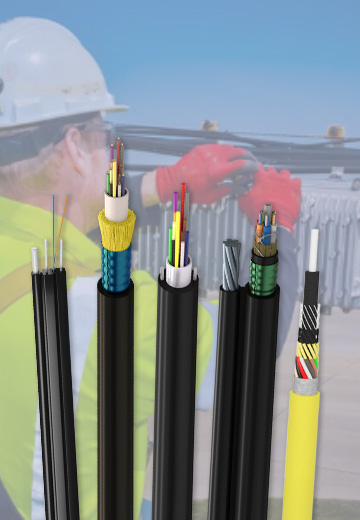
Fiber optic cable systems
Outdoor, indoor, FTTH and distribution cable lines for access networks, backbone routes and campus deployments.
 Telecom & ISP NetworksFTTH, PON, ODN
 Data Center InfrastructureServer room cabling
 Building Low-Voltage SystemsBMS, AV, weak current
 Security & Fire ProtectionAlarm, CCTV, access
 Industrial Automation CablePLC, RS485, fieldbus
 Energy & Power InfrastructureSolar, battery, power
Telecom & ISP Networks
For FTTH / PON access, outdoor fiber deployment, aerial routes, duct routes, direct burial routes, rural broadband and ODN planning.
Tools
Use calculators and planning tools for conduit capacity, PoE voltage drop and fiber optic link loss budget work.