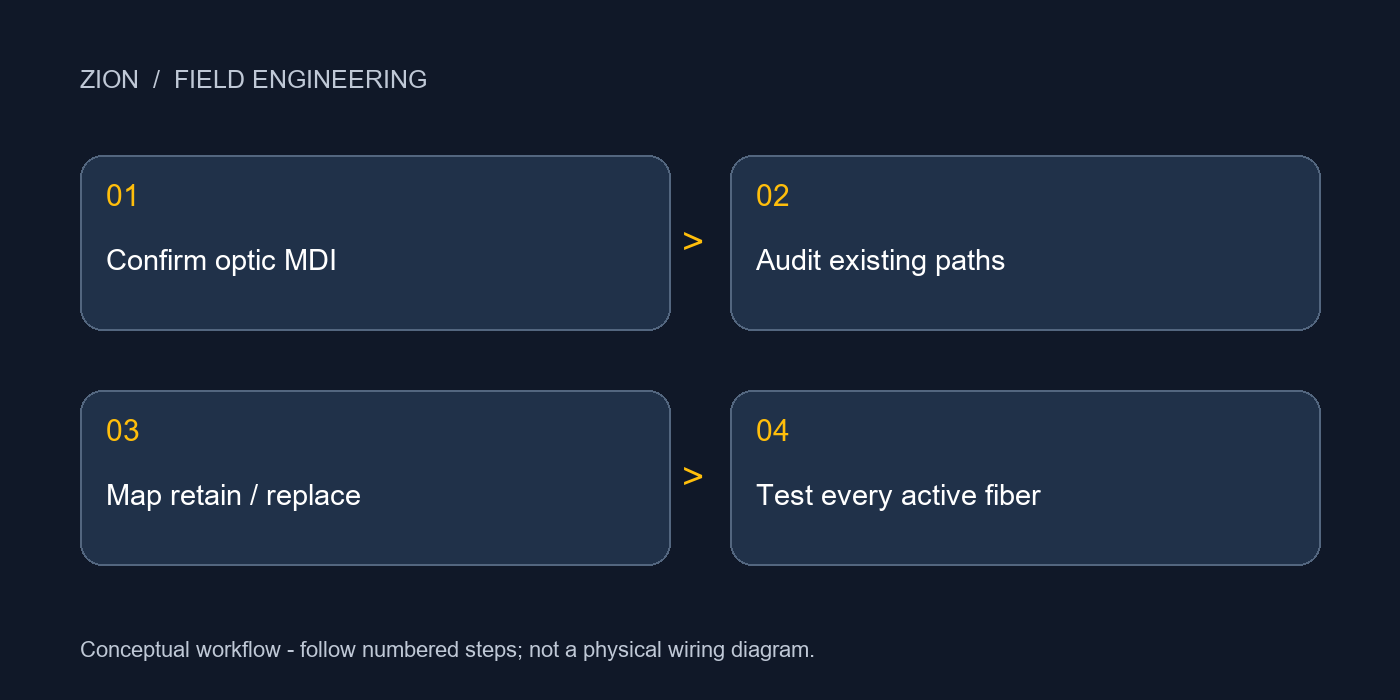
1. Confirm that the new optic actually needs MPO-16
Start with the exact transceiver part number at both ends. Record its optical interface, fiber type, lane count, connector polish, reach and maximum channel insertion loss. An Ethernet rate such as 400G or 800G does not uniquely define the connector: different optics can use MPO-16, dual MPO interfaces or duplex connections. Use the ZION high-density MPO selection guide to organize the cable decision around the optic.
Separate total cable fiber count from fibers per connector and active fibers per link. A 48-fiber trunk assembled with four MPO-12 connectors is not an MPO-16 trunk. Likewise, the existence of spare fibers somewhere in a rack does not mean they form the continuous, correctly mapped paths required between the two new ports.
2. Treat MPO-12 and MPO-16 as different mating interfaces
US Conec documents a dedicated MTP-16 family with an offset key, despite an external footprint comparable to traditional MTP connectors. Do not use apparent housing size as evidence of mating compatibility. The ferrule layout, keying and adapter interface must match the selected connector system. Do not force an MPO-12 connector into an MPO-16 interface or assume a passive sleeve converts the two.
At each intended mating pair, verify pinning, key orientation and polish. The applicable pair needs compatible guide-pin and guide-hole arrangements; never mate two pinned ends. Match APC or PC/UPC as specified by the equipment rather than by jacket colour. Changing a polarity setting or replacing an adapter cannot create four additional fiber paths.
3. Audit reusable infrastructure separately from optical assemblies
Racks, trays and cable managers are usually reuse candidates when space, bend protection and access remain adequate. An existing panel chassis may also remain if the manufacturer offers mechanically compatible modules for the new design. Confirm module dimensions, fixing method and rear cable clearance; a shared rack-unit height is insufficient.
MPO-12 equipment patch cords do not directly serve an MPO-16 port. Existing adapters and MPO-to-LC cassettes must be evaluated against the new interface and mapping, and commonly require replacement or a redesigned role. The ZION MPO patch panel and cassette range is a starting point for checking module fit, connector configuration and front-to-rear mapping. Obtain the proposed assembly drawing before releasing an order.
4. Compare a new trunk with engineered reuse
A new end-to-end MPO-16 assembly can simplify the lane map and reduce conversion points, provided its fiber type and loss performance fit the optics. Existing ZION MPO trunk cable configurations can also inform the inventory, but total fiber count alone does not establish a compatible MPO-16 ordering option. Specify the exact end connector and request confirmation for the proposed build.
Reuse may be possible through an engineered conversion harness or retermination when enough suitable continuous fibers are available. For example, two independent 12-fiber paths contain 24 fibers in total; allocating 16 of them to one interface is an arithmetic possibility, not an approved assembly design. It requires accessible endpoints, documented lane mapping, compatible fiber specifications, acceptable path differences for the application and an adequate loss budget. Such conversion combines physical fiber paths; it does not convert protocol, optical wavelength or transceiver lane rate.
Retermination is specialist work. Confirm available cable slack, fiber construction, termination process and testing capability before treating it as economical. Include outage duration, access work, new connection losses and future maintenance in the comparison with a new trunk.
5. Validate every active fiber before cutover
Prepare an end-to-end map from transmit lanes to receive lanes and identify every intermediate connector. A label such as Type B is not a substitute for a complete mapping drawing when multiple harnesses or cassettes are involved. Inspect and clean connector end faces using tips and procedures suitable for the specific MPO interface.
Test continuity and polarity on every active fiber. Measure insertion loss with the approved wavelength, reference method and test boundaries; assess the worst path against the optic’s channel allowance, including the design margin specified for the project. Use additional reflectance or OTDR checks where the project requires them, rather than treating a single OTDR trace as a complete acceptance result.
After the passive channel passes, validate the active links for the intended configuration, traffic and error behaviour. Keep the old route available until the cutover acceptance is complete where the migration plan permits. Archive lane maps, component identifiers, test records and the rollback procedure.
6. Send a migration-ready requirement to ZION
Provide both transceiver part numbers, old and new topology drawings, existing trunk fiber type and count, per-connector format, route length, available spare fibers, panel model and allowable loss. Add pinning, polish, jacket rating, labelling and test-report requirements. Mark every item as retain, replace or conditional reuse.
Ask for confirmation of the proposed assembly configuration rather than assuming that a general MPO product family guarantees a particular MPO-16 build. Agree on the mapping drawing and acceptance plan before production. The result should be a traceable bill of materials in which every retained element has a defined role and every new part has a verified interface.
Technical References
Frequently Asked Questions
Can an adapter turn one MPO-12 path into MPO-16?
No. A passive adapter cannot add fibers. An engineered conversion needs enough continuous compatible fibers and a verified mapping.
Must the entire rack be replaced?
Usually not. Audit racks, trays and chassis separately from connectors and optical modules; retain them only when mechanical fit, capacity and cable protection remain suitable.
Prepare Your Project Information
Provide equipment models, channel layout, site conditions and test records to identify suitable cabling components.



 Fiber Optic Cable
 Fiber Optic Tools
 Ethernet Cable
 Coaxial Cable
 Fire & Security Cable
 Voice, Audio & Video
 Power & Control Cable