1-1/4 Inch 50 Ohm Corrugated RF Coaxial Cables
ZION 1-1/4 inch corrugated RF coaxial cables are 50 ohm feeder cables with a smooth copper inner conductor, foamed PE dielectric, and a corrugated copper or aluminum outer conductor. Start by choosing the outer-conductor material, then confirm attenuation at your operating frequency, jacket type, bend radius, installation temperature, and required drum length.
Product Range
The range includes two 50 ohm designs. 7101112 uses a corrugated copper outer conductor and offers PE or LSZH jacket versions, while 7101113 uses a corrugated aluminum outer conductor with a black PE jacket. Use the measured attenuation and mechanical limits for the selected model rather than choosing by material name alone.
![7101112 1-1/4 inch copper corrugated RF coaxial cable]()
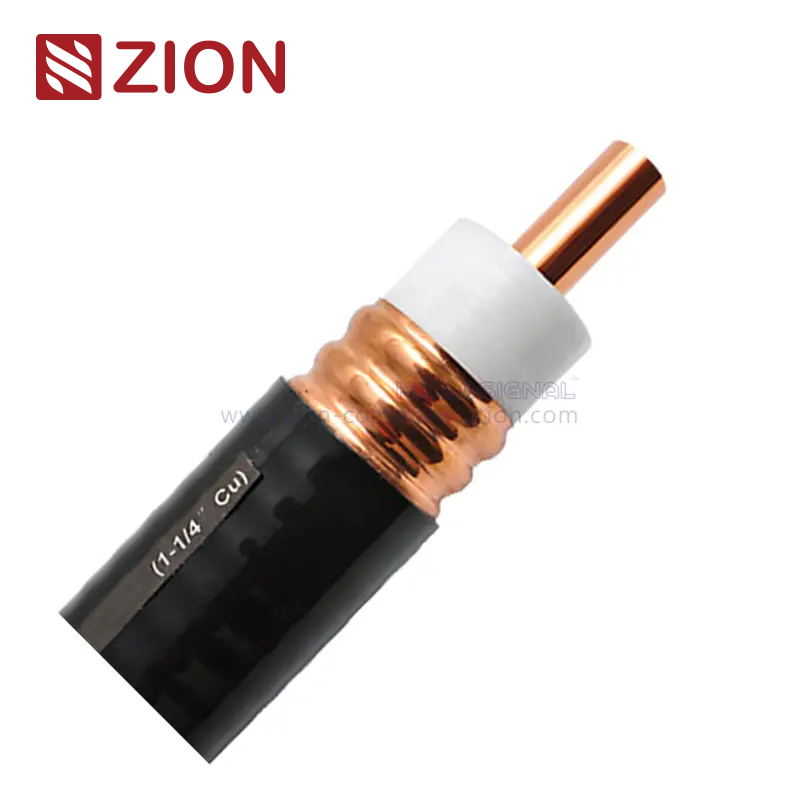
7101112
1-1/4 Inch Copper RF Coaxial Cable
A 50 ±2 Ω cable with an annular corrugated copper outer conductor, maximum operating frequency of 3.7 GHz, and PE or LSZH jacket options. Consider it when the lower published attenuation and a choice of jacket constructions match the project. Confirm the selected SKU, CPR class, drum length, and frequency-specific loss.
View Product Details →![7101113 1-1/4 inch aluminum corrugated RF coaxial cable]()
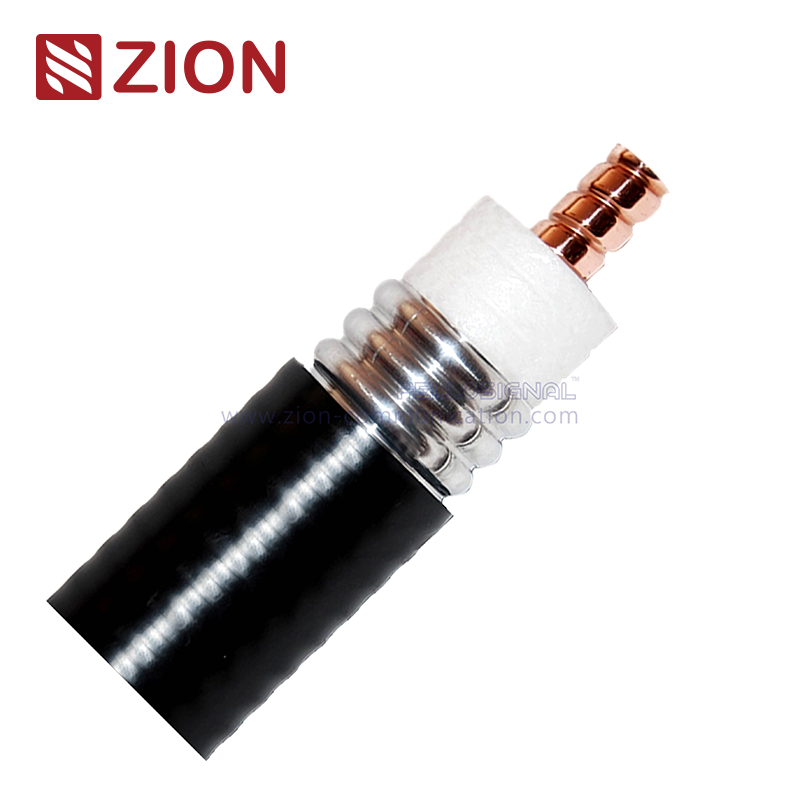
7101113
1-1/4 Inch Aluminum RF Coaxial Cable
A 50 Ω cable with an annular corrugated aluminum outer conductor and black PE jacket. Consider it when the project specifically calls for this conductor construction. Its published data covers attenuation through 2.7 GHz, so confirm any requirement above that frequency, along with connector compatibility and drum length.
View Product Details → How Do I Choose a 1-1/4 Inch RF Coaxial Cable?
Choose by the complete link requirement, not by cable diameter alone. Frequency-specific attenuation, outer-conductor material, jacket, routing limits, and compatible hardware determine whether a model fits the installation.
Copper or aluminum?
Use the conductor construction specified by the system design. 7101112 has a copper outer conductor; 7101113 uses aluminum. Material affects the published attenuation and hardware choice, so do not treat the two designs as interchangeable without a link-budget and connector check.
What frequency and loss?
Calculate total loss at the actual operating frequency and route length. The copper model publishes operation up to 3.7 GHz; the aluminum model publishes attenuation points through 2.7 GHz. Add connector and jumper losses separately, and request the applicable data sheet when the project frequency is outside a published range.
PE or LSZH jacket?
Match the jacket to the installation environment and applicable fire requirements. Model 7101112 lists PE and LSZH versions with different installation and operating temperature ranges; model 7101113 lists black PE. Confirm the exact SKU and required CPR class before ordering.
Will the route bend?
Check both the single-bend and repeated-bend limits before planning the route. Published single-bend radii are 200 mm for 7101112 and 150 mm for 7101113; both list a 380 mm repeated-bend radius. Installation tooling, pulling load, supports, grounding, and connector space still need a project-specific review.
Quick Comparison
The copper design has lower published attenuation at the shared test frequencies, while the aluminum design provides a different outer-conductor construction. Confirm the selected jacket, frequency range, connector system, and required performance before treating either value as a complete link budget.
| Model | Outer Conductor | Jacket | Attenuation at 900 MHz | Attenuation at 2700 MHz | Single / Repeated Bend Radius |
|---|
| 7101112 | Annular corrugated copper tube | PE or LSZH | 2.86 dB/100 m | 5.36 dB/100 m | 200 mm / 380 mm |
| 7101113 | Annular corrugated aluminum tube | Black PE | 3.25 dB/100 m | 6.38 dB/100 m | 150 mm / 380 mm |
Where Do These Cables Fit?
These cables fit fixed 50 ohm RF feeder routes where the system design calls for 1-1/4 inch corrugated coax. They are not a substitute for a complete link design: frequency, loss, power, VSWR, PIM, routing, grounding, connectors, and environmental requirements must be checked together.
Long fixed RF runs
Use the frequency-by-frequency attenuation table to calculate cable loss over the route. Include connectors, jumpers, and design margin; do not rely on the cable diameter as a shortcut for link performance.
Indoor or outdoor routing
Select PE or LSZH only after checking the route, local fire rules, temperature range, UV exposure, and required CPR class. A jacket label by itself does not confirm compliance with a project specification.
Connectorized feeder systems
Specify the connector interface, approved connector family, grounding kit, weatherproofing, supports, and installation tooling with the cable. Connector compatibility must be confirmed separately for the copper and aluminum outer-conductor designs.
Frequently Asked Questions
What is a 1-1/4 inch corrugated RF coaxial cable?
It is a 50 ohm RF feeder cable with a foamed dielectric and a corrugated outer conductor. The corrugation allows the large cable to bend within specified limits while the conductor structure carries and shields the RF signal.
What is the difference between 7101112 and 7101113?
The main difference is the outer conductor: 7101112 uses corrugated copper, while 7101113 uses corrugated aluminum. Their published attenuation, jacket choices, frequency coverage, and single-bend radius also differ, so select from the complete specification.
Can I use the aluminum version above 2.7 GHz?
Do not specify it above 2.7 GHz without confirmation. The published 7101113 attenuation table ends at 2.7 GHz, so request performance data for the required higher frequency before completing the link budget.
Does the cable include connectors?
Specify connectors and installation accessories separately unless the quotation states otherwise. Provide the connector interface, cable model, grounding, weatherproofing, clamp spacing, and tooling requirements so every component can be checked against the selected cable.
Which attenuation value should I use?
Use the value for the selected model at the nearest applicable operating frequency, then apply the project method for cable length, temperature, connectors, jumpers, and safety margin. Request a detailed data sheet when the exact frequency is not listed.
RFQ Checklist
You do not need to know every cable term before asking for a quotation. Start with the system and route information below so the cable construction, length, jacket, and accessories can be matched to the project.
Required model or preferred outer-conductor material: copper or aluminum
Operating frequency range and allowable total link loss
RF power, VSWR, PIM, and shielding requirements
Indoor or outdoor route, jacket type, temperature range, and fire-performance requirement
Route length, drum length, bend points, pulling conditions, and support method
Connector interfaces, jumpers, grounding kit, clamps, weatherproofing, and installation tools
Quantity, packaging, marking, test documents, and required approvals





 Fiber Optic Cable
 Fiber Optic Tools
 Ethernet Cable
 Coaxial Cable
 Fire & Security Cable
 Voice, Audio & Video
 Power & Control Cable